
 @PerryLink
dsh-catalog
DSH Desktop Market standard catalog source for the PerryLink plugin family: curated summaries, same-origin icons, contract-validated, CI-smoked.
- Stars
- 0
- Language
- JavaScript
- Created
- Sep 3, 2026
- Updated
- Oct 19, 2026
Introduction
dsh-catalog





A DSH Community Market standard catalog source for the PerryLink DeepSeek Harness plugin family, generated from the npm registry, validated against the public v1 contract schemas. Every item carries a Chinese name and a one-line Chinese summary (displayNameZh / summaryZh) next to the English pair.
- Manifest:
catalog-source.json(generated; see Deploy) - Provider page:
artifacts/v1/plugins.json(generated) - Source of truth:
data/packages.json(npm name → repo → display name → categories) +data/npm-snapshot.json(npm registry snapshot) - Generator / validator:
scripts/build-catalog.mjs,scripts/validate.mjs,scripts/check-counts.mjs - Deploy: live at
https://perrylink-dsh-catalog.perrylink.workers.dev(Cloudflare Workers, automated viadeploy.yml; Vercel static alternative invercel.json; Deno unitdeploy/deno-worker.jsas manual alternative)
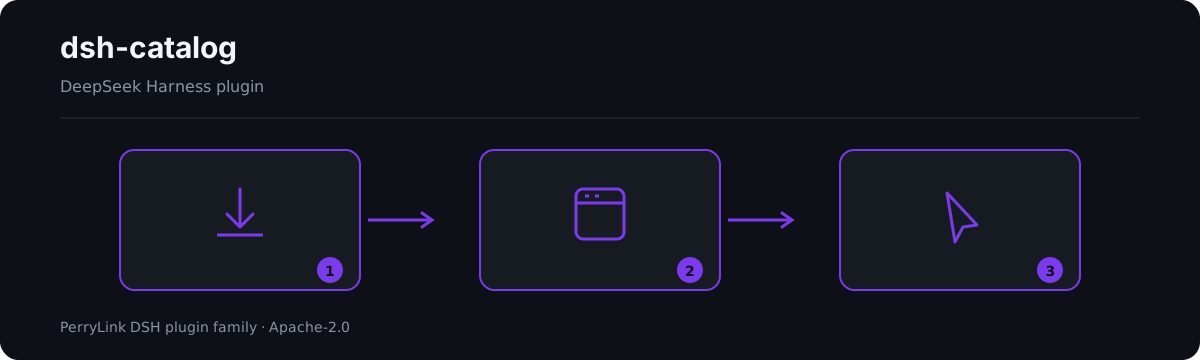
Workflow overview: install → open panel → act. The catalog is the discovery surface.
Maintenance status: family-internal tool
Reclassified on 2026-10-05 — deliberately NOT retired. A review of the whole plugin family against the official harness and the wider ecosystem classified this repository as family-internal tooling rather than a product. Its job is to inventory this family for the DSH Desktop Community Market, so it does not compete with third-party catalogs and needs no retirement. It stays maintained.
One roster, one source
The catalog is the discoverability surface, not a 1:1 projection of the family
roster. It carries npm records in data/packages.json (including
community/third-party records and the retired names kept for older installs).
Every per-plugin README carries the same collapsed roster.
Compliance notes
- Contract: catalog-provider-contract.md (v1,
manifestVersion/schemaVersion1.0.0). The schemas are vendored nowhere in this repo;scripts/validate.mjsmirrors the structural rules ofcatalog-source.schema.jsonandcatalog-provider-page.schema.jsonand the cross-field rules (unique item ids, npm name pattern, no install commands in items, HTTPS repository URLs, page shape). - The minimal valid profile is used:
query.supported = [],defaultLimit = maxLimit = 50,sorts = []. The endpoint returns the complete bounded page (99 items in one response), so DSH Desktop scans it in one request and runs search/filtering over its local index. ⚠️maxLimit = 50caps a slice request, not this whole-page response — the shipped page is larger thanmaxLimitby design, and the two numbers are not supposed to agree. - Every item carries
package.registry = "npm"+package.nameand a canonicalrepository.url; no install commands, shell fragments or executable data are ever emitted. - Every item also carries a same-origin
media.icon(/icons/<slug>.png, generated deterministically byscripts/build-icons.mjs); the Worker serves the PNGs itself, so the icons stay on the catalog origin as the market media rule requires. - The manifest endpoint and the manifest itself must share one HTTPS origin (market rule). The generated placeholder endpoint
https://replace-with-deploy-origin.invalid/...is replaced by the real deploy origin at deploy time — do not register the placeholder URL in DSH Desktop.
Build
node scripts/build-catalog.mjs            # placeholder endpoint
node scripts/validate.mjs                 # structural checks
node scripts/build-catalog.mjs https://<your-project>.deno.dev   # real origin
build-catalog.mjs writes the manifest and provider page to the repo root and mirrors both into deploy/, so deploy/deno-worker.js is a self-contained Deno Deploy unit (its ./ imports always resolve).
data/npm-snapshot.json is refreshed UTF-8-safely with:
node scripts/refresh-snapshot.mjs # re-fetch every package from registry.npmjs.org
Maintaining data/
data/packages.json and data/npm-snapshot.json are one unit: a new or renamed package
needs its snapshot row in the same commit. Two consecutive main deploys went red on
2026-09-09 exactly this way — first a missing comma in data/packages.json, then a package
listed without its snapshot row (Error: npm snapshot missing for …). Both are caught locally
by the pre-push gate; enable it once per clone:
git config core.hooksPath .githooks # then every push runs node scripts/check-data.mjs
scripts/check-data.mjs is read-only. Do not use node scripts/build-catalog.mjs as a
gate: called without an argument it rewrites the committed deploy/ artifacts with the
placeholder origin.
The family count is not hand-maintained: scripts/check-counts.mjs derives it from
data/packages.json and holds every place that states it — the README summaries (EN + ZH), the
manifest description, the shipped page's items/page.total and the deploy live-smoke floor —
to that one source. Run it to verify, or node scripts/check-counts.mjs --write to rewrite the
README count sites from the source. It exists because the number did drift: the README and the
manifest advertised a family one package larger than the page actually shipped (the concrete
figures and the commit that fixed them are recorded in the scripts/check-counts.mjs header).
.github/workflows/ci.yml runs scripts/check-data.mjs, scripts/check-counts.mjs and the
build/validate pair on every push to main and on every pull request, so the hook above is a
convenience rather than the only line of defence. scripts/validate.mjs resolves the committed
deploy/ mirrors first — the payload that actually ships, and the only copy a fresh clone has —
and holds page.total to items.length. CI then rebuilds to assert that the committed
deploy/catalog-source.json still matches, which catches a data/ change that was never
mirrored into deploy/. That rebuild is the one place the no-argument form is safe: the
runner's checkout is throwaway, and the manifest carries no timestamp, so it is
byte-reproducible.
Deploy
Live: https://perrylink-dsh-catalog.perrylink.workers.dev (Cloudflare Workers, deployed automatically by the deploy workflow).
Automated channels — the workflow rebuilds the manifest with the live origin, validates, then deploys; each channel skips gracefully when its token secret is absent:
- Cloudflare Workers (active):
deploy/wrangler.toml+deploy/cloudflare-worker.js. RequiresCLOUDFLARE_API_TOKEN+CLOUDFLARE_ACCOUNT_IDsecrets. Two-pass deploy: first uploads the placeholder-origin worker, reads the assigned*.workers.devURL, rebuilds the manifest pinned to that origin, and redeploys. Falls back to Cloudflare Pages (.pages.dev) whenworkers.devis unavailable. - Vercel:
vercel.jsonrewrite/v1/plugins→artifacts/v1/plugins.json. RequiresVERCEL_TOKEN. - Deno Deploy (manual): self-contained
deploy/deno-worker.js; rebuild withnode scripts/build-catalog.mjs https://<your-project>.deno.devbefore deploying.
The site serves GET /catalog-source.json and GET /v1/plugins as application/json on one HTTPS origin.
Use in DSH Desktop
Open the built-in Market → Sources → add source → paste the manifest URL https://perrylink-dsh-catalog.perrylink.workers.dev/catalog-source.json → select it. Browsing is read-only; installation of any listed plugin goes through the Market's own npm-identity verification and user confirmation.
A listing in this catalog is metadata, not a security review. The same plugins also have evidence records in dsh-plugin-certification and MCP access via dsh-cert-mcp.
中文说明
PerryLink 全家桶的 DSH Community Market 标准目录源:99 个 npm 包(95 个家族仓 + 第三方 dsh-phocinae,后者只是并列收录,不算家族作品),由 npm registry 生成,按公开 v1 契约做结构校验;每个条目都带中文名与一句话中文摘要(displayNameZh / summaryZh),与英文成对。已上线 Cloudflare Workers(perrylink-dsh-catalog.perrylink.workers.dev,deploy workflow 自动部署;Vercel 静态重写与 Deno Deploy 为备选通道)。每个条目还带同源 media.icon 图标(/icons/*.png,由 scripts/build-icons.mjs 确定性生成)。在 DSH Desktop 的 市场 → Sources 里添加 manifest URL 即可浏览(浏览只读;安装仍走市场自身的 npm 身份校验与用户确认)。生成产物中的占位域名 replace-with-deploy-origin.invalid 在部署时替换,请勿直接注册占位地址。维护纪律:data/packages.json 与 data/npm-snapshot.json 必须同一次 commit 成对更新(2026-09-09 连续两次 main 部署红灯即由此而来:先是漏逗号,后是新增包缺 npm 快照行);执行一次 git config core.hooksPath .githooks 后,每次 push 都会跑只读门禁 scripts/check-data.mjs。切勿把不带参数的 node scripts/build-catalog.mjs 当作门禁——它会把已入库的 deploy/ 产物改写成占位域名。CI:.github/workflows/ci.yml 在每次 push 到 main 与每个 PR 上跑 scripts/check-data.mjs、scripts/check-counts.mjs 与 build+validate;scripts/validate.mjs 默认直接读已入库的 deploy/ 产物(真正上线的载荷,干净 clone 里只有它),并把 page.total 锁到 items.length;随后重建断言 deploy/catalog-source.json 未过期,可发现「改了 data/ 却没重建 deploy/」;该重建在 CI 的一次性 checkout 里是安全的,因为 manifest 不含时间戳、可字节复现。计数单一来源:包数一律由 data/packages.json 派生——scripts/check-counts.mjs 校验 README(EN+ZH)/manifest/产物/部署冒烟下限一致,--write 可从该来源重写 README 计数,禁止手写。
License
Apache-2.0. Catalog data derives from the npm registry and the PerryLink plugin repositories.
DSH family line: this repository belongs to the PerryLink DeepSeek Harness plugin family, whose current line is dsh-v0.1.7-rc.2.
PerryLink DSH Plugin Family
This project is part of the DeepSeek Harness plugin family from PerryLink. The roster stays collapsed below so every README keeps a short first screen; expand it to see every row and its status.