
 @VanadisGithub
dsh-skill-evolution
Hermes-style skill self-evolution plugin for DeepSeek Harness (DSH): crystallizes reusable agent skills from successful turns via signal-triggered LLM review, progressively improves them, and manages everything in a Settings panel.
- Stars
- 4
- Language
- JavaScript
- Created
- Sep 1, 2026
- Updated
- Sep 7, 2026
Introduction
dsh-skill-evolution


English | 中文
A skill self-evolution plugin for DeepSeek Harness (DSH): it watches agent execution traces and, at the end of every successful turn, fires an LLM review when signals trip — distilling workflows worth reusing into crystallized skills registered in the skill catalog. Later runs of the same workflow fold fresh lessons into the existing skill — skills are alive and get better with use.
Highlights
- Event-driven crystallization — review fires at turn end, not on pure frequency counting; any of three signals (complex / recovered / repeated) sends the turn to review
- Strict review gate — LLM reviewer plus a hard do-not-capture list keeps junk out;
NOTHING_TO_SAVEis a first-class outcome - Skills keep evolving — new evidence is merged into existing skills (version bump); semantic dedup (
FOLD_INTO) blocks near-duplicates reached through different tool sequences - Full management UI in Settings — tabbed skills/settings views, master switch, skill cards with value/version/invocation chips, a tuning pipeline diagram with controls embedded in-place, and editable review prompts
- Persistent & self-contained — skills persist under
generated/and re-register on restart; host half depends only onnode:builtins
Screenshots
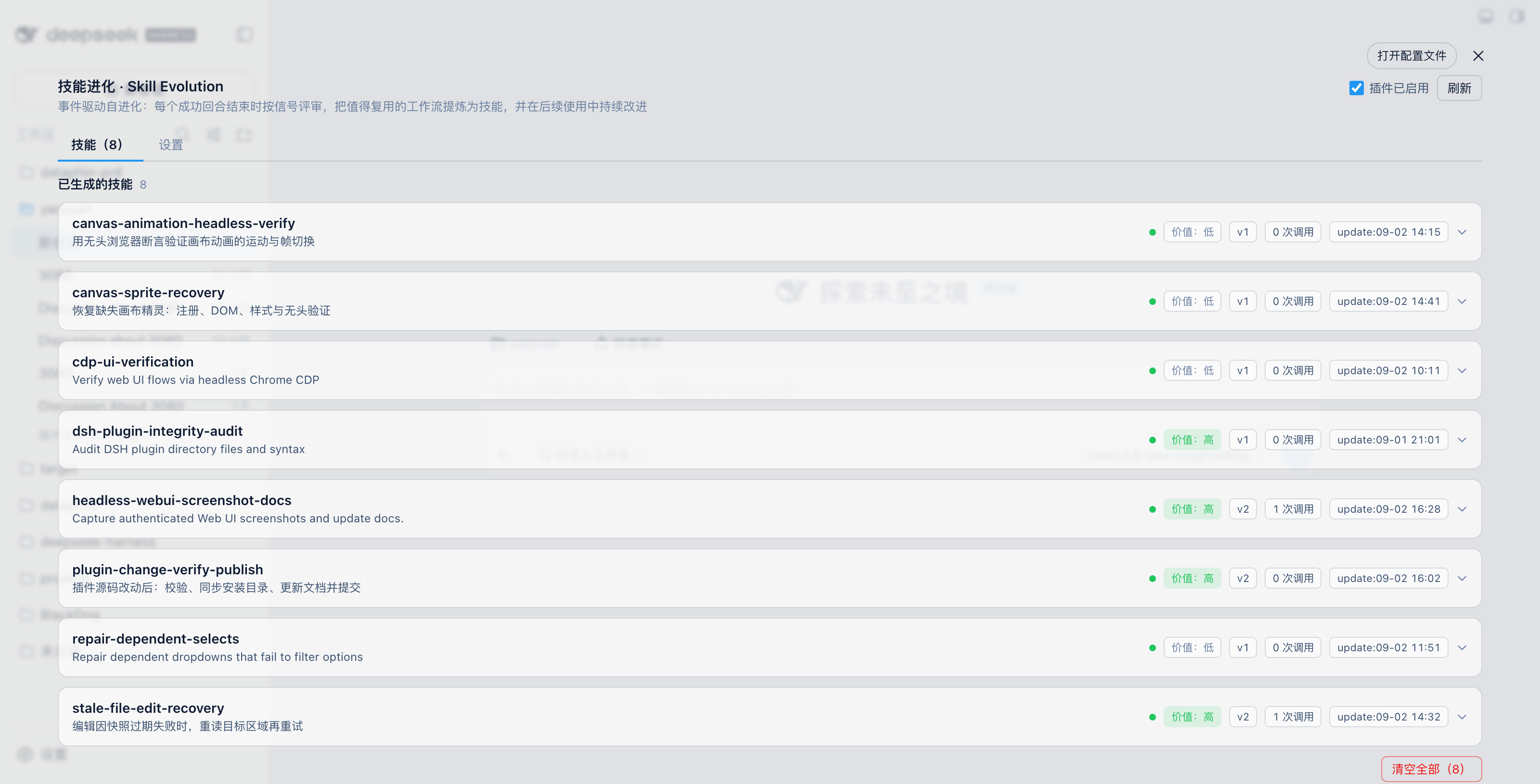
Skills tab — skill cards with value (high/medium/low), version, invocation count and update-time chips; expand for crystallization signals, tool sequence and the full SKILL.md:
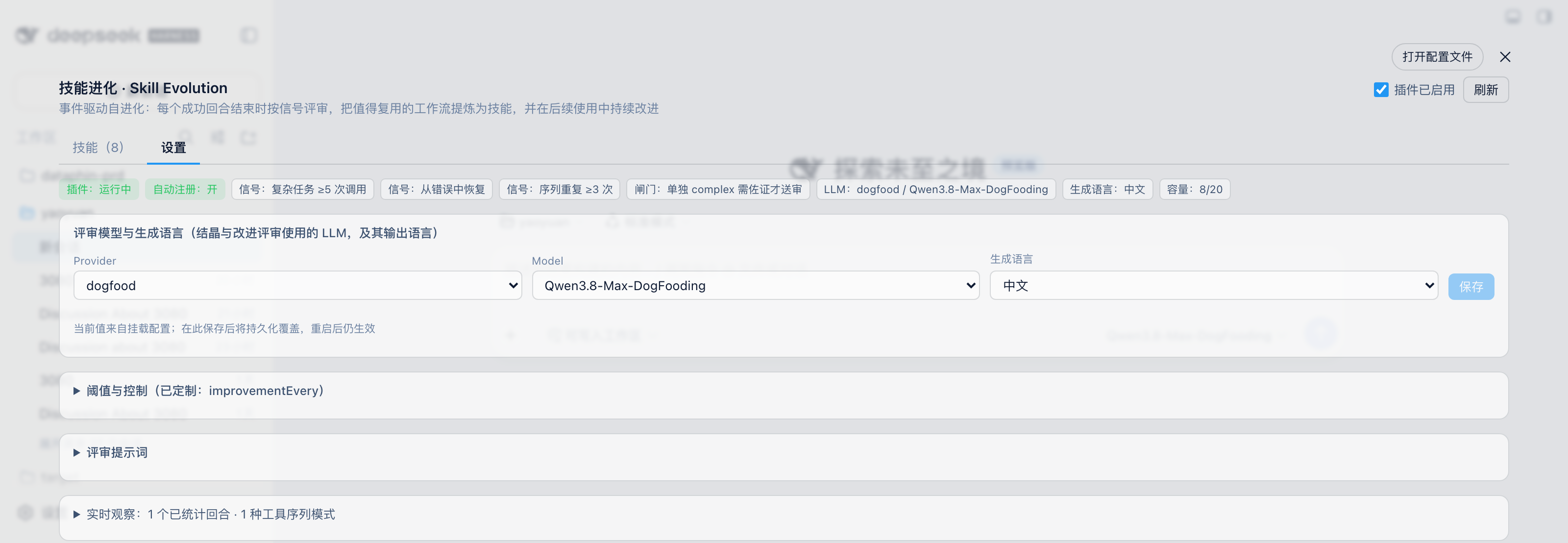
Settings tab — status overview, review model, generation language and the configuration panels:
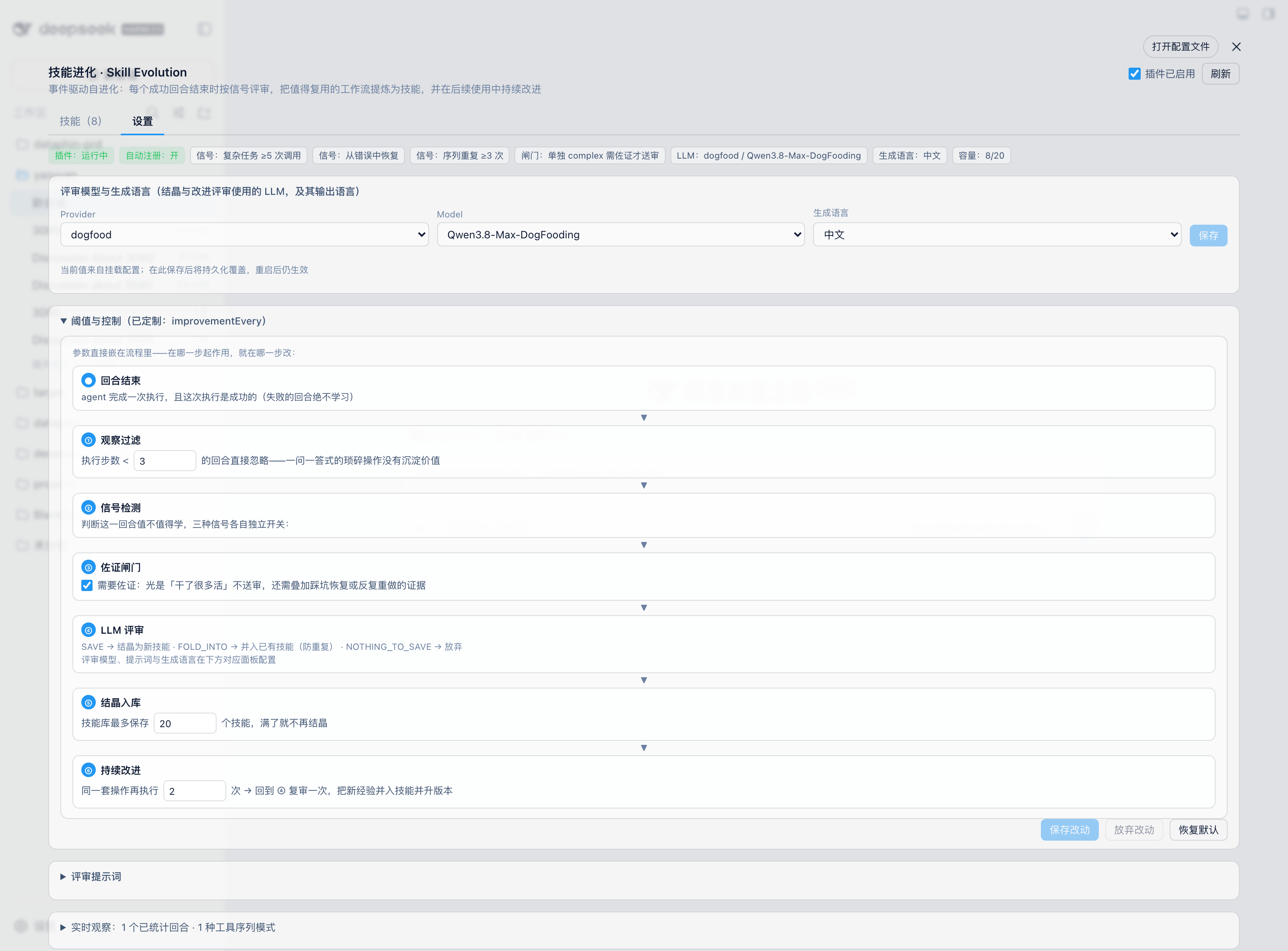
Thresholds & controls — every parameter embedded in the pipeline diagram, editable exactly where it takes effect:
How it works
Signal detection
At every turn end (turn/end), successful traces meeting a minimum step count are checked against three signals:
| Signal | Condition | Meaning |
|---|---|---|
complex | successful turn with ≥ minToolCalls tool calls (default 5) | completed a complex task |
recovered | had failed steps but the turn still succeeded | hit dead ends and found a working path around them |
repeated | same tool sequence recurred ≥ minPatternOccurrences times with success rate ≥ minSuccessRate | a recurring, proven workflow |
Corroboration gate (complexRequiresCorroboration, on by default): a lone complex signal is weak evidence (any long turn qualifies), so by default it must be corroborated by recovered or repeated before review; withheld turns are logged and re-submitted once the sequence later earns a corroborating signal.
Review gate
The reviewer LLM receives full evidence (signals, user intent, tool sequence, per-step outcomes and summaries) plus the existing evolved-skill list, and answers one of: SAVE (crystallize a new skill), FOLD_INTO (merge into an existing skill), or NOTHING_TO_SAVE.
Hard do-not-capture list — the following is never crystallized:
- environment-dependent failures (missing binaries, unconfigured credentials, uninstalled packages)
- negative claims about tools ("tool X is broken" would freeze into a long-lived refusal)
- transient errors cured by a retry (the lesson is the retry pattern, not the original error)
- one-off task narratives, unresolved failures
Continuous evolution
- Progressive improvement — when new evidence lands on an existing skill's sequence (especially error-recovery experience), the reviewer merges the new lessons into the skill body and bumps the version instead of creating a duplicate
- Semantic dedup (
FOLD_INTO) — the same class of experience can reappear via a different tool sequence, which pure sequence matching cannot catch. The crystallization reviewer sees the existing skill list (name + description) and may answerVERDICT: FOLD_INTO: <existing-skill-name>; the host then runs the improvement pipeline against that skill
Output format
Class-level, kebab-case skills with the standard SKILL.md shape (# Title / ## When to Use / ## Procedure / ## Pitfalls / ## Verification). NAME and section headings are always English; body language follows skillLanguage.
Install
Option 1: official CLI (once published to npm)
dsh plugin --profile web add dsh-skill-evolution
The bundled dsh.bundle.patch mounts automatically — no profile edits needed.
Option 2: git clone + link
git clone https://github.com/VanadisGithub/dsh-skill-evolution.git ~/Code/dsh-skill-evolution
Add to dependencies in ~/.dsh/profiles/web/package.json:
"dsh-skill-evolution": "link:/Users/<you>/Code/dsh-skill-evolution"
Then run pnpm install in ~/.dsh/profiles/web and hard-refresh the browser.
Option 3: file:// manual mount (prototype debugging)
Place the repo anywhere (e.g. ~/.dsh/plugins/skill-evolution/) and append to ~/.dsh/cordis.patch.yml:
- insert:
  - id: 'skill-evolution'
    name: file:///Users/<you>/.dsh/plugins/skill-evolution/plugin.mjs?v=1
    config:
      minToolCalls: 5
      minPatternOccurrences: 3
      autoRegister: true
      llmProvider: deepseek      # adjust to a provider available in your deployment
      llmModel: deepseek-chat
?v=N busts the Node module cache; bump it whenever plugin.mjs changes. Host-half changes need a loader patch replay; browser-half changes just need a hard refresh.
⚠️ Pick exactly one option — duplicate mounts cause a dual instance.
Configuration
Every key below works both via mount config and directly in the Settings panel (panel edits persist to runtime-config.json in the plugin directory, overriding mount config across restarts):
| Key | Default | Description |
|---|---|---|
enabled | true | master switch: false stops turn observation and review (existing skills stay registered) |
minTraceSteps | 3 | minimum trace steps (noise floor) |
minToolCalls | 5 | complex signal threshold |
minPatternOccurrences | 3 | repeated signal threshold |
minSuccessRate | 0.7 | repeated signal success-rate floor |
signals | all on | {complex, recovered, repeated} individual toggles |
complexRequiresCorroboration | true | a lone complex signal needs corroboration before review |
autoRegister | true | auto-register crystallized skills into the catalog |
llmProvider / llmModel | deepseek / deepseek-chat | review model (the picker cascades to the provider's model catalog) |
skillLanguage | en | generated-skill language: zh / en |
maxEvolvedSkills | 20 | evolved-skill capacity |
improvementEvery | 3 | trigger an improvement review every N same-sequence reruns |
maxImprovementsPerSkill | 5 | max improvements per skill |
maxEvidenceSteps | 30 | max evidence steps sent to review (truncation guard) |
maxTracesPerSession | 200 | per-session trace cache cap (memory guard) |
maxStepTextLength | 200 | per-step summary truncation length |
reviewSystemPrompt | built-in | override the crystallization review system prompt |
improveSystemPrompt | built-in | override the improvement review system prompt |
Management panel
The "Skill Evolution" section in Settings, a two-tab layout with a master switch in the top-right corner:
- Skills tab — skill cards: name, description, value chip (high/medium/low, rated from crystallization and improvement counts), version, invocation count (skill-tool calls + user-explicit injection), update time; expand for crystallization signals, tool sequence and the full SKILL.md; delete/clear use two-step confirmation
- Settings tab — status overview, review model (provider-cascaded picker), generation language, and four panels:
- Thresholds & controls — all thresholds drawn as one pipeline (turn end → observation filter → signal detection → corroboration gate → LLM review → crystallization → continuous improvement), each parameter embedded in the step where it takes effect
- Review prompts — edit the crystallization/improvement system prompts in place (draft–save workflow), resettable to built-ins at any time
- Live pattern stats — observed tool-sequence patterns and trigger counts
- Danger zone — clear all evolved skills (two-step confirmation)
Data & privacy
- Trace evidence lives in memory only (bounded cache), never on disk
- On disk: crystallization artifacts (
generated/*.json: SKILL.md body, signals, sequences, stats) andruntime-config.json - Review LLM calls go through providers already configured in the deployment — no external endpoints introduced
- Uninstalling the plugin removes all data (
generated/goes with the directory)
Layout & development
Two-sided plugin package (host + web client):
| File | Role |
|---|---|
plugin.mjs | host half: trace observation, signal detection, LLM review, skill registration, ./generated/ persistence, authenticated /skill-evolution RPC channel (list / get / remove / clear / listModels / setModel / setLanguage / setEnabled / setTuning / setPrompt …) |
client.js | browser half: the Settings "Skill Evolution" section |
cordis.patch.yml | dsh.bundle.patch mount layer |
test/smoke.mjs | host-half smoke test (mock cordis context, 51 assertions covering crystallization/improvement/FOLD_INTO/dedup/RPC/counting) |
test/screenshot.mjs | headless screenshot script (CDP-driven, full-screen mode) |
node --check plugin.mjs && node --check client.js   # syntax
node test/smoke.mjs                                  # smoke test
node test/screenshot.mjs <output-dir>                # re-capture README screenshots
Only node: builtins are imported — no @deepseek-ai packages — avoiding any dual-instance conflict with the host's own cordis.