
 @andregoncalves
dsh-balance
Provider-aware balance chip for the DeepSeek Harness web sidebar: DeepSeek, OpenRouter, Moonshot/Kimi, Zhipu/GLM, MiniMax. Lightweight, zero runtime deps, no core patches.
- Stars
- 0
- Language
- TypeScript
- Created
- Aug 16, 2026
- Updated
- Sep 28, 2026
Introduction
dsh-balance





English | 中文
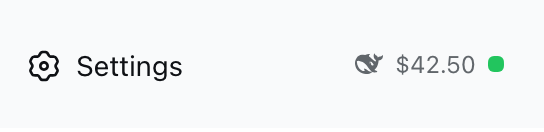
A DeepSeek Harness plugin that puts the account balance of the provider serving your active model in the sidebar foot — right-aligned next to the Settings button — and keeps it fresh.
The chip is provider-aware: it reads the active session's selected model and shows the matching provider's balance, flipping automatically when you switch models.
On DeepSeek the chip also tracks peak / off-peak billing — the status dot turns red inside DeepSeek's peak window and green off-peak, when requests cost half price. See DeepSeek peak / off-peak hours.

Contents
- Why dsh-balance?
- Lightweight by design
- Highlights
- Screenshots
- Supported providers
- Install
- Configuration
- Preview without an account (mock mode)
- How it works
- Development
- Troubleshooting
- FAQ
- Changelog
- License
Why dsh-balance?
- Provider-aware, not DeepSeek-only. It follows the active model's provider across DeepSeek, OpenRouter, Moonshot/Kimi, Zhipu/GLM, and MiniMax — the chip changes the moment you switch models.
- The smallest thing that does the job. No settings panel, no cost projection, no extra services. One route, one chip, ~11 kB gzipped.
- Zero core interference. An out-of-tree package that registers into a declared slot. Nothing in the Harness source is patched or forked.
Lightweight by design
dsh-balance is deliberately minimal, and it adds no machinery to the Harness:
| Runtime dependencies | none — dependencies: {}; the only imports are @deepseek-ai/* platform modules and React, all supplied by the running Harness as optional peers |
| Bundle size | host half ~8 kB (3.1 kB gzip) + browser half ~23 kB (8.1 kB gzip) → ~11 kB gzip combined |
| Harness surface | one exact route (GET /plugins/balance) and one component in the declared sidebar.footer.action slot |
| Core patches | none — no forked files and no core CSS patch; the plugin styles only its own footer row from its own DOM anchor |
| Background work | none — no database, no worker, no telemetry, no global state; a single setInterval per chip, cleared on unmount |
| Lifecycle | the route is registered through ctx.effect, so it unwinds on unload; model-directory subscriptions unsubscribe; removing the plugin leaves nothing behind |
| Failure isolation | a missing key or an upstream error degrades to a muted pill — it never blocks a session or the UI |
Nothing to configure, nothing to tear down. Install it and the only change is one row in the sidebar foot. Uninstall it and the Harness is exactly as it was.
Highlights
- One chip, five providers. DeepSeek, OpenRouter, Moonshot/Kimi, Zhipu/GLM (Z.ai), and MiniMax — each with its own brand mark, currency, and tooltip breakdown.
- Provider-aware. Switching the active model switches the chip to that provider's balance immediately.
- Peak/off-peak aware on DeepSeek. The status dot turns red during DeepSeek's peak billing window (Monday–Friday, Beijing 09:00–12:00 and 14:00–18:00) and green off-peak, when requests cost half price.
- Your key never reaches the browser. The host half resolves the credential and calls the provider; the browser only ever sees a normalized balance.
- Live. Auto-refreshes every 60 seconds, on click, when the session changes, and the moment the model's provider changes.
- Graceful. A missing key or an upstream error becomes a muted
Balance —pill with the reason in the tooltip — never a broken layout. - Preview without an account. A built-in mock mode renders real-looking balances for any provider.
Screenshots
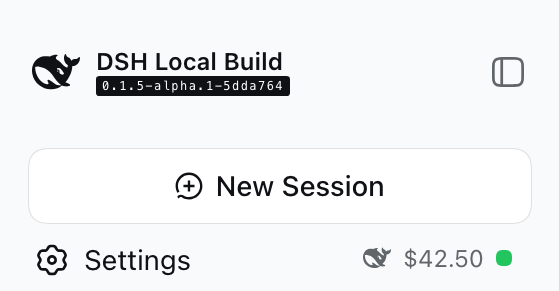 | 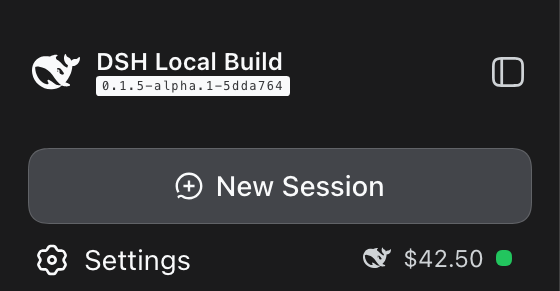 |
| Light theme | Dark theme |
Supported providers
| Active model route | Balance shown | Source |
|---|---|---|
deepseek, deepseek-official | DeepSeek account balance (native currency) | api.deepseek.com/user/balance |
openrouter | Remaining credits (total_credits − total_usage, USD) | openrouter.ai/api/v1/credits |
moonshotai, moonshotai-cn | Available balance (USD, cash + voucher) | api.moonshot.ai / api.moonshot.cn /v1/users/me/balance |
zai, zai-coding-cn, zhipu | Account balance (CNY by default) | open.bigmodel.cn / api.z.ai account report |
minimax, minimax-cn | Token-plan remaining quota (count or %) | minimax.io / api.minimaxi.com /v1/token_plan/remains |
| anything else | DeepSeek balance | same as the deepseek row |
The mapping is deliberately narrow: a route the plugin does not recognize (including a custom provider id) falls back to the DeepSeek balance rather than failing the chip.
What the chip shows
[brand mark] $9.74 ●— the provider's logo, the amount, then a status dot.- Status dot — DeepSeek marks its peak/off-peak billing window (green = off-peak, red = peak; see DeepSeek peak / off-peak hours). OpenRouter, Moonshot, Zhipu, and MiniMax mark a positive remaining balance or quota (green = left, red = exhausted).
- Tooltip — the full breakdown (for example
Total $42.50 · Granted $5.00 · Topped up $37.50). - Click — refresh now.
- Errors — a muted
Balance —pill; hover for the reason, click to retry. - Narrow sidebars — the chip takes exactly the width its own content needs and the account label beside it gets the rest. The chip never gives up its amount; the label truncates with an ellipsis instead.
- The collapsed 56px sidebar rail hides the chip — there is no room beside the gear.
DeepSeek peak / off-peak hours
DeepSeek bills off-peak requests at half the peak price. The chip's status dot reflects the current window, evaluated in UTC so it is correct regardless of your machine's timezone:
| Window | When |
|---|---|
| Peak — red dot | Monday–Friday, Beijing time (UTC+8) 09:00–12:00 and 14:00–18:00 — i.e. 01:00–04:00 and 06:00–10:00 UTC |
| Off-peak — green dot | Every other hour, including the whole weekend, at 50% of the peak price |
Source: DeepSeek API — Models & Pricing, footnote (1): "Off-peak prices are half of the peak prices. Peak hours are Beijing time Monday to Friday 9:00–12:00 and 14:00–18:00 (all other times are off-peak)."
DeepSeek is the only one of the five with a recurring peak/off-peak schedule. The other providers have no time-of-day pricing windows, so their dot reflects balance/quota rather than a pricing window:
| Provider | Time-of-day pricing? | What it uses instead |
|---|---|---|
| DeepSeek | Yes — Mon–Fri peak, off-peak at half price | — |
| OpenRouter | No | Provider pass-through prices plus a platform fee |
| Moonshot / Kimi | No | Flat token prices with cache discounts |
| Zhipu / GLM (Z.ai) | No | List prices with occasional limited-time promotions |
| MiniMax | No | Flat token prices (a permanent 50% off M3) plus an optional 1.5× priority tier |
Install
Requirements: a DeepSeek Harness install with the web profile (dsh web) and Node.js ≥ 22.18.
The plugin is self-contained: it needs no extra services, no configuration file, and no core patch. Installation adds one dependency and one sidebar row.
From npm
pnpm dsh plugin --profile web add @andrecgoncalves/dsh-balance
From GitHub
pnpm dsh plugin --profile web add github:andregoncalves/dsh-balance
The package builds itself on install (prepare → pnpm run build), so lib/ does not need to be committed.
From a local clone (development)
git clone https://github.com/andregoncalves/dsh-balance.git
cd dsh-balance
pnpm install
pnpm run build
pnpm dsh plugin --profile web add link:"$PWD"
Use link: rather than file:: a plain file: dependency is hardlinked and breaks on atomic rebuilds.
How the row is wired
The package declares dsh.bundle, so dsh plugin add appends it to your profile's dsh.profile.bundles and the bundle's own cordis.patch.yml inserts the sidebar row — no manual patch editing. Refresh the browser once after the first install so the boot manifest (window.__DSH_BOOT__) picks up the new row; after that, source changes rebuild and hot-swap live.
Managing the profile by hand (or an older dsh that ignores dsh.bundle)
Add the bundle to ~/.dsh/profiles/web/package.json:
"dsh": { "profile": { "bundles": ["@deepseek-ai/dsh-base", "@deepseek-ai/dsh-web-app", "@andrecgoncalves/dsh-balance"] } }
The bundle's patch then inserts the row. If you prefer a plain dependency instead, drop the dsh.bundle handling and add the row yourself to ~/.dsh/profiles/web/cordis.patch.yml:
- insert:
    - id: dsh-balance
      name: "@andrecgoncalves/dsh-balance"
Either way the id is the plugin's internal Cordis name and stays dsh-balance; the name is the installed package.
Verify
curl http://127.0.0.1:3080/plugins/balance                    # DeepSeek
curl "http://127.0.0.1:3080/plugins/balance?kind=openrouter"  # OpenRouter
curl "http://127.0.0.1:3080/plugins/balance?kind=moonshot"    # Moonshot / Kimi
curl "http://127.0.0.1:3080/plugins/balance?kind=zhipu"       # Zhipu / GLM
curl "http://127.0.0.1:3080/plugins/balance?kind=minimax"     # MiniMax
Each returns {"ok":true,"provider":"…","balance":{…}}, or {"ok":false,"error":"no-key","message":"…"} when the credential is missing.
Configuration
DeepSeek resolves DEEPSEEK_API_KEY through the Harness credentials seam (for example ~/.dsh/.credentials.yaml). The other providers try the seam first, then fall back to the ambient launch environment (process, the invoking project's .env, then the Harness home's .env).
| Provider | Credential names tried, in order |
|---|---|
| DeepSeek | DEEPSEEK_API_KEY |
| OpenRouter | OPENROUTER_API_KEY |
| Moonshot / Kimi | MOONSHOT_API_KEY |
| Zhipu / GLM | ZAI_API_KEY, GLM_API_KEY, ZHIPU_API_KEY |
| MiniMax | MINIMAX_API_KEY, MINIMAX_CN_API_KEY, MINIMAX_API_TOKEN |
To share one credential plane with the model adapter, store the key in ~/.dsh/.credentials.yaml and add apiKeyEnv to the route. Zhipu's account endpoints expect the key verbatim (no Bearer prefix); the host applies the right scheme automatically. Moonshot and Zhipu mirror across two regional hosts, so a key valid on only one site falls through to the other before the request is reported as failed.
Preview without an account (mock mode)
Mock mode serves canned balances from the host and skips credential resolution and the upstream call. It is off by default and enabled with DSH_BALANCE_MOCK=1 or a ?mock=1 query parameter.
curl "http://127.0.0.1:3080/plugins/balance?kind=moonshot&mock=1"
curl "http://127.0.0.1:3080/plugins/balance?kind=zhipu&mock=1"
curl "http://127.0.0.1:3080/plugins/balance?kind=minimax&mock=1"
To see it in the GUI, start the server with the environment variable:
DSH_BALANCE_MOCK=1 dsh web
Then add a route in Settings → Models for the provider you want to preview (moonshotai, zai, minimax, …), add a model, and select it. The chip follows the active model and shows the canned balance with no real key. Mock mode never reads a credential and never contacts a provider — its numbers are for layout preview only.
How it works
dsh-balance is a dual-face Cordis package: one npm package with a host half and a browser half.
| Part | File | Job |
|---|---|---|
| Bundle layer | cordis.patch.yml | Declared by dsh.bundle; inserts the dsh-balance row when a profile lists the package, so dsh plugin add needs no manual patch editing. |
| Host (Node) | src/index.ts | Registers GET /plugins/balance?kind=… on the host web server. Resolves the key through the credentials seam (and the launch environment for the added providers), calls the provider, and relays a normalized balance. The key never crosses the wire to the browser. |
| Browser | src/client/index.tsx | Registers the BalanceChip component into the sidebar.footer.action slot. Reads the active session's model provider from the model-directory store (ctx.modelDirectories), maps it to a kind, and polls the host route every 60s, on click, on session change, and on model switch. Each provider's payload is shaped by its own renderer. |
The browser bundle is served by the host's client-module pipeline in the window.__ModuleLoader__.load({ id, factory }) closure format the web shell consumes; react and the @deepseek-ai/* platform modules stay external and resolve from the browser's frozen module table.
Forking note. The client-module entry id is the npm package name. The build reads it from
package.json(tsdown.config.ts), andscripts/verify-client.mjsasserts the same value. If you rename the package, update thenameincordis.patch.ymland the entry in the profile'sdsh.profile.bundlestoo — the plugin's internal Cordisnameexport staysdsh-balance.
Development
pnpm install
pnpm run build     # tsdown: lib/index.js (host) + lib/client.js (browser)
pnpm run verify    # evaluates the client bundle against a stubbed module table
With a link: install, rebuilding lib/ updates the running app immediately, including a live hot-swap of the chip in an open browser tab. Host-side changes may need a reload or restart depending on your DSH workflow.
The @deepseek-ai/* platform packages are optional peer dependencies supplied by the running Harness, so they are never fetched during pnpm install (see pnpm-workspace.yaml). TypeScript type-checking therefore requires a Harness checkout on your tsconfig paths; the build itself has no such requirement.
Troubleshooting
| Symptom | Cause and fix |
|---|---|
Balance — with Set DEEPSEEK_API_KEY … | The credential is not resolvable. Store it in ~/.dsh/.credentials.yaml or the launch environment. |
| Chip shows the DeepSeek balance on another provider | The route id is not in the mapping above — open an issue with the route id. |
| Chip missing after renaming the package | The client-module id is the package name; make sure the cordis.patch.yml row and the dsh.profile.bundles entry match package.json, then restart dsh web. |
| Chip missing in the collapsed rail | Expected — the 56px rail has no room beside the gear. |
Upstream 401/403 on Moonshot or Zhipu | The key belongs to the other regional host; the plugin already tries the mirror, so a persistent error means the key is invalid on both. |
FAQ
Does the browser ever see my API key? No. The host half resolves the credential through the Harness credentials seam and calls the provider; the browser only receives a normalized balance.
Will it break the Harness if I remove it? No. It registers one route and one slot component, both owned by the plugin. Uninstall it and the Harness is exactly as it was — nothing in the core is modified.
What does it cost to run? One small local HTTP request per minute per open tab, and only while the sidebar is wide. Mock mode makes no provider requests at all.
Why does a custom provider show the DeepSeek balance? Unknown routes deliberately fall back to DeepSeek instead of failing the chip. Open an issue with the route id and it can be added.
Does it work with a headless/CLI session? The chip is a web-sidebar feature; the host route works in any profile that mounts the web server, but there is no chip to render without the web UI.
Changelog
See CHANGELOG.md for the full history. Every release is also published on GitHub Releases and npm.
License
MIT © 2026 Andre Goncalves