
 @honghuachen
deepseekharness-desktop
一键安装的跨平台桌面容器(macOS / Windows),完整运行官方 DeepSeek Harness Web 壳,内置兼容性守护机制,支持第三方插件管理、更新与移除,并自动拉取官方内核最新版本。 | One-click cross-platform desktop container (macOS / Windows) running the official DeepSeek Harness Web shell, with built-in compatibility safeguards, third-party plugin management (update & remove), and automatic updates to the official runtime.
- Stars
- 2
- Language
- JavaScript
- Created
- Sep 4, 2026
- Updated
- Oct 20, 2026
Introduction
English | 中文
DSH Web — Desktop Container for the Official DeepSeek Harness
An extremely thin, cross-platform (macOS + Windows) desktop container: the window always runs the official deepseek-ai/deepseek-harness web shell — the container itself ships no business UI of its own.
Core capability: fast cold start using local runtime, with automatic background update detection and seamless switching.
┌─────────────────────────────────────────────────────┐
│  DSH Web.app (thin Electron shell)                   │
│                                                       │
│  1. Fast-start using installed local kernel          │
│     (zero network blocking on launch)                │
│  2. Launch official `dsh web` (127.0.0.1:<port>)     │
│  3. Window loads official page ← 100% official       │
│  4. Background update monitor detects new releases   │
│  5. Update window provides seamless 1-click upgrades │
└─────────────────────────────────────────────────────┘
Design principles
| Decision | Rationale |
|---|---|
| The shell has zero business logic — only "update + launch + open window" | The upstream project iterates fast; a thin shell never conflicts with it |
| Each runtime version installs into its own directory, switched via a symlink | An upgrade that fails rolls back instantly; old versions stay around for rollback |
pnpm's build-script allowlist (allowBuilds) is pre-configured | Only known native modules (node-pty/koffi, etc.) are allowed to run install scripts |
| A portable Node v22 ships with the app | No dependency on the system Node version; ABI stays consistent with native modules |
| The data directory is independent of the shell | Session data lives in ~/.dsh; upgrading or reinstalling the shell never touches it |
Quick start
Development mode
npm install          # install Electron and other devDependencies
npm run fetch-tools  # download vendor/pnpm + vendor/node (portable Node)
npm start
The first launch downloads the official runtime (roughly 1–2 minutes, depending on your network); afterwards it only downloads again when a new version is available.
Building the app
npm run dist # produces macOS (dmg/zip) + Windows (NSIS installer/zip)
One build covers both platforms (electron-builder cross-builds the Windows target directly on macOS):
| Platform | Artifacts |
|---|---|
| macOS arm64 | DSH Web-<ver>-arm64.dmg / -mac.zip |
| Windows x64 | DSH-Web-Setup-<ver>-x64.exe / -win.zip |
Windows notes:
- Unsigned — the first run triggers a SmartScreen prompt ("Run anyway" is fine); the installer runs in per-user mode with a selectable install directory.
- A portable
node.exeand pnpm ship inside the package; version switching uses NTFS junctions (no admin privileges needed), falling back to a pointer file in restricted environments. - The task-completion badge shows up as a taskbar overlay number; parsing session logs for it depends on the system
zstdcommand (if missing, the badge feature silently degrades — install it withscoop install zstdif you want it).
Update mechanism
On every launch, unless a kernel version has been manually pinned (see below):
GET https://registry.npmjs.org/@deepseek-ai/dsh/latestto fetch the latest version;- Compare it against the currently active local version using semver (pre-release ordering like
-rc.Nis supported); - If newer: download and install into
<data dir>/runtime/versions/v<version>/, then atomically flip theruntime/currentsymlink over to it on success; on failure, the previous version stays active; - Auto-cleanup: only the 2 most recent versions are kept (plus a pinned version, if any — see below).
Offline: the check is skipped and the already-installed version is used directly; an error is only raised if there's no installed version at all and the machine is offline.
The About DSH Web menu item shows both the container's own version and the "kernel" version (the currently active version of the official @deepseek-ai/dsh runtime).
Check for Updates window
Menu DSH Web → Check for Updates… (⌘U) opens a dedicated window covering both halves of the app:
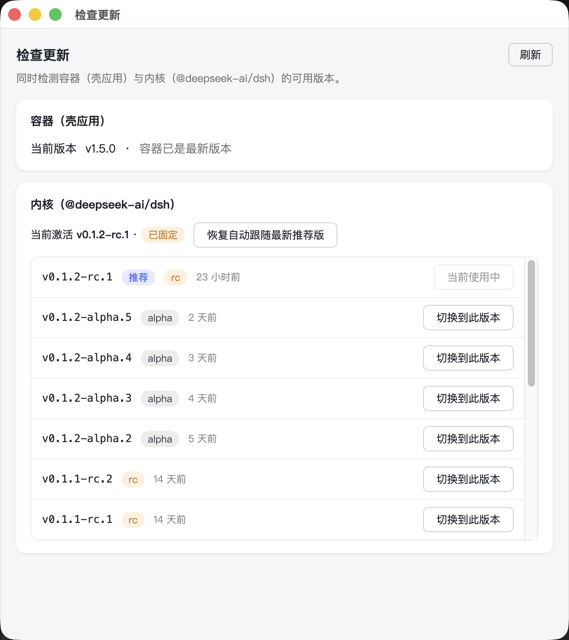
- Container (the shell app itself): compares the current version against the latest tag on GitHub Releases for this repo.
- Windows: wired up to
electron-updater— "Download & Install" fetches the update, then "Restart & Install" applies it in place. Because the installer isn't code-signed, Authenticode verification is disabled at runtime (win.verifyUpdateCodeSignature: falseinelectron-builder.yml). Every release must include thelatest.yml/.blockmapfiles electron-builder generates alongside the installer, or the updater has nothing to compare against. - macOS: unsigned/unnotarized, and Squirrel.Mac hard-requires signing to auto-update, so this stays detection-only — just a button to jump to the release page.
- Windows: wired up to
- Kernel (
@deepseek-ai/dsh): lists every version ever published to npm, newest first, taggedalpha/rc/ (once the official package ships one) a truestable, with the version behind npm'slatestdist-tag marked "Recommended". You can switch to any version in the list; switching briefly restarts the background service and streams the install log live. - Switching to a version pins it: you can freely switch to any version in the list whenever desired, and the active version remains pinned across launches without automatic switching.
prune()preserves the active pinned version. - The container and kernel checks are independent — a GitHub API hiccup only shows an inline "Retry" on that one card, the other keeps working.
"Recommended" here means npm's
latestdist-tag, which the official package has maintained since day one — it is not the semver notion of "no pre-release suffix". As of writing, every published version of@deepseek-ai/dshstill carries a-rc.N/-alpha.Nsuffix, so there's no true GA release yet; the UI intentionally avoids the word "stable" for that reason.
Directory layout
<data dir>/                        # ~/Library/Application Support/DSH Web when packaged; .data/ under the repo in dev
├── runtime/
│   ├── versions/v0.1.1-rc.2/     # each version gets its own full node_modules
│   └── current -> versions/v0.1.1-rc.2
├── pnpm-store/                    # content-addressed store, deduplicated across versions
├── logs/app-YYYY-MM-DD.log        # runtime logs
└── settings.json                  # user configuration
Configuration
settings.json (openable from the menu):
{
  "port": 43130,             // web service port; auto-probes forward if taken
  "channel": "latest",       // update channel (currently only npm's `latest`)
  "autoCheckUpdates": true,  // background update detection for shell, kernel, and plugins
  "dshHome": "",             // empty = the official standard ~/.dsh; point elsewhere to isolate data
  "taskBadge": true,         // show a completed-task count badge on the Dock/taskbar icon
  "pinnedKernelVersion": ""  // empty = follow latest release; set via the Check for Updates window to pin a specific kernel version
}
Data relationship with third-party shells
By default the app uses the official standard data directory ~/.dsh, so session history is fully interoperable with the official CLI.
Third-party containers (e.g. the older DSH Desktop) may push community plugins into a profile through a plugin marketplace. These are often incompatible with newer official releases and can crash the web service on startup (showing up as a blank white window). To address that, this app provides:
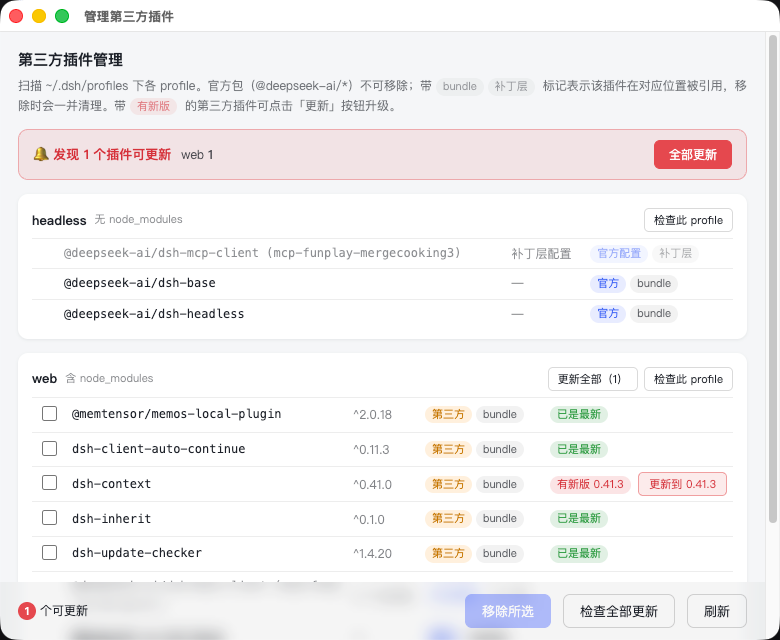
- A plugin manager (menu: DSH Web → Manage Third-Party Plugins…): browse every plugin under a profile, distinguish official vs. third-party and where each is referenced (bundle, patch layer), and remove selected ones precisely. Removal requires confirmation, and the original files are automatically backed up under the profile's
.sanitized-backup-*directory. - Automatic cleanup on first launch: if the web profile has been contaminated, it's restored to the official default shape, while user-level configuration for official components (e.g. the Funplay MCP) is preserved.
- Crash self-healing: the service auto-restarts if it exits unexpectedly; if it has never been cleaned before, cleanup runs first, then it restarts.
Note: the
desktopprofile belongs to the older DSH Desktop. Removing plugins from it will break that older shell's marketplace features (that's the intended effect of decontamination) — quit the older shell first if you still use it. To install a plugin, use the official method:dsh plugin --profile <name> add <package>.
Community plugin marketplace
Menu DSH Web → Community Plugin Marketplace… (⌘⇧M, or switch to that tab inside the "Manage Third-Party Plugins" window):
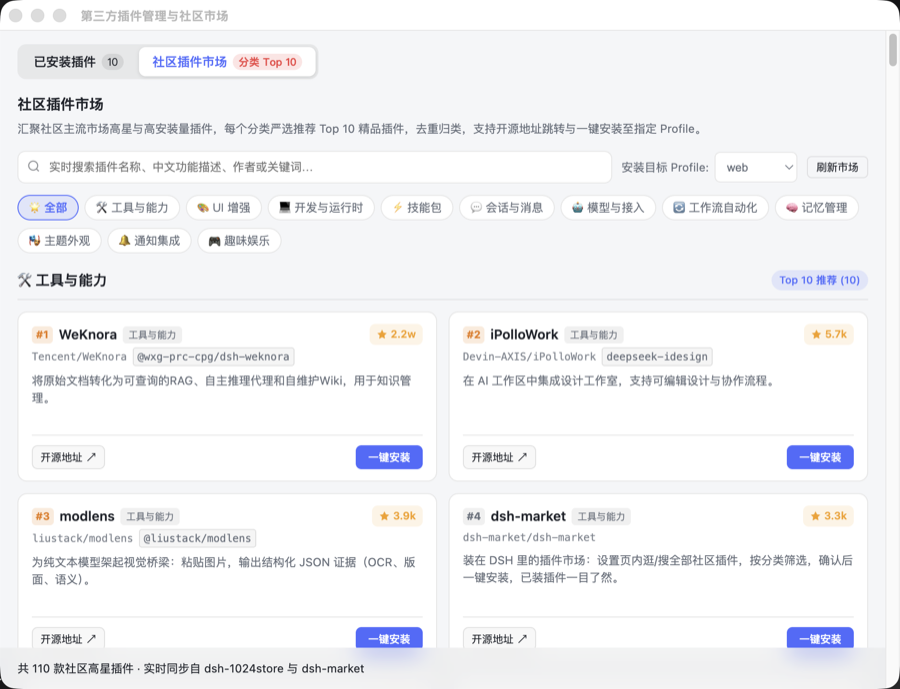
- Aggregates high-star, high-install plugins from the mainstream community marketplaces (dsh-1024store, dsh-market) into 11 categories (Tools & Capabilities, UI Enhancements, Dev & Runtime, Skill Packs, Conversation & Messaging, Models & Providers, Workflow Automation, Memory Management, Themes, Notifications, Fun & Games), each curated down to a Top 10; duplicate listings of the same GitHub repo/package are merged.
- Real-time search by plugin name, Chinese description, author, or keyword, plus category filtering.
- Already-installed plugins are flagged on their card so you don't install them twice; pick a target profile and click "Install" to write the dependency into that profile's
package.jsonanddsh.profile.bundlesdirectly — no manual file editing needed. - Click a plugin's name or its "open-source" badge to open its GitHub/npm homepage in the system default browser.
- Marketplace data is cached locally for 12 hours; if the network is unavailable or the API errors out, it falls back seamlessly to a bundled Top 100 seed dataset, so the list is always usable.
Token usage & cost stats
Menu DSH Web → Token 用量统计… (⌘⇧T) opens a dedicated window that tallies token usage and estimated cost across every session under ~/.dsh/sessions:
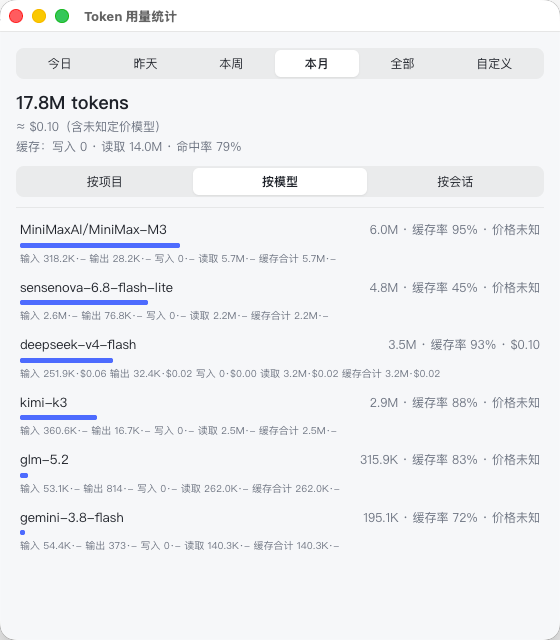
- Time range: today / yesterday / this week / this month / all time / a custom range
- Grouping: by project (folded up to the repository root along
.git, worktrees included) / by model / by session (capped at the 50 most recently active) - Each row shows total tokens, cache hit rate, and estimated cost; the by-model/by-session views additionally break the cost down into input/output/cache-write/cache-read
- Clicking a project or session row opens its folder in Finder (Explorer on Windows)
- The window re-scans automatically every 60 seconds while open
Cost estimates come from a local, editable pricing table. The first time the window opens, the bundled pricing.default.json is copied to pricing.json in the app's data directory; from then on only that user copy is read/written (an app update never overwrites it). DeepSeek Harness can route to any provider/model — real-world usage has included OpenRouter, SenseNova, Zhipu, and Google models, for example — and this table only ships pricing for DeepSeek's own official models; every other model shows as "unknown pricing" until you add its rate using the same JSON shape. DeepSeek's official API also prices differently during UTC peak/off-peak windows; this only uses the (lower) off-peak rate as a single approximation, so the cost shown is an estimate (≈), not an exact bill.
Performance and cross-platform support: decompressing .zstd session logs prefers the system-installed zstd CLI when available (roughly an order of magnitude faster in practice), and falls back to the pure-JS fzstd library otherwise — a case that mainly shows up on Windows machines without extra command-line tools installed. Neither path needs any native compilation, so it works correctly on Windows too. The whole scan/decompress/parse pipeline runs on a dedicated worker thread and never blocks the main process or the UI.
Notes
- Don't run two DSH containers at once (e.g. the older DSH Desktop.app): both share the
~/.dshsession data, and concurrent writes are risky. After migrating to this app, quit or remove the old shell. - The default port is
43130, chosen to avoid colliding with the old DSH Desktop's43120. - Native modules (node-pty, koffi) all use official prebuilt binaries — no Xcode command line tools required.
- To distribute the app to others, configure Apple code signing (the
CSC_LINKenvironment variable) before runningnpm run distagain.
Project structure
src/main/
├── main.js              # startup orchestration, windows, menu, lifecycle, crash self-healing
├── config.js            # paths and constants (registry URL, build allowlist)
├── updater.js           # update engine: check/install/atomic-swap/cleanup (pure Node, testable)
├── kernel-versions.js   # fetches every published npm version of @deepseek-ai/dsh (pure Node, testable)
├── shell-update.js      # checks GitHub Releases for a newer container version (pure Node, testable)
├── shell-auto-updater.js # container auto-update: wraps electron-updater (Windows only)
├── kernel-switch.js     # kernel version switch state machine: install → activate → persist pin (pure Node, testable)
├── update-window.js     # Check for Updates window (container + kernel) + its IPC handlers
├── runner.js            # official service process management: launch/double health check/graceful exit
├── plugin-guard.js      # third-party plugin guard: surgically restores an official profile
├── plugin-manager.js    # third-party plugin manager window
├── badge.js             # task-completion Dock/taskbar badge watcher
├── semver.js            # pre-release-aware version comparison
├── status-window.js     # startup progress window (plain text, not the product UI)
├── logger.js            # file logging
└── token-usage/         # token usage stats: scan/decompress/parse/dedupe/aggregate/pricing/window
    ├── scanner.js        # recursively find session.jsonl(.zstd)
    ├── decompress.js     # prefers system zstd, falls back to pure-JS fzstd
    ├── parser.js         # parses session events into usage records
    ├── dedup.js          # dedupes by requestId (streaming snapshots repeat the same request)
    ├── aggregator.js     # aggregates by project/model/session + estimates cost
    ├── pricing.js        # pricing table loading (bundled default + user-editable copy)
    ├── cache.js           # incremental cache keyed by file mtime/size
    ├── scan-worker.js     # runs the actual scan on a worker thread, off the main process
    ├── service.js         # orchestrates the steps above
    ├── window.js          # the stats window + its IPC handlers
    └── stats-window.html  # the stats window's UI
scripts/
├── fetch-tools.mjs        # build-time download of pnpm/portable Node into vendor/
├── e2e-update-test.mjs    # headless end-to-end test (hits the real registry, full chain)
├── test-plugin-update.mjs # self-test for third-party plugin update logic
├── test-token-usage.mjs   # self-test for the token usage module (incl. a real-file decompression regression)
├── kernel-versions-test.mjs # self-test for parsing/classifying/sorting the npm version list
├── shell-update-test.mjs  # self-test for the GitHub Releases update check
├── kernel-switch-test.mjs # self-test for the kernel switch state machine (incl. pin/rollback-on-failure)
├── badge-test.mjs         # self-test for the task-completion badge
├── plugin-guard-test.mjs  # self-test for the plugin guard
├── repair-session.mjs     # repairs sequence numbers in a corrupted session.jsonl(.zstd)
└── verify-session-file.cjs # verifies a session file's zstd framing / sequence continuity
Testing
npm test          # fast regression suite: badge / plugin guard / plugin update / token usage / kernel versions / shell update / kernel switch (no network needed)
npm run test:e2e  # end-to-end update flow test (hits the real npm registry, slower)
Contributing
Issues and PRs are welcome. Please read CONTRIBUTING.md first (it covers the dev workflow and the commit message convention).