
 @jigjoy-ai
baro
A CLI that turns a goal into a pull request - and a sandbox for testing concurrent AI coding agents on the Mozaik runtime.
- Stars
- 124
- Language
- TypeScript
- Created
- Mar 22, 2026
- Updated
- Oct 13, 2026
Introduction
baro
Type a goal in your repo. Walk away. Come back to a verified pull request.


baro is an autonomous software factory. It compiles your goal into a machine-checkable contract, splits it into a DAG of stories, builds them in parallel across isolated git worktrees, and blocks every merge behind fail-closed gates — declared tests, build, an evidence critic, write-surface ownership. You review a PR the gates already accepted.
One prompt → a 33-story plan → 808 passing tests → a PR, in 71 minutes. See a real run.
Install
npm install -g baro-ai
Needs Node 20+, git, and at least one backend: the claude CLI (default), codex,
or any OpenAI-compatible endpoint. baro --doctor checks your setup.
Use
cd your-repo
baro "Add JWT authentication with role-based access control"
That opens the TUI: intake asks only what matters, you confirm the plan, the fleet runs.
For automation, detach and follow from anywhere:
baro --headless --detach --goal-file goal.txt   # prints a run id, returns immediately
baro watch <run-id>                             # follow milestone events
baro logs <run-id> --follow                     # tail the raw log
baro runs                                       # list live runs
baro stop <run-id>                              # stop one
Commands
| Command | What it does |
|---|---|
baro "<goal>" | run a goal in the current repo (TUI) |
baro --goal-file <path> | read the goal from a file |
baro --headless --detach ... | background run for CI/automation; prints the run id |
baro watch <run-id> | follow a live run's milestones |
baro logs <run-id> [--follow] | print or tail a run's log |
baro runs / baro stop <id> | list / stop live runs |
baro --resume | resume an interrupted run from prd.json — never re-plans |
baro --continue | follow-up on the current branch — always re-plans |
baro --doctor | self-diagnostic: backends, auth, gh, permissions |
baro login | browser sign-in for baro cloud |
baro connect [--install-service] | attach this machine as a cloud runner |
The flags that matter
--llm claude|codex|openai|opencode|pi|hybrid|jigjoy   # backend for all phases
-m opus|sonnet|haiku          # model override (verbatim pass-through on other backends)
--effort low..max             # thinking per turn (default: high)
--parallel N                  # max parallel story agents (0 = unlimited)
--mode focused|sequential|parallel   # force an execution mode (default: intake proposes)
--quick                       # trivial goals: one story, no architect/critic/surgeon
--local-only                  # no pushes, no PRs — hard isolation
--shell-budget <seconds>      # per-command budget for story shell tools
--openai-base-url <url>       # any OpenAI-compatible provider (OpenRouter, vLLM, Ollama…)
--tier-map "light=openai:MiniMax-M3,heavy=claude:opus"   # mix backends per story tier
Per-phase overrides (--architect-llm, --story-model, …), .barorc, and everything
else: docs.baro.rs
How it works
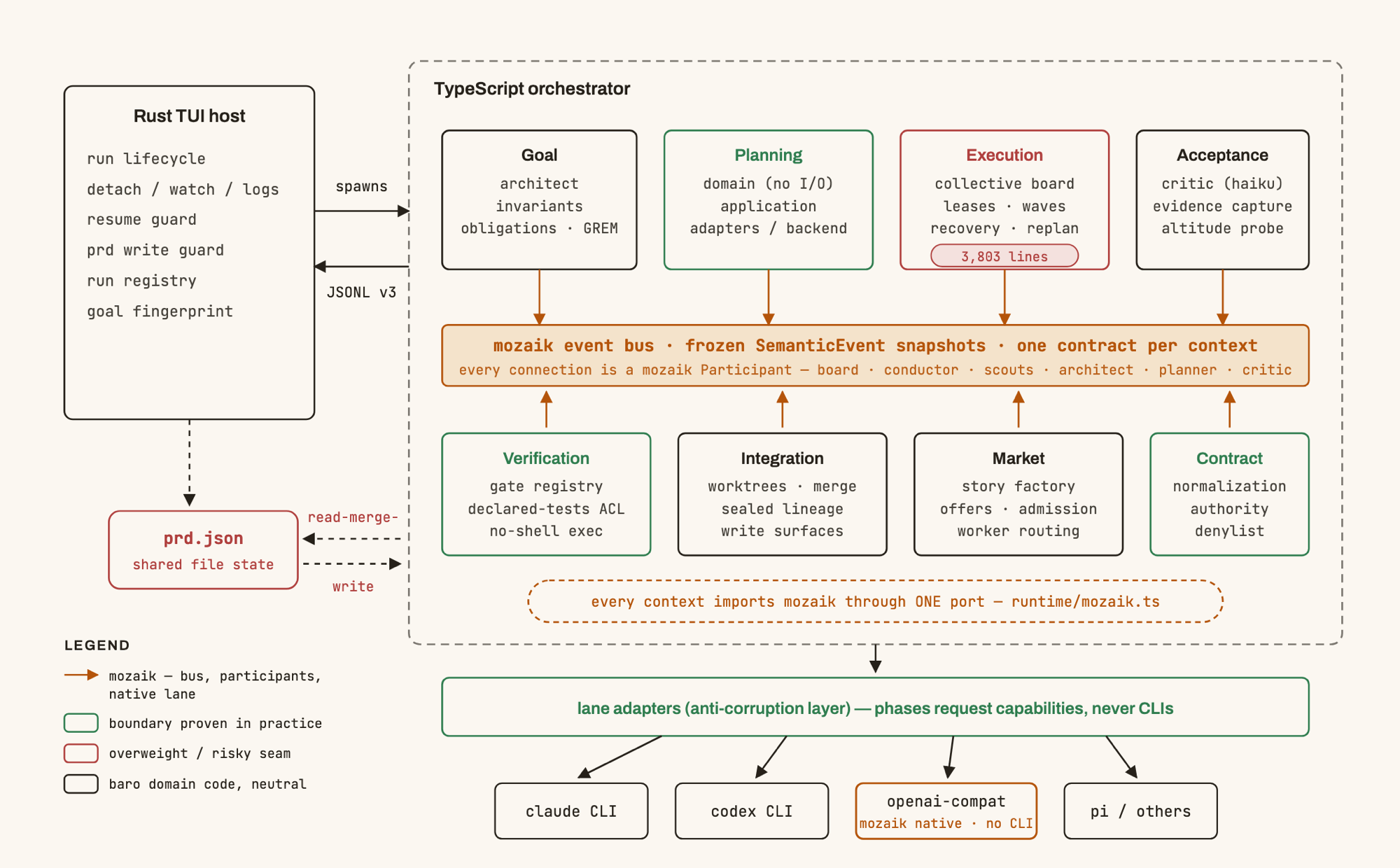
- Contract first. An architect turns the goal into invariants and obligations that are machine-checkable — before any code is written.
- A collective, not a coordinator. Story agents are peers on an event bus: they see the events that concern them, exchange notes, and suspend/resume on each other's work. There is no single context window everything must squeeze through.
- Gates, not vibes. Declared tests, build-before-commit, an evidence critic that judges captured command output, and write-surface ownership — fail-closed, blocking every merge. The human reviews a PR the gates already accepted.
- A live plan. The plan is a DAG the run negotiates with: runtime replanning adds and rewires stories mid-run, and a failed gate can spawn its own remediation story.
Drive it with Claude Code
baro pairs well with a coding agent in the driver's seat. Paste this into Claude Code inside your repo:
Install baro (npm install -g baro-ai) and run `baro --doctor` to verify the setup.
Then drive it for me:

1. Write my task as an evidence-rich goal file: name the exact files and line numbers
   the change touches, state the constraints, and say which tests must prove it.
2. Launch it detached: `baro --headless --detach --goal-file goal.txt`, note the run id.
3. Follow it with `baro watch <run-id>`; if it stalls, read `baro logs <run-id>`.
4. When the pull request opens, review the diff against the goal, run the project's
   test suite yourself, and report back: what shipped, what the gates proved, and
   anything that needs my eyes. Merge only if everything is green.

Keep goals narrow — one concern per run. If the run fails, read why, tighten the goal
with the new evidence, and launch again.
Cloud
No machine, or no Claude/Codex subscription? Run the same fleet on
app.baro.jigjoy.ai — nothing to install, isolated
sandboxes, our keys. Or keep your own hardware in the pool: baro login, then
baro connect --install-service.
Docs: docs.baro.rs · Issues: github.com/jigjoy-ai/baro/issues · Twitter: @lotus_sbc