
 @joekytc
dsh-swarm
Run multi-agent task pipelines on DSH like a team — plan, execute, review, and deliver code through a visual kanban with provable completion.
- Stars
- 6
- Language
- TypeScript
- Created
- Aug 20, 2026
- Updated
- Sep 30, 2026
Introduction
dsh-swarm
Say one requirement, reply one confirmation — six specialist agents take it from planning to verified delivery. No commands to memorize.
dsh-swarm is a DSH plugin that turns one requirement into a strict, evidence-verified delivery pipeline. An orchestrator (V) decomposes an approved spec into a strictly ordered phase chain (p → (pt?) → w2 → d → dt → w3 → summary); six single-purpose roles (V / P / W / D / PT / DT) run each phase with isolated, permission-gated tool faces; every handoff is machine-verified against an evidence contract; failures recover through idempotent retry and human-gated reviews; and a live Workflow kanban tab streams all state to the browser via SSE. Design inspired by the Hermes Agent kanban.


Swarm mode (recommended)
Swarm mode turns your main session into a team lead: you state the requirement, it clarifies, plans, confirms, delegates and follows through — entirely in natural language, no commands to remember.
- No commands to memorize — just state your requirement; no
/plan:or/openspec:prefixes needed. - Automatic intent recognition — development requests → clarify/plan and build a chain; lessons & retrospectives → persist to memory; group notifications → deliver to WeCom; Q&A / chit-chat → answered directly. Intent is judged by the model, not by a code-level classifier — the confirmation gate below is what stops a misjudged chain.
- Free delivery —
/sms <intent>(e.g. "post current progress to the group"): facts are grounded via kanban lookup, then the body is composed per intent and delivered;-sor wording like "private chat" targets the DM. A bare/smsre-sends the latest completed-chain report and/sms blocked [chainId]the block notice — those two bodies are rendered by system code from kanban facts, never rewritten by the lead. Group and private-chat targets auto-resolve to the single saved target (0 or 2+ targets error out; clean up in dsh-im settings, or pinimDelivery.targetId/imDelivery.dmTargetId, which skips the count check — though withimDelivery.botIdempty the pinned target must still belong to the auto-discovered bot, or it errors out). - Confirmation gate against accidental chains — after the checklist is saved, the lead is instructed to build a chain only once you reply with an explicit affirmative (
确认/开干/开跑/开始/go, etc.). The gate is judged by the model, not enforced by a code-level check; vague replies, topic switches, or edit-only feedback count as not confirmed. - The lead is read-only — the main session cannot write/edit repo sources, nor run git mutations (push/commit/reset…); a bare
git checkout/git switchof an existing branch is allowed. Writing code is done by the executor (D) in an isolated workspace by design. - Progress is always actually queried — ask "how is it going?" anytime and the lead reports from real kanban lookups, never fabricated.
Why it's designed this way
Coordinating several agents on one task typically fails in three ways:
- Role drift — the "planner" starts writing code, the "executor" reviews its own work, and nobody owns the outcome.
- Unverifiable handoffs — an agent claims "done" with no reproducible evidence, and the next agent builds on sand.
- Silent deadlocks — an agent stops without finishing and the pipeline hangs, or bad code is merged before anyone reviewed it.
dsh-swarm encodes a contract against all three: one responsibility per role, enforced by the permission matrix, tool faces and task-body instructions; every handoff must carry structured evidence or the phase will not close; every stall or review failure lands in a visible, recoverable state — with you (the human) as the final trust anchor. It is built correctness-first: deterministic state machines, append-only event sourcing, idempotent schedulers, and a red-team test suite that replays the event log and rejects any illegal transition (mechanics in Advanced).
Two modes
| Mode | How you use it | Notes |
|---|---|---|
| Swarm mode (recommended) | Just say the requirement in natural language | No commands to memorize, intent auto-recognized, runs on confirmation |
| Command mode (compatible) | /plan: <requirement> → clarify → /openspec: confirm | Kept for compatibility, functionally equivalent; may be removed in the future — new users should use swarm mode |
Quickstart
1. Install
Prerequisites: a working DSH runtime (@deepseek-ai/*), Node.js ≥ 22.19 and npm. Optional: a wiki-vault HTTP service (KB features, see Configuration).
From npm (the published tarball ships the built lib/):
dsh plugin --profile web add @joekytc/dsh-swarm
From a source checkout (rebuild first so lib/ matches the sources):
npm install
npm run build        # tsc -p tsconfig.build.json + client bundle (lib/client.js)
dsh plugin --profile web add .
From GitHub source:
dsh plugin --profile web add github:joekytc/dsh-swarm— the repository tracks the builtlib/.
2. Switch your main-session preset
Switch the main session's agent preset to Swarm (蜂群模式) — it is installed at $DSH_HOME/.agent-presets/swarm once the plugin is installed.
3. Say → confirm → watch progress
Example conversation:
You: Add a role-management page to the admin project with CRUD and permission checkboxes

Lead: Let me confirm a few things first —
  · Which role fields do you need (name/description/status/…)?
  · Permission source: the existing menu tree, or custom?
  · Any acceptance requirements, e.g. "deleting a role must not affect linked users"?

You: Fields are name and description, permissions from the existing menu tree, acceptance via TDD

Lead: Checklist saved (six spec sections + repo facts). Reply "confirm" to launch —
      I'll spin up the p → (pt) → w2 → d → dt → w3 pipeline.

You: confirm

Lead: Chain created (ch_…), live progress on the kanban tab (Conversation → Trajectory → Kanban).
      First phase: Planning (P)…
- Kanban: the third tab of the conversation center (Conversation → Trajectory → Kanban). Click a card for Overview / Trajectory / Handoff / Spec / Comments.
- Completion: when a chain completes, the system audits the workspace and (for D chains) automatically merges the feature branch into the spec-declared target branch. An audit warning blocks the final wrap-up until you confirm ownership in the GUI — it does not gate the merge.
- Progress: just ask "how is it going?" — the lead reports from real kanban lookups and relays blocking reasons faithfully.
What it does for you
Six roles, one job each — boundaries enforced by the permission matrix, trimmed tool faces and task-body instructions, so no role creep:
| Role | One-line responsibility | What it never does |
|---|---|---|
| V Orchestrator | Creates phase cards, drives the pipeline, gives guidance on stalls | Never executes |
| P Planner | Reads the spec + repo facts, writes the implementation plan | Never writes code |
| PT Plan reviewer | Read-only review of P's plan (on demand) | Never changes anything |
| W Knowledge officer | Syncs the KB in planning/completion phases | Never touches code/git |
| D Executor | The only role that writes code: implement → verify → commit → push feature branch | Never merges into the target branch itself |
| DT Implementation reviewer | Empirically verifies D's delivery (tests/build/typecheck/diff) | Read-only against the repo |
The pipeline (strictly serial within a chain, parallel across chains):
p ──> (pt?) ──> w2 ──> d ──> dt ──> w3 ──> summary
plan   plan rev.  KB    impl  impl rev.  KB    wrap-up
ptappears only when P decides a plan review is needed;dis always followed by an implementation review (dt).- Chain completion is decided by a mechanical rule (W3 done + D done with delivery evidence + no open tasks), not by an agent's self-assessment.
Configuration
All keys are optional; schema lives in src/config.ts. Most users only need the first three — keep the rest at their defaults.
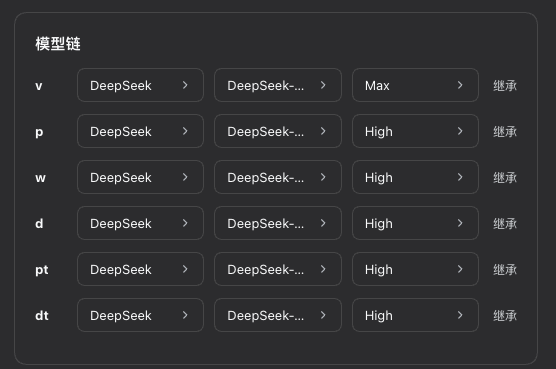
The 「模型链」 (model chain) card in the config panel: every role gets its own model — pick provider, model and reasoning effort per role; roles you leave untouched show 「继承」 (inherit) and follow the default.
| Key | Default | Description |
|---|---|---|
storageDir | $DSH_HOME/storages/kanban | Event log (events.jsonl), orchestration state, per-task workspaces, dispatcher.log. Value must use the unquoted !!js dshHomePath("storages/kanban") form — quoting degrades it into a literal string |
wikiVault.baseUrl | '' (empty) | wiki-vault HTTP service for KB reads/writes — required for KB features; set to your own server |
wikiVault.pagePrefix | projects/ | Namespace prefix for generated wiki pages |
roles.models.<role> | {} | Per-role model: { provider, model, reasoningEffort?, fallbacks?[] } |
roles.models.<role>.reasoningEffort | high | Default reasoning effort for all roles |
roles.models.<role>.fallbacks | [] | Silent fallback candidates (audited via [model-fallback] comment) |
dispatcher.staleTimeoutSeconds | 14400 | Heartbeat timeout; running task without heartbeat is reclaimed |
dispatcher.maxRetries | 3 | Failure retries before circuit → blocked(gave_up) |
dispatcher.heartbeatIntervalSeconds | 300 | Watchdog heartbeat period |
dispatcher.maxProtocolViolations | 2 | Protocol-violation guardrail: once consecutive violations reach this many, the next one is final (gave_up) |
dispatcher.maxReworksPerRole | { pt: 3, dt: 3 } | Max review rework rounds before review/gave-up + [review-final] |
prefixRoutes.plan | /plan: | Command-mode phase-0 planning prefix |
prefixRoutes.openspec | /openspec: | Command-mode approve-and-execute prefix |
prefixRoutes.learning | /learning | Lessons / retrospective prefix |
prefixRoutes.send | /sms | Free-delivery prefix (DM with -s) |
memory.enabled | true | Memory recall index; false makes planning_memory_recall return a disabled notice |
memory.maxIndexEntries | 8 | Max recalled memory entries (1–20) |
ui.enabled | true | Declared switch; not consumed yet — the tab registers unconditionally |
ui.contentMinWidth | 715 | Declared lower width bound (px); not consumed by the client yet — the tab follows the host conversation width |
ui.contentMaxWidth | 780 | Declared upper width bound (px); not consumed by the client yet |
ui.sseHeartbeatSeconds | 20 | SSE heartbeat interval |
gates.enabled | true | TDD measurement gate; false → silent skip (no event) |
gates.timeoutMs | 600000 | Per-command gate timeout (ms), SIGKILL at the deadline |
gates.forbidden | ['rm -rf /', 'git push'] | Command-blacklist substrings (defence in depth) |
evidenceReplay.enabled | false | L3 replay of model-written commands — not a sandbox, see Issue evidence check |
evidenceReplay.timeoutMs | 600000 | Per-replay command timeout (ms) |
evidenceReplay.allowPrefixes | ['npx --no-install vitest', 'npm test', 'npm run build', 'npm run typecheck', 'tsc', 'eslint'] | Allowlisted tool prefixes (word-boundary match) |
imDelivery.enabled | false | WeCom delivery via dsh-im (W3 wrap-up / chain blocked / review gave-up) |
imDelivery.botId | '' | Empty = auto-discover the only wecom bot |
imDelivery.targetId | '' | Empty = auto-discover the only saved group target |
imDelivery.dmTargetId | '' | DM target for /sms -s |
imDelivery.fallbackBotId | '' | Bot used when preset-based matching finds nothing |
reviewEngine.mode | delegate | delegate or managed — see Review engine (ocr) |
reviewEngine.managed.provider | '' | Model-chain provider id used in managed mode |
reviewEngine.managed.model | '' | Model-chain model id used in managed mode |
wikiWritePresets | ['swarm', 'kanban-w', 'ptc'] | Presets allowed to call wiki_write (page paths are still whitelisted by namespace) |
Review engine (ocr)
Implementation reviews (the in-chain DT phase and standalone reviews) are powered by open-code-review (ocr), with two modes switchable in the web config panel under 「Swarm 配置 → 评审引擎(ocr)」 (Swarm config → Review engine (ocr)):
| Mode | How it works | Notes |
|---|---|---|
| Delegate (default) | ocr only outputs the review scope and rules; DT reviews each file with its own model | Zero API keys, works out of the box |
| Managed | ocr runs the full review with your chosen provider/model and returns normalized findings in one shot | For large change sets; delegate mode hints at switching past 50 files (a hint only, never auto-switched) |
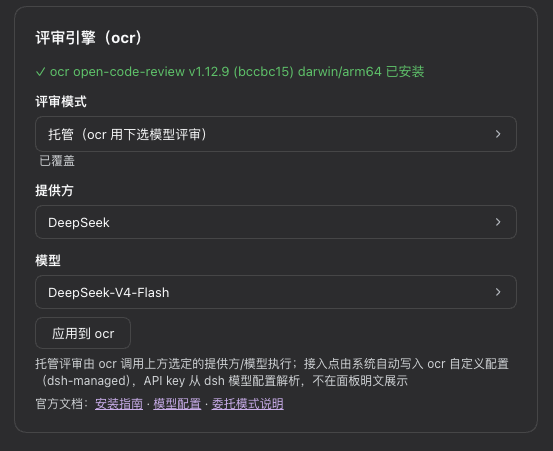
The 「评审引擎(ocr)」 (review engine) card in the config panel: with ocr installed, choose the mode (managed / delegate) plus provider and model, then click 「应用到 ocr」 (Apply to ocr) to wire it up.
Install
- When ocr is missing, the config panel shows a red banner — click 「安装 ocr」 (Install ocr) for a one-click global install (async, cancellable);
- or run
npm install -g @alibaba-group/open-code-reviewin a terminal, then verify withocr --version.
Standalone review (no chain needed)
- Switch the session to 「交付评审官(DT)」 (Delivery Reviewer (DT)) at the top of the dsh web UI and just talk;
- State the review target: a local directory / branch range (from…to) / a single commit / uncommitted workspace diff / a public repo URL (auto-cloned into a temp dir, discarded afterwards);
- The report is first fully output to the conversation;
- Only after you confirm is it written to the KB at
projects/<repo>/reviews/<topic>-<date>/— remote KB mode only; with the default emptywikiVault.baseUrl(local mode) no wiki page is written.
Read-only in practice: bash/run_code writes and wiki writes outside the reviews namespace are blocked by the guard, while the fs write/edit tools are not blocked in a standalone DT session.
Configuration notes
- Mode, provider and model are all chosen on the 「评审引擎(ocr)」 card; the provider/model dropdowns share the same catalog as the model chain;
- After picking, click 「应用到 ocr」 (Apply to ocr) — the system writes the wiring into ocr's custom config (
dsh-managed); the API key is resolved from the dsh model config and written into ocr, never shown in plain text in the panel; if resolution fails it degrades gracefully and points you to a manualocr config providerin a terminal; - When managed is not ready, the ocr tool refuses the managed call and returns delegate guidance; the reviewer switches to delegate mode — nothing is blocked.
Official docs: Installation · Model configuration · Delegate mode
Trust & guardrails (user's view)
- Read-only hard gate for the lead — in swarm mode, main-session writes to sources and git mutations are blocked by a system gate; if blocked, just let the lead explain — execution is done by the D role.
- Confirmation gate — the lead only builds a chain after you reply with an explicit affirmative (enforced by the lead's instructions, not by a code-level check).
- TDD hard gate — implementations must ship with tests (or an explained skip); reviews machine-verify "tests really ran, and were written first".
- Human trust anchors — spec approval, unblock, audit confirmation and chain deletion are human-only; role agents cannot approve specs, and a chain is only created from your confirmed routing call (the main session routes as
human). - Guardrails are constraints, not a sandbox — PT/DT write guards rely on path and command regexes (reviewers get no git credentials), and review evidence is existence-checked: fields must be present and well-formed, while replaying the commands to prove they ran happens only when
evidenceReplay.enabledis turned on. - Full mechanics (permission matrix, delivery contract, review chain, rework, failure recovery) live under Advanced / Developers.
Advanced / Developers
Mechanics and implementation details below — regular users can skip.
Roles & the execution pipeline (full table)
Six roles are dispatched by the scheduler as one-shot agent sessions (deterministic session id kbn-<taskId>; a retry resumes that same session — resumeSessionId is always null in the current implementation — while a rework task starts its own kbn-<reworkId> session). Each role-agent session is bound to exactly one task (boundTaskId) and gets a trimmed tool face. V is the exception: a chain-scoped orchestrator session (kbn-v-<chainId>) with no boundTaskId.
| Role | Alias | Responsibility | Tool face (highlights) |
|---|---|---|---|
| V | Orchestrator | Drives the phase machine, creates one card per phase, posts [blocked-review] guidance on stalls. Never executes. | kanban_create + task tools + spec view |
| P | Planner | Reads spec + repo facts (incl. read-only self-checks), writes an OpenSpec implementation plan, opts into PT via pt_decision.needed. Never executes. | Task tools + spec view, read-only (writes only openspec/changes/) |
| PT | Plan reviewer | Read-only review of P's plan (requirements alignment, completeness, logic). Outputs verdict + issues. | Task tools + spec view, read-only ToolGuard |
| W | Knowledge officer | W2/W3 KB sync (w:kb). Never touches code/git. | Task tools + wiki_search/read/write (remote) / skill→llm-wiki (local) + prefetch_file/prefetch_external/prefetch_kb + read-only spec view |
| D | Executor | The only role that writes code: worktree → implement → verify → [AI-GEN] commit → push feature branch (merging into the spec-declared target branch is done by the system only after DT passes). | Task tools + wiki read + bash/fs/run_code (full dev) + subagent (spawn/fork/list-agents) + goal |
| DT | Implementation reviewer | Empirically verifies D's work (test/build/typecheck/diff/git + open-code-review), writes review page to KB. Read-only against the repo. | Task tools + wiki read/write (review namespace) + ocr_review + bash/fs/run_code, read-only ToolGuard |
Guardrails in detail
Permission matrix
can(action, actor, task, { boundTaskId }) in src/domain/permissions.ts.
"Bound" means the actor is the role agent session spawned for that exact task
(boundTaskId === task.id and, for complete, also actor === task.assignee).
| Action | V | P | W | D | PT | DT | Human | System |
|---|---|---|---|---|---|---|---|---|
| create-chain / create-task | ✅ | ❌ | ❌ | ❌ | ❌ | ❌ | ✅ | ❌ |
| claim | ❌ | ❌ | ❌ | ❌ | ❌ | ❌ | ❌ | ✅ |
| complete | ❌ | bound | bound | bound | bound | bound | ✅ (GUI) | ✅ |
| block | ❌ | bound | bound | bound | bound | bound | ✅ | ✅ |
| heartbeat | ❌ | bound | bound | bound | bound | bound | ❌ | ❌ |
| comment | ✅ | ✅ | ✅ | ✅ | ✅ | ✅ | ✅ | ✅ |
| unblock | ❌ | ❌ | ❌ | ❌ | ❌ | ❌ | ✅ | ❌ |
| archive | ✅ | ❌ | ❌ | ❌ | ❌ | ❌ | ✅ | ❌ |
| spec-approve | ❌ | ❌ | ❌ | ❌ | ❌ | ❌ | ✅ | ❌ |
| spec-edit | ❌ | ❌ | ❌ | ❌ | ❌ | ❌ | ✅ | ❌ |
| spec-attach | ✅ | ❌ | ❌ | ❌ | ❌ | ❌ | ✅ | ❌ |
| update-title | ❌ | ❌ | ❌ | ❌ | ❌ | ❌ | ✅ | ❌ |
| delete-chain | ❌ | ❌ | ❌ | ❌ | ❌ | ❌ | ✅ | ❌ |
| wiki-write | ❌ | ❌ | ✅ | ❌ | ❌ | ✅ (review ns) | ❌ | ❌ |
| wiki-read | ❌ | ❌ | ✅ | ✅ | ❌ | ✅ | ❌ | ❌ |
| prefetch | ❌ | ❌ | ✅ | ❌ | ❌ | ❌ | ❌ | ❌ |
| audit-confirm | ❌ | ❌ | ❌ | ❌ | ❌ | ❌ | ✅ | ❌ |
| create-rework-task | ❌ | ❌ | ❌ | ❌ | ❌ | ❌ | ❌ | ✅ |
| reopen-chain | ❌ | ❌ | ❌ | ❌ | ❌ | ❌ | ✅ | ❌ |
| waive-review | ❌ | ❌ | ❌ | ❌ | ❌ | ❌ | ✅ | ❌ |
Key guarantees (two):
- The main session cannot execute. Its kanban tool face is a read-only subset —
kanban_show/kanban_chain/kanban_list/kanban_commentplus the human-recovery pairkanban_reopen_chain/kanban_waive_review— together withspec_card_view,kanban_route, theplanning_*tools andsms_send; neverkanban_create/kanban_complete/kanban_block. Chains/specs are created only via swarm-mode intents or/plan:+/openspec:; the GUI observes and mutates task state but never creates chains or tasks — "who decided to run what" stays explicit and auditable. - Session binding prevents cross-task escalation (a W agent bound to task A
cannot complete/block task B even though both are W tasks); DT writes are
confined to the
projects/<repoSlug>/<chain>/review/namespace by a ToolGuard on top of the matrix; and no role agent can approve specs, unblock, confirm audits, waive a review or reopen a chain — those are human trust anchors;systemhandles only mechanical bookkeeping.
Delivery contract (upstream owes downstream)
Each phase's handoff must carry the keys its downstream actually reads
(src/domain/delivery-contract.ts). Missing delivery keys block the W/P card
immediately and admit no human exemption; the D/PT/DT evidence gates instead reject
complete with an error (the card stays running) and are human-exempt. The
orchestrator never builds a downstream card on a blocked parent:
| Card | Required handoff keys |
|---|---|
W2 / W3 (w:kb) | kb_url + page_path — non-empty is not enough: with a configured wikiVault.baseUrl the kb_url must start with it (and must be exactly '' in local mode), while page_path must sit in the allowlisted namespaces (wiki/** locally) |
P (p:openspec) | artifacts_path + pt_decision (needed boolean required; when needed: true, reason is required) |
D (d:execute) | changed_files + (commit_hash or push) — hasDeliveryEvidence; branch (feature branch) is not a delivery key, but when the TDD gate actually runs the tests it checks the branch and bounces the card if it is absent or mismatched; tdd (test_files or skipped.reason, XOR) |
| PT / DT | review_evidence (schema-valid) — validateReviewEvidence |
TDD hard gate (evidence threshold)
D completes only with tdd — test_files (with test_first) or skipped.reason
(XOR, delivery-evidence.ts). DT's review_evidence must carry tdd; whenever
tdd.test_files are declared the runner must be vitest (test.runner), and on a
pass verdict test_first === true must hold (review-evidence.ts). This makes
"tests actually ran, and were written first" a machine-checked property rather than
a claim.
Gate skip alarm & declaration cross-check
A declaration that disagrees with the diff no longer passes the gate silently
(three silent-skip modes remain, emitting no event: gates.enabled=false, a handoff
without worktree_dir, and non-d:execute cards):
task/gate-skippedevent — a declaredtdd.skippedis allowed when the diff is pure docs/config, or when the diff cannot be computed (conservative alarm-skip); both leave the event as an audit trail. Otherwise the gate bounces the card back (same session, agent fixes and re-completes).- Declaration ↔ reality cross-check — declaring
test_fileswith no test-file change in the diff (stale-test handoff), an emptytest_files, an invalid path, or a branch mismatch all bounce instead of silently skipping. - After 3 cumulative bounces the task is blocked for human review (
gave_up: gate bounced 3 times). - Gate runs now archive raw output to
<storageDir>/gate-logs/<taskId>.log(path is referenced in the gate event detail). review_evidence.lintmust be a structured object (aligning withbuild/typecheck);null/scalars are rejected.
Issue evidence check (PR2, opt-in)
Reviewer-reported issues (DT cards only — PT issues are never evidence-checked) can carry evidence = { file, command, exit } (raw output archive, first line [exit code: N]). Verification is three-tier: missing evidence → flagged (not-provided; critical/high → could-not-replay + needs-human); archive paper-check (zero execution) → matches; on mismatch a replay re-runs the command — only if evidenceReplay.enabled is turned on, and only for allowlisted tool prefixes (word-boundary match; npm run restricted to fixed script names). Replays execute model-written commands and are NOT a sandbox; keep the switch off unless you accept that risk. Results are summarized in a review/evidence-check event; differs never auto-fails a review — it surfaces to human review.
Phase-0 planning checklist
Planning runs a read-only planning session (grill-me → planning_prefetch →
planning_checklist_save, planning-driver.ts). The checklist carries a structured
manifest (repo facts + file baseline, prefetch-manifest.ts); an invalid manifest
blocks the save, and chain creation mounts the checklist as the file-prefetch +
kb attachments on the spec card (prefix-router.ts).
Review quality chain
- After P completes, PT is skipped only when P's handoff delivers
pt_decision.needed = false;trueor an absent decision creates the PT card (fail-safe) — the orchestrator never overrides the decision (V only creates the card). - After D completes, a DT card is always created.
- PT/DT are read-only: a ToolGuard mechanically denies writes to the repo sources, git mutations, and (for DT) wiki writes outside the review namespace.
- DT review engine:
open-code-review(ocr, dual mode: delegate/managed, see Review engine (ocr)); a pre-start probe blocksreview-tool-unavailablewhen ocr is missing (reason notes GUI install), without burning retries. review_evidencemust passvalidateReviewEvidenceor the review card cannot complete: PT needs verdict + issues + plan ref, and afailverdict requires at least one unresolvedcritical/highissue (otherwise it must bepass); DT additionally needs test (exit 0 on pass), build/typecheck, lint, non-empty diff, git, ocr/fallback conclusion, andtdd.
Rework (review failure)
A failed review never mutates a done card. Instead the system records
review/failed, creates a rework task ([返工] ...) with its own session
(kbn-<reworkId>, resumeSessionId = null), reviewAttempt + 1, and starts as
todo (reviewStatus: 'pending'). The rework card body additionally carries the
previous round's issues verbatim in a ## 本轮修复清单 (fix-this-round) section.
A fresh review card is then dispatched for the rework.
When reviewAttempt reaches maxReworksPerRole (PT 3 / DT 3), the system records
review/gave-up and posts a [review-final] evidence-chain comment (the same marker
is reused by the convergence-gate downgrade below), and (with IM
delivery enabled) sends a [评审超限待裁决] notification with two exit paths:
waive the review (kanban_waive_review / GUI “豁免评审”) or reopen the chain
(kanban_reopen_chain / GUI “人工恢复”). Convergence gate: on PT
rework rounds, once all legacy issues are resolved and no unresolved critical
remains, a fail verdict is downgraded to pass (new findings flow downstream as
non-blocking suggestions), so the loop always converges.
Failure recovery
Two orthogonal failure paths, both human-recoverable:
- Protocol violation (agent idle without
complete/block): role agent →blocked(protocol_violation)→ V posts idempotent[blocked-review]guidance → human unblocks → same-session resume (NOT a fresh start). AftermaxProtocolViolations(2) recoverable cycles, the next violation →blocked(gave_up)+ system posts[blocked-final]evidence chain (block timeline + review/comment timeline + final reason). - Hard failures & circuit:
task/failedincrementsattempts; the dispatcher re-dispatches (same-session resume) whileattempts < maxRetries, then circuits toblocked(gave_up: max retries). The watchdog reclaimsrunningtasks that stop heartbeating afterstaleTimeoutSeconds(heartbeats are a status signal, never a business mutation; SSE heartbeats never carry board state). Per-role model candidates (primary + fallbacks,reasoningEffort: highdefault) fall back silently (audited via[model-fallback]comment); if all candidates fail it blocksmodel-unavailablefor the human. A single hanging V wake cannot stall the scheduler — V wakes are wrapped in a 60 s timeout (role-task dispatch still awaits the session'swhenIdle).
Chain completion: audit gate + merge gate
When the mechanical chain-complete rule fires, two gates run in the
chain/completed hook:
- Completion audit gate: the
ChainAuditorscans live non-role sessions for write-capable tool calls aimed at the chain workspace (kanban-*preset subagents exempt), then reconciles artifact ownership as a mechanical fallback. Orphaned writes emitchain/audit-warning; the UI shows a warning banner and blocks the final summary until the human confirms ownership (chain/audit-confirmed, human-only). - Merge gate (post-DT system merge): D never merges to the target branch and
never pushes it — it only commits to (and optionally pushes) its feature branch,
carrying
branchin its handoff. The target branch is the one declared in the spec (written by V into the D task body). After DT approves and the chain completes,merge-gate.tsperforms, assystem:git checkout <target-branch> → git merge --no-ff <feature-branch> → git push. Outcomes are recorded as idempotent comments:[merge-done](with hash),[merge-skip](merge input unresolvable), or[merge-failed](checkout/merge/push failed, e.g. a conflict). Failures never throw — the gate only records[merge-failed]; note that a failed push can leave the target branch already merged locally, and a conflicting merge leaves the worktree mid-merge. Repairing is a human job.
Event sourcing & domain model
Every state change is appended to <storageDir>/events.jsonl, one JSON event per
line. The seq is assigned by the store (re-read from the file tail on every append
as the last line's seq + 1) — append-only, except that a human chain delete purges
that chain's lines and renumbers the remaining seq values. The trajectory is the
event log itself; restart replays it to rebuild the board.
// one line in events.jsonl
{ "seq": 12, "chainId": "ch_x_...", "taskId": "t_y_...",
  "kind": "task/completed",
  "payload": { "summary": "...", "metadata": { /* handoff evidence */ }, "completedAt": 1760000000000 },
  "author": "w", "at": 1760000000000 }
Event families actually emitted: chain/* (created, executing, completed, blocked,
reopened, root-task-set, audit-warning, audit-confirmed, title-updated,
im-delivery-failed), spec-card/* (created, edited, approved), task/* (created,
claimed, heartbeat, commented, completed, blocked, unblocked, failed, archived,
renamed, gate-passed, gate-failed, gate-skipped), and review/* (passed, failed,
gave-up, waived, evidence-check).
Replay is strict: the projection replays every transition event through the state
machine and throws on any illegal transition, so a corrupted or tampered log fails
loudly instead of silently producing an inconsistent board (non-transition kinds such
as task/commented are recorded as no-ops). Covered by
tests/redteam/anti-escalation.test.ts and tests/domain/projection.test.ts.
The service emits events through a serialized queue (append-then-publish), and subscribers (SSE) receive every event exactly once in order. UI and dispatcher both consume the same persisted events — there is no secondary source of truth.
Web client (Workflow kanban tab)
A browser-half React tab registered into conversation.view (id=kanban,
order=20, so it sits after Conversation and Trajectory). It registers no
shell-level overlays, sidebars, or detail panes.
- Data path: initial snapshot (
GET /kanban/board) → SSE stream (GET /kanban/events?after=<seq>) → board-store applies events incrementally, deduplicates byseq, and re-pulls the full snapshot on any gap. No business polling. - Layout: multi-chain vertical rails; the width follows the host conversation
width (
--dsh-chat-content-width, 780 px fallback), full height; the active chain is expanded, blocked chains always show a warning summary. In-page rename/delete use a lightweight modal (no shell overlays); no drag-and-drop, no width memory. - Cards: compact two-line cards with profile-colored nodes; status lines are green solid (done) / blue solid (current) / gray dashed (pending) / red broken (blocked).
- Detail drawer: five sections — Overview / Trajectory / Handoff / Spec /
Comments;
Escor back returns to the list. - Actions (
POST /kanban/action): block / unblock / retry / complete / archive / comment /waive-review, plus chain-levelconfirm-audit,rename(chain or task),reopen-chainanddelete(chain, human-only, double-confirmed in the GUI). Status actions (block / unblock / complete / archive / retry) apply optimistic updates with rollback; the rest wait for the server event, and the store re-pulls the authoritative snapshot on any divergence. - Build:
npm run build:clientproduceslib/client.jsin thewindow.__ModuleLoader__.load()format (identical convention todsh-client-*). Adding dsh-swarm to a web profile auto-embeds it into__DSH_BOOT__.
Architecture
Layers, with the domain layer kept free of runtime DSH dependencies (a single
type-only import of ObjectJsonSchema in prefetch-manifest.ts) so it can be fully
unit-tested and replayed in isolation.
flowchart TB
    subgraph Client
        Tab["conversation.view tab (id=kanban, order=20)"]
        Store["board-store: snapshot + SSE + seq gap resync"]
        Model["workflow-model: pure view projection"]
    end

    subgraph Domain ["domain/ (pure TS; no runtime DSH deps)"]
        ES["event-store (JSONL append-only, monotonic seq)"]
        SM["state-machine (task/chain/spec transitions)"]
        PJ["projection (events → BoardState)"]
        PM["permissions (actor × session-bound matrix)"]
        KS["kanban-service (three-interface facade)"]
        EC["delivery-contract / delivery-evidence / review-evidence / prefetch-manifest"]
    end

    subgraph Integration ["integration (cordis)"]
        TOOLS["tools: kanban_* / spec_card_* / wiki_* / prefetch_* / kanban_route"]
        ROUTES["prefix-router + planning-driver (/plan: /openspec: + intent)"]
        HTTP["kanban-http + kanban-sse (/kanban/board, /kanban/events, /kanban/action)"]
    end

    subgraph Dispatcher ["dispatcher/"]
        WAKER["event-waker (events → wake V)"]
        VORCH["v-orchestrator (phase machine)"]
        RUNNER["agent-runner (one-shot role sessions, presets, ToolGuards)"]
        WD["watchdog (heartbeat / stale reclaim / circuit)"]
        AUDIT["chain-auditor (completion audit)"]
        MG["merge-gate (post-DT system merge)"]
    end

    subgraph Roles ["roles/ + personas/"]
        PRESETS["preset-installer (6 role presets + swarm)"]
        TOOLSETS["toolsets (per-role tool faces + write guards + swarm hard gate)"]
        WK["wiki-worker (W prefetch worker)"]
    end

    subgraph Services ["services/"]
        PROVIDER["kanban-provider (gate + evidence wiring)"]
        GATERUN["gate-runner / gate-evidence / evidence-replay"]
        OCRCLI["ocr-cli"]
        IMD["im-delivery"]
        CFG["config-provider"]
    end

    subgraph Wiki ["wiki/"]
        WVC["wiki-vault-client (search/read/write)"]
    end

    Store <-->|HTTP/SSE| HTTP
    Tab --> Store --> Model
    ROUTES --> KS
    TOOLS --> KS
    HTTP --> KS
    WAKER --> VORCH
    VORCH --> KS
    VORCH --> RUNNER
    RUNNER --> TOOLSETS --> PRESETS
    RUNNER --> WVC
    WK --> WVC
    AUDIT --> KS
    MG --> KS
    KS --> ES --> PJ --> SM --> PM
    EC --> KS
    PROVIDER --> KS
    GATERUN --> PROVIDER
    OCRCLI --> TOOLSETS
    IMD --> KS
    CFG --> VORCH
Layer responsibilities
- Domain (
src/domain/) — the entire business model as pure TypeScript: event store, state machines, projection, permission matrix, delivery/review/ manifest validators, and theKanbanServicefacade that routes every write from tools, CLI, and UI through one authority. Extensively unit-tested. - Integration (
src/tools/,src/routes/) — cordis tools and routes: the role tool faces, main-session tools (kanban_route+ read-only subset), and the/kanban/*HTTP/SSE bridge. - Services (
src/services/) — provider wiring (kanban-providerinstalls the gate and evidence-check hooks), the gate runner / evidence replay,ocr-cli, IM delivery and the config provider; the scheduler itself (src/dispatcher/dispatcher.ts) belongs to the Dispatcher layer. - Dispatcher (
src/dispatcher/) — event wake, phase orchestration, one-shot agent runner (persona preset mounting, model candidate chain, ToolGuard installation), watchdog, chain auditor, and merge gate. - Roles (
src/roles/,personas/) — trimmed agent presets installed into$DSH_HOME/.agent-presets/(including the swarm preset), per-role tool assembly, write-guard logic, and the swarm-session hard gate. - Wiki (
src/wiki/) — thin HTTP client for wiki-vault.
Development
Quality gates (see AGENTS.md):
npm run typecheck   # tsc -p tsconfig.json --noEmit  (0 errors)
npm test            # vitest run  (all green)
npm run build       # tsc -p tsconfig.build.json + build:client (lib/client.js)
GUI verification (only when a dsh web instance is already running on port 3080; do not start a second instance):
python tests/e2e/gui-check.py --url http://127.0.0.1:3080/
Deploying to a running DSH instance requires a plugin reload/restart; building alone does not hot-reload the running plugin.