
 @linxuhao
Deepseek-Continuity
DeepSeek Harness plugin for local image / voice / music / SFX generation: the same character stays the same character across calls, degenerate output is refused rather than returned, and the GPU is untouched when idle. Hand the image half to any OpenAI-shaped API instead and its engine and 10.1 GiB of weights are never installed.
- Stars
- 3
- Language
- Python
- Created
- Aug 20, 2026
- Updated
- Sep 17, 2026
Introduction
场记 / Continuity
A DeepSeek Harness plugin that gives an agent local image / speech / music / SFX generation, the transcription to hear its own output back, and a memory of what it made — the same character stays the same character across every call, and a failed generation is never allowed to pass as a success.
Runs locally. Models are lazy-loaded per request and released when idle, so when you are not using it the GPU is untouched — 0.21 GiB resident, measured. You can play a game on the same card.
Or keep only the half you want local: image generation speaks any OpenAI-shaped /v1/images/*
API and transcription any OpenAI-shaped /v1/audio/transcriptions, and telling continuity-setup
so means that half's engine and weights are never downloaded — the 8 GiB VRAM gate leaves with the
image half. See Bring your own backend.
场记 is the continuity supervisor on a film set. Their entire job is two things: make sure the costume, hair and props match between takes, and catch the mistake on set before it is cut into the film. That is exactly this plugin's job.
What it looks like
One create_character call fixed this face. Everything after it is a single subject_image
call carrying nothing but a scene — no reference image passed by hand, no re-describing the
character, no retouching. These are the files the tools returned.
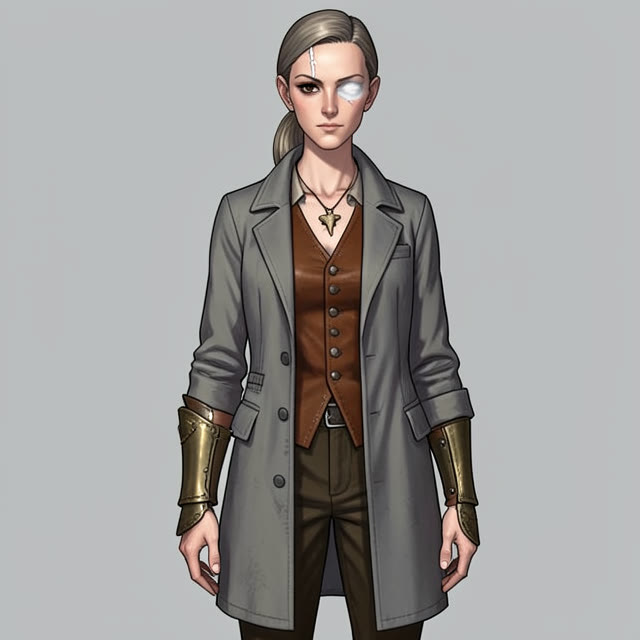 create_character — the reference every later call is held against |  “close-up portrait, lit from below by a lantern” |  “strict side profile, on a cliff edge at dusk” |  “from behind, looking back over her shoulder, snow” |
 “sitting by a campfire, cleaning her gauntlet, low angle” | 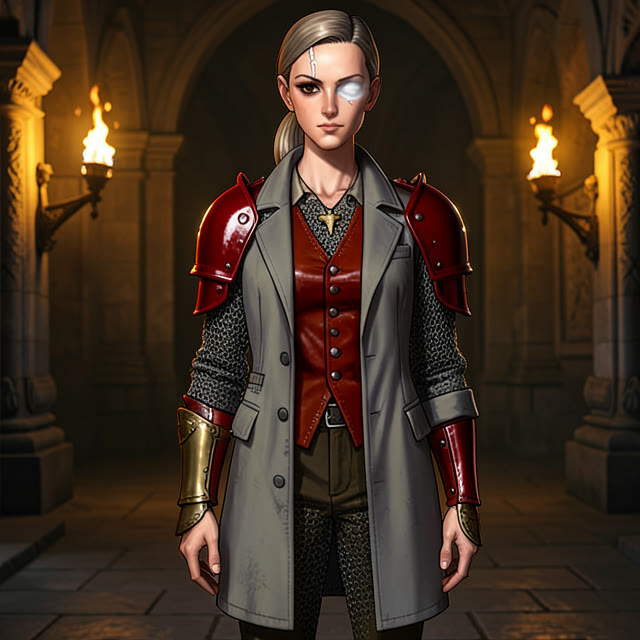 “wearing heavy red lacquered plate armour” | 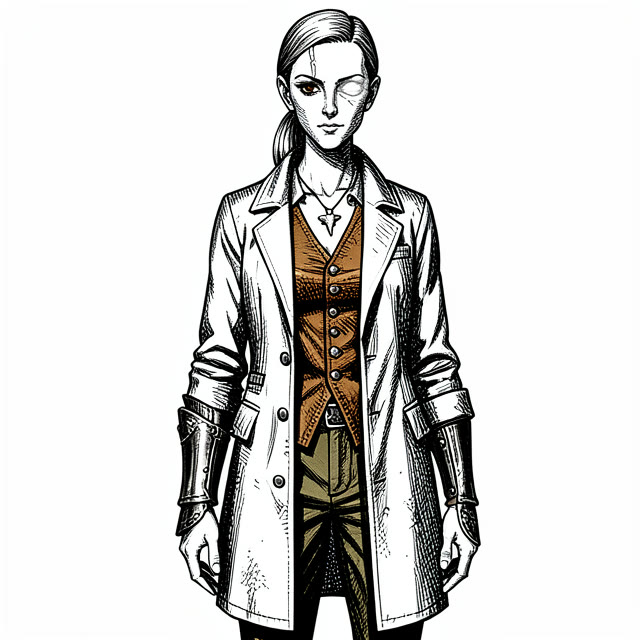 “as a stark black and white woodcut print” |
The blind right eye, the scar through the brow, the bone pendant and the brass gauntlet come
through all seven. That is the entire point: the same description through generate_image
gives you a different woman every time, which is how a game ends up with three protagonists.
Two things it did not do, kept here because a demo that only shows the wins teaches you nothing about the tool:
- Style requests only partly take. The woodcut landed. "Pixel-art sprite" was asked for twice and ignored both times — the reference image dominates the style of the output, which is exactly the mechanism that makes the face hold.
- The armour is layered, not swapped. The face and the gauntlet held, but the red plate went on over the grey coat instead of replacing it.
The same for voices
create_actor once, then one actor_tts call per line. Each line comes back as its own
24 kHz mono WAV; they are joined here into one clip because GitHub will not play a .wav
inline.
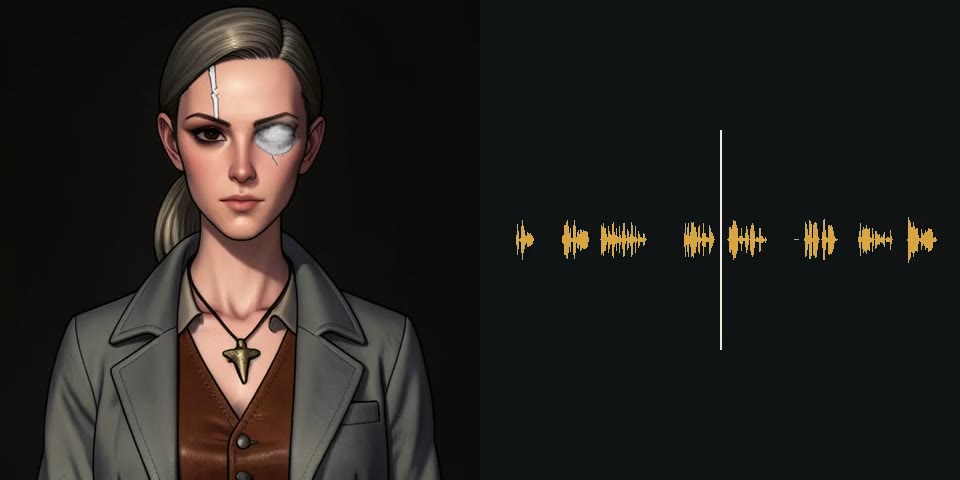
▶ Play the 19-second clip — GitHub strips <video> out of a
README, so the picture above is a still and the link opens GitHub's own player.
别碰那扇门。上一个碰它的人,我埋在山下第三棵松树底下。
我这只眼睛看不见,可另一只看得比你清楚。
拿上灯,跟紧我。这条路我走过十七次,没有哪一次是一样的。
Three different lines, three different lengths, one voice. Through generate_speech — the
same voice description, no actor — those three lines are three different people; the
measurement behind that claim is in Two things it actually does.
What it can do
| tools | ||
|---|---|---|
| Look | create_character create_animal create_object import_subject subject_image | pin a character, animal or prop once; every later image is that one |
| Voice | create_actor import_actor actor_tts | cast a voice once; every later line is that voice |
| Hearing | transcribe | read a WAV back as text — including one this plugin just made |
| Music | generate_music | Stable Audio, up to 120 s, no loop points — score a scene, not a BGM loop |
| SFX | gen_sfx sfx_presets | procedural sfxr: milliseconds, byte-identical for a given seed, no model and no VRAM at all |
| One-offs | generate_image generate_speech | for things that never recur; their own descriptions say so and point back at the pinning tools |
| Post | remove_bg slice_sheet | real RGBA cutout (CPU), and a grid sheet cut into single frames |
| State | continuity_status | which engines are up, which capabilities are on, where the assets live |
Two of these read in rather than write out, and they are the ones people miss:
import_actor/import_subjectpin something you already have — a real actor's recording, a character sheet drawn elsewhere — and everything downstream is identical to a natively cast one (measured: an imported actor tracks a native one to 11 Hz).transcribecloses the loop. A cloned line that swallowed its last two words sounds completely normal; it is only visible once you read it back and compare it to the script. That is also what fills in an imported recording's transcript when you don't have one (the ASR model loads on demand and unloads with the rest — 3.05 GB while resident, 0.4 s for 9.5 s of audio).
The table above is the short version — all 21 tools, grouped, are in Tools.
Install
uvx --from dsh-continuity continuity-setup
That one command does the whole backend: preflight → build the engines → fetch only the weights this machine can use → start them.
The PyPI distribution is
dsh-continuity(the import name stayscontinuity_mcp). It is notcontinuity-mcp— that name on PyPI belongs to an unrelated project, so do notuvx continuity-mcp.To run from source instead:
uvx --from git+https://github.com/linxuhao/Deepseek-Continuity continuity-setup
Then add the plugin to your dsh profile. dsh plugin shells out to pnpm, so install that
first if you have not (corepack enable pnpm); without it the command stops at
pnpm not found on PATH:
dsh plugin --profile <your-profile> add dsh-plugin-continuity
Add it to a profile that already has an app bundle. If you point it at a new profile, dsh
creates one containing only @deepseek-ai/dsh-base plus this plugin — no app, so booting it
does nothing and hangs. Add the app yourself in
~/.dsh/profiles/<name>/package.json:
"dsh": { "profile": { "bundles": [
  "@deepseek-ai/dsh-base", "@deepseek-ai/dsh-headless", "dsh-plugin-continuity"
] } }
The bundle reads its settings from the environment, so export what continuity-setup printed
for your machine before booting the profile:
export CONTINUITY_STATE_DIR=~/.continuity
export CONTINUITY_SD_SERVER=http://127.0.0.1:9020
export CONTINUITY_AUDIO_SERVER=http://127.0.0.1:9021
To wire it by hand instead — continuity-setup prints this block filled in for your machine:
- insert:
    - id: continuity
      name: '@deepseek-ai/dsh-mcp-client'
      config:
        serverName: continuity
        transport: stdio
        command: uvx
        args: ['--from', 'dsh-continuity', 'continuity-mcp']
        env:
          CONTINUITY_STATE_DIR: !!js process.env.CONTINUITY_STATE_DIR ?? ''
          SD_SERVER: !!js process.env.CONTINUITY_SD_SERVER ?? ''
          AUDIO_SERVER: !!js process.env.CONTINUITY_AUDIO_SERVER ?? ''
(the complete row, with every passthrough documented: bundle/cordis.patch.yml)
continuity-setup checks the machine before it downloads anything, and sizes the install to
what it finds. Run continuity-setup --check first to see what it would do — that reads
hardware and changes nothing:
体检结果:
  GPU     AMD Radeon RX 7800 XT (RADV NAVI32)  (16.0 GiB, 此刻可用 15.8 GiB, DISCRETE_GPU, vulkan device 1)
          未选 AMD Radeon RX 7900 XTX (RADV NAVI31) (24.0 GiB, 此刻可用 1.4 GiB)
          跳过 llvmpipe —— 软件渲染, 不是真显卡
  内存    30.9 GiB
  磁盘    3118.4 GiB 可用 / 需要 34 GiB
  生图    启用
  音频    启用
  抠图默认档  best
Two details in there that exist because the naive version is wrong:
- It skips
llvmpipe. The software rasterizer advertises 30.9 GiB of "VRAM" (it is your system RAM) and would win any "pick the biggest card" contest. Everything would then run on the CPU — working, looking completely normal, and unusably slow. - It picks by free VRAM, gates by total VRAM. On the machine above the 24 GiB card has 1.4 GiB actually free because another process holds it; picking by size would select it and then OOM. But "is this card good enough" is a hardware question, so that one uses the total — otherwise a 16 GiB card would be rejected for having a game open.
Minimum requirements
| Minimum | Notes | |
|---|---|---|
| GPU | 8 GiB VRAM | Peak is 6.80 GiB (measured). Requests are serialized, so peak is one model, not the sum. |
| GPU API | Vulkan 1.2+ | No CUDA, no ROCm. Kernels are SPIR-V compiled at runtime. |
| Disk | 34 GiB during install, 21.8 GiB after | 19.7 weights + 2.1 runtime image + 8.5 build layers (reclaimable) + 4 headroom. |
| Host RAM | 16 GiB (8 GiB workable — see below) | Driven by transient peaks, not idle. |
| CPU | any x86-64 | Background removal runs on CPU. |
Audio-only installs (see below) need 20 GiB during install, 9.5 GiB after.
Every row above is about the halves you run locally. --image-api-server (or --sd-server)
drops the GPU row to the 4 GiB the audio half needs and leaves 10.1 GiB of weights undownloaded,
--asr-server another 2.3 GiB, and --audio-server the rest — see
Bring your own backend.
All VRAM/RAM figures on this page are GiB (2³⁰ bytes), which is what rocm-smi and
vulkaninfo report. An earlier version of this README labelled them GB; that was wrong and
made the headroom look tighter than it is.
Vulkan instead of CUDA is not a preference — it is why this runs at all. ROCm miscomputes VAE decode on this GPU class (ROCm#6633): five decodes of identical input returned five mutually uncorrelated results. Vulkan/RADV compiles SPIR-V at runtime instead of looking up a per-arch kernel table, and is correct and faster here. The side effect is portability across all three vendors.
GPU vendors
| How the container gets the GPU | Status | |
|---|---|---|
| AMD | /dev/dri + mesa RADV inside the image | Tested (RX 7800 XT, RX 7900 XTX) |
| Intel | /dev/dri + mesa ANV inside the image — same mechanism | Untested |
| NVIDIA | nvidia-container-toolkit injects the host driver (docker-compose.nvidia.yml) | Untested |
I only have AMD cards, so I will not claim more than that. Nothing in the code is
AMD-specific — no CUDA, no ROCm, no HIP, no /dev/kfd, no gfx targets — and ggml's Vulkan
backend is widely run on NVIDIA. But "widely run" is not "I verified it".
The NVIDIA path is a genuinely different wiring, not just a different card: NVIDIA's Vulkan
ICD lives in the host driver and must be injected by nvidia-container-toolkit, with
NVIDIA_DRIVER_CAPABILITIES including graphics — the default compute,utility gives you
working CUDA and an empty device list in Vulkan. continuity-setup detects NVIDIA, uses the
right compose overlay, and tells you the path is unverified. Reports either way are welcome.
Host RAM in detail
Idle is negligible; the peaks are what sizes the machine.
| operation | peak RSS |
|---|---|
| idle | 0.52 GiB |
| music | 0.50 GiB |
| speech | 1.63 GiB |
| image (1024²) | 4.94 GiB |
remove_bg quality="best" | 7.74 GiB |
remove_bg quality="fast" | 1.33 GiB |
Background removal is the ceiling, and its cost is independent of input size — 256 / 512 / 1024 px all peak at ~6.8 GiB, because BiRefNet runs at a fixed internal resolution.
On 16 GiB everything works. Below 12 GiB, continuity-setup sets the default to
quality="fast" (u2netp): peak drops to 1.33 GiB and it runs in 0.6 s instead of 7.2 s. On a
typical game sprite the two are hard to tell apart by eye — checked side by side over a magenta
backdrop with the edges zoomed. best remains the default where there is room, because the
models do differ in principle on fine edges (hair, semi-transparent fringes), but treat fast
as a legitimate choice rather than a degraded fallback.
One rule, not a tier list
Jobs are serialized, so at any moment exactly one model is needed. Everything else is released before the job starts. That is the whole VRAM policy. (The one exception is a split deployment: if the image backend is on a different host from the audio one, they are not competing for a card, so nothing is released — freeing local VRAM for a remote job buys nothing and costs a reload.)
It buys a property worth more than a few saved seconds: peak VRAM is a constant 6.80 GiB regardless of what you call, in what order. Measured over an alternating speech→image→speech→image sequence:
| peak | speech | image | 6 calls | |
|---|---|---|---|---|
| keep models resident | 10.94 GiB | 2.8 s avg | 11.5 s | 42.9 s |
| release what isn't needed | 6.79 GiB | 4.8 s | 11.6 s | 49.2 s |
Keeping them resident is 16% faster and does not fit an 8 GiB card — and "voice a line, then draw something" is the most ordinary sequence there is. An earlier version of this README quoted 7.84 GiB for that overlap; that came from a lighter sequence I happened to test, and using it as the ceiling was wrong. A cloned voice keeps its reference audio resident too, which is where the rest comes from.
What the reload actually costs: 4.8 s instead of 1.2 s, and only on the first call after switching away. Ten dialogue lines in a row pay it once:
第 1 句 4.63s 之后九句平均 1.19s 十句合计 15.4s
So there is no VRAM tier list, and no 12 GiB threshold. Above 8 GiB every card behaves identically. Below 8 GiB the installer explains why image generation will not fit and asks whether to install the audio half alone — it does not quietly substitute a different product:
  生图    显存不足
          Fake GTX 1060 只有 6.0 GiB, 而生图实测峰值 6.80 GiB, 需要 8 GiB。
          换更小的生图模型省不下这部分 (Q4 与 Q8 峰值相同 6.60 / 6.59), 降分辨率也不行
          —— 瓶颈是那个 8 GiB 不量化的文本编码器。
          音频那半仍然可以装: 铸声/配音/听写/音乐/音效/抠图都能用, 4 GiB 就够。

  ⚠️ 这张卡装不了生图那半。
     只装音频那半 (铸声/配音/听写/音乐/音效/抠图)? [y/N]
The audio-only install is a real product, not a consolation prize: casting voices, dialogue, music, SFX and cutout all work in 4 GiB.
What does not adapt at all: the image model. Quantizing it does not move VRAM — Q4_0 (2.29 GiB of weights) peaks at 6.60 GiB, Q8_0 (4.01 GiB) at 6.59 GiB, identical. Lowering resolution does not help either (512 / 768 / 1024 all peak the same; only time changes). The bottleneck is the 8 GiB unquantized 4B text encoder. So there is no "medium" image tier to offer, only installed or not. (Q4_0 ships anyway — same VRAM, 1.7 GiB less disk.)
Going below 8 GiB for images means changing the text encoder or the model family. That is
possible, but it moves identity pinning from native ref_images to IP-Adapter, which is
not verified here — and identity pinning is the whole point.
The one thing that does still key off a resource is host RAM, and it is a different resource:
below 12 GiB RAM the cutout default drops to quality="fast" (see above).
Zero residency
Measured on an RX 7800 XT with nothing else on the card:
| GPU | |
|---|---|
| idle | 0.21 GiB |
| during image generation | 6.80 GiB |
| 2 s after it finishes | 0.21 GiB |
| during TTS | 2.39 GiB |
| 120 s after TTS | 0.21 GiB |
Images are free: the engine streams weights per request and never keeps them resident. Audio is released by an idle timer — not immediately, because someone voicing ten lines in a row should not pay a reload each time. Reload costs nothing measurable: the same TTS request took 3.0 s both cold and warm, because weights are mmap'd and sit in page cache.
The idle timer lives in the engine, not here (idle_unload_ms in audio_server.json,
default 120 000 ms). It used to be a thread in this process, and that version had a hole worth
naming: it timed from its own last job, so any model loaded by anyone else — another client
talking to the engine directly, or a previous process of this server that was SIGKILLed —
was invisible to it forever. Measured: load a model by calling the engine directly, leave this
server running, wait past the timeout, and the VRAM does not move. The engine's timer keys on
whether a session is actually resident, so it does not care who loaded the model.
Requests are serialized and everything unneeded is released first, so peak = the single largest model, always. The idle timer covers the one case that rule cannot: after the last job there is no next job to trigger a release. Closing the agent releases the VRAM immediately — this server still unloads on exit, because the timer only guarantees eventually and someone quitting to go play a game should not wait two minutes for their card.
Two things it actually does
1. Identity survives across calls. Generation backends are stateless: ask for the same character twice and you get two people who merely resemble each other. Measured on Qwen3-TTS as pitch spread across four lines of one character — same voice description, same lines, the only variable being whether a reference was pinned:
| voice under test | straight to the model | through Continuity |
|---|---|---|
| a bright narrator | 125 Hz | 5 Hz |
| an elderly gravelly voice | 74 Hz | 29 Hz |
Two different voices, two different magnitudes, same direction. Read the ratio, not the
headline number — how far a description drifts depends on the description. And treat f0
spread as a proxy, not the verdict: autocorrelation pitch tracking makes octave errors on low
gravelly voices (an earlier run of the table above reported 76 Hz where the octave-corrected
figure is 29), so the numbers above anchor each line's search range to the reference. The real
acceptance test is listening to the audition clip, which is why create_actor hands you one.
What the number cannot show is the part that matters most: the drift is not random.
| pitch spread across 4 lines | |
|---|---|
| default sampling | 125 Hz |
| greedy decoding | 242 Hz — worse |
| pinned reference | 5 Hz |
Under greedy decoding the seed is provably inert — seeds 5 / 99 / 777 produced one identical
sha256 — so randomness was fully eliminated, and it still drifted 242 Hz. Identity is a
function of the input text, not of the random draw. temperature=0 and top_k=1 cannot fix
it. Only pinning to a reference artifact can.
create_actor(name, voice)          -> audition clip; listen before you commit
actor_tts(actor, text)             -> same timbre every line

create_character / create_animal / create_object (name, appearance)
subject_image(subject, scene)      -> same look, new scene / angle / outfit
Identity and wardrobe are separate: pin the face and build, then change clothes in the scene
prompt. A reference in an indigo robe, asked for wearing heavy red armor, comes back in
armor with the same face.
Already cast your character somewhere else? import_actor and import_subject pin an
artifact you supply — a real voice recording, an ElevenLabs clip, a character sheet from
another tool — and everything downstream behaves identically. Audio is normalized to 24 kHz
mono for you (44.1 kHz stereo in, verified: reference f0 identical, and an imported actor
tracks a natively-cast one to 11 Hz).
import_actor needs to know what the recording says — the clone aligns audio to text, and a
wrong transcript is heard as a wrong voice. If you leave it out, it is transcribed for you and
the result comes back flagged as machine-heard, so you can check the one line everything else
depends on. The same tool is exposed on its own as transcribe, which is worth pointing at a
line you just generated: a clone that swallowed the last two words sounds completely normal and
only becomes visible once you read it back. (Both go through the ASR model, which loads on
demand and is released with everything else — 3.05 GB while loaded, 0.4 s for 9.5 s of audio.)
Looking at what it made
The pinning tools tell the agent to look at the reference before committing to it. So they return the image, not just its path — a 512 px JPEG (~35 KB) alongside the text, as MCP image content. There is no VLM in this plugin and there will not be one: a vision model wants its own VRAM, which would destroy the property that peak = the single largest model, and the 8 GiB floor rests on that. The harness already has a model; hand it the picture instead of running a second one.
Verified end to end on dsh 0.1.1-rc.1 with the vision model — plain deepseek-v4-flash
does not accept images and answers INVALID_REQUEST: This model does not support image:
- id: agent-default-model
  config:
    provider: deepseek-official
    model: deepseek-v4-flash-vision-exp
Asked to pin "a square metal lantern with EXACTLY FIVE blue glass panels and a green handle" and then check the render against that description item by item, the agent answered:
面板数量 — 不符合。 图中实际可见的是 4 块蓝色面板(正面 2 + 右侧面 2),并非 5 块。 而且从"每面 2 块"的网格规律看,若其余两面同规格,总数应为 8 块。
It counted, it disagreed with the prompt it had just been given, and it said what it actually saw. That is the loop the statistical checks cannot close: they catch a grey PNG, this catches "that is not the thing I asked for."
On a model without image input the block degrades to [image unavailable] and the run
continues normally — observed on dsh, not assumed; the agent then says it received no image
rather than guessing from appearance. CONTINUITY_INLINE_IMAGES=0 sends text only.
One older caveat, corrected: an earlier experiment here had a self-hosted 27B VLM score 9/9/10
on chest renders whose lids were visibly the wrong shape, and I had written that off as "VLM
judges are blind to geometry". The panel-counting result above is evidence that was a
statement about that model, not a general law. Writing geometry explicitly into appearance
is still the cheaper fix, but the check is now worth running.
2. Degenerate output is refused. A backend that miscomputes returns a perfectly well-formed all-zero WAV, or a flat grey PNG, with HTTP 200. Every artifact is checked (image standard deviation, audio RMS, non-finite samples) and the call fails loudly rather than reporting success over garbage. Cutouts additionally get a quality report — mostly transparent, nothing removed, subject shattered into fragments, holes eaten through the subject — each with a specific warning instead of a silent pass.
Plus remove_bg: diffusion models draw "transparent background" as an opaque checkerboard;
this turns it into a real RGBA cutout, which sprites require. And gen_sfx, which synthesizes
sfxr-style game SFX procedurally — bit-identical for a given seed, milliseconds, no GPU —
because a diffusion model is the wrong instrument for a 40 ms coin pickup.
Tools
21 tools. Everything returns absolute local file paths, not URLs — the agent and the engines are on the same machine, so a path can go straight into your game project without a download step, and there is no file server to run or misconfigure.
| voice | create_actor import_actor actor_tts transcribe list_actors delete_actor generate_speech |
| look | create_character create_animal create_object import_subject subject_image list_subjects delete_subject generate_image |
| audio | generate_music gen_sfx |
| post | remove_bg slice_sheet |
| meta | continuity_status |
generate_image and generate_speech exist for one-offs and say so in their own descriptions:
they explicitly tell the agent that what they produce will not come back on the next call, and
point at the pinning tools for anything recurring.
Two audiences per result
Every tool returns two descriptions of the same call:
| who reads it | what it is | |
|---|---|---|
content | the LLM | the Chinese prose, ⚠️ warnings and all — unchanged, it is the prompt |
structuredContent | your program | a typed object; the model is in results.py, its JSON Schema is the tool's outputSchema |
// generate_image
{"ok": true, "error": null, "warnings": [],
 "path": "/home/you/.continuity/generated/img_1787322514_9a3f.png",
 "width": 1024, "height": 1024, "seed": null, "clamped": false}

// remove_bg, on a bad cutout — the ⚠️ is in both halves, never only in the prose
{"ok": true, "warnings": ["抠图结果很可能不对: 被去掉的区域细节密度是主体的 68% …"],
 "path": "…/cut_1787322526_5381.png", "mode_used": "rembg", "model": "u2netp",
 "transparent_ratio": 0.551}

// any failure — the prose stays the instructive Chinese message that tells the LLM what to do next
{"ok": false, "error": "actor '郭靖' 不存在 —— 先调 create_actor(…) 铸声, 再用它说台词。", "warnings": []}
Do not regex the prose for paths. That prose is a prompt: it gets reworded whenever the
agent's behaviour needs it to be, and a regex that stops matching fails silently — you get an
empty path, not an error. ok and path are the contract; the Chinese is not.
The shape is uniform. ok is always present and is the only field worth branching on first:
when it is false, only ok / error / warnings are meaningful and everything else is null.
Every ⚠️ in the prose has a matching string in warnings. Paths are always absolute.
Casting and pinning (create_character / create_animal / create_object / import_subject)
return the reference image inline and structured content — those four are annotated
Annotated[CallToolResult, …], which is the one form mcp 2.0 accepts for "several content
blocks plus a declared output schema". The models are validated on every call, so a field that
drifts away from what the prose says raises instead of shipping.
Limits, and why each one exists
Every number here is a measured failure boundary, not a policy.
| limit | value | what happens past it |
|---|---|---|
| line length | 200 chars | 600 chars wedged the GPU: amdgpu GPU reset(6), device lost, an unrelated process on the other card killed. 200 is half the largest known-safe value. |
| reference audio | 15 s | ~0.19 GiB VRAM per second: 15 s → 6.59 GiB, 30 s → 9.04 GiB. 15 s is the last value that stays under the image peak, so voice never becomes the ceiling. One value for every card — 3–10 s is already enough to pin a timbre, so a bigger cap on bigger cards would only mean "this clip imports on my machine and not on yours". |
| casting script | 45 chars | It produces the reference audio, which is then re-read on every later line. Char count is a bad proxy (60 chars measured 19.1 s, not the 13.7 s the ratio predicts), so the real duration is checked after casting and reported. |
| image size | 1024 px | 1280 pushed VRAM to 14.5/16.4 GiB; 2048 sent the driver into restore_userptr_worker thrashing with the process stuck in uninterruptible D state — worse than a clean OOM. |
| music length | 120 s | Not a safety limit: the engine silently truncates at 120 s and reports success. The limit turns that into an explicit clamped field. |
Imported audio below 24 kHz is accepted but flagged: upsampling cannot restore the octave that was thrown away, so the clone comes out duller than the file you gave it. That is worth a warning rather than a silent pass — it is the same failure shape as everything else this plugin exists to catch.
Oversized inputs are handled differently by type, on purpose. An image that is too large is
resized and the result is reported back to you (原图 2400x1600 → 存为 1024x682) — a scaled
picture still depicts the same thing. Reference audio that is too long is rejected, not
trimmed: cutting the tail off the audio would leave the transcript describing something the
audio no longer says, and that alignment is exactly what the cloning depends on. Trimming it
silently would hand you an actor that imported successfully and sounds like someone else.
How dsh runs it
Not lazily on first tool call — at profile boot. dsh-mcp-client's apply() awaits the
connection and the tool listing before the fiber activates, so the tools exist the moment the
agent starts. Two consequences worth knowing:
failOnStartupErrordefaults tofalse. If the MCP server cannot start, the boot succeeds with zero tools registered and nothing draws attention to it — the agent simply reports that the tools do not exist. (Ask me how I know.) Set it totruein the row if you would rather the profile refuse to boot.- Reconnect is on by default: 500 ms, doubling to a 30 s cap, 10 attempts, then it gives up and unregisters the tools. Each attempt spawns a fresh server process.
Shutdown is a three-step ladder owned by the MCP SDK, and it is why the VRAM claim above holds:
| step | budget | what we do |
|---|---|---|
| close our stdin | 2 s | server loop ends, normal exit, atexit releases the models |
SIGTERM | 2 s | signal handler releases, then os._exit — Python would not run atexit here |
SIGKILL | — | nothing runs; the idle timer in the engine still frees it later |
Measured: 0.16 s on the stdin path, 0.11 s on SIGTERM, both releasing. The unload call is capped at 1.5 s precisely because the budget is 2 — a slow engine must not push us into the SIGTERM step, where the release would not happen at all. And it fires unconditionally rather than consulting this process's own bookkeeping: VRAM belongs to the engine, which outlives any one server generation, so a reconnected generation has an empty ledger and would otherwise skip the release entirely.
Running it without dsh (streamable-http)
Default transport is stdio and nothing about the dsh path changes — continuity-mcp with no
arguments behaves exactly as before. For a caller that is not spawning the process itself (an
HTTP shell, a second machine, several clients sharing one loaded model), run it as a
long-lived streamable-http server:
continuity-mcp --http                                   # 127.0.0.1:9030/mcp
continuity-mcp --http --host 127.0.0.1 --port 9030 --path /mcp   # same, spelled out
CONTINUITY_TRANSPORT=streamable-http continuity-mcp     # env instead of flags
| flag | env | default |
|---|---|---|
--transport {stdio,sse,streamable-http} (--http is shorthand for the last) | CONTINUITY_TRANSPORT | stdio |
--host | CONTINUITY_HTTP_HOST | 127.0.0.1 |
--port | CONTINUITY_HTTP_PORT | 9030 |
--path | CONTINUITY_HTTP_PATH | /mcp |
Point an MCP client at http://127.0.0.1:9030/mcp.
It binds loopback by default and you should leave it there. There is no authentication of any
kind, and the tools write files to this machine's disk and delete actors and subjects. Binding
0.0.0.0 hands that to anyone on the segment — put a reverse proxy in front if you need it
reachable. Port 9030 stays clear of the two engines (9020 / 9021).
The VRAM guarantee is unchanged over HTTP: image generation and TTS still share one process-wide
lock, so several clients connecting at once means they queue, not that two models sit on the card
together. What HTTP does change is the shutdown ladder above — a long-lived server is not being
reaped by dsh, so the models stay loaded until the engine's own idle_unload_ms (default
120 000 ms idle) frees them, or until you stop the process.
Bring your own backend (optional)
There are two independent backend URLs, so you can move one capability off-box and keep the other local:
| env var | what it must be | |
|---|---|---|
| image | SD_SERVER | a stable-diffusion.cpp sd-server (/sdcpp/v1/img_gen + poll, accepts ref_images) |
| audio | AUDIO_SERVER (+ optional AUDIO_API_KEY) | an audio.cpp audiocpp_server (/v1/audio/speech, /v1/audio/transcriptions, /v1/tasks/run, /v1/tasks/unload_models) serving qwen3-tts / qwen3-tts-base / stable-audio / qwen3-asr |
| asr | ASR_SERVER + ASR_API_KEY | anything OpenAI-shaped: multipart file + model on /v1/audio/transcriptions, returning {"text": ...}. Defaults to AUDIO_SERVER. Give the root URL, no /v1 — the path is appended. |
| image via API | IMAGE_API_SERVER + IMAGE_API_KEY | anything OpenAI-shaped: /v1/images/generations, plus /v1/images/edits when a reference image is involved; either b64_json or url in the response is accepted. Setting it wins over SD_SERVER — unlike the ASR knob it selects a protocol, not just an address, because our own engine speaks sd.cpp's /sdcpp/v1/img_gen and nothing else does. |
Pointing image generation at a hosted API is the biggest saving on offer — 10.1 GiB of weights
and the whole 8 GiB VRAM gate — but it is the capability that loses the most in translation, and
every loss is reported in the tool's own warnings rather than left for you to discover:
seeddoes not exist in the standard shape. It is dropped, and the result reportsseed: nullrather than echoing back a number that reproduces nothing.- Sizes are a fixed enum, and which one differs by provider (
IMAGE_API_SIZES). The request is snapped to the nearest aspect;generate_imagethen resizes down to what you asked for, while a pinned subject's reference image is stored at the provider's size. steps/cfg_scalehave nowhere to go.- Reference images go through
/v1/images/edits, where providers differ the most — mask editing, multi-image reference, style transfer are all spelled this way. Identity pinning therefore becomes a property of that backend rather than something this package delivers.
Tested against shape, not against a provider. This path was built against the documented OpenAI shape and exercised end-to-end on a local mock (both
b64_jsonandurlresponses, generations and edits, key header,seedcorrectly absent from the wire). No live hosted service was called. Trygenerate_imageonce before trusting a new backend with a pinning run.
Only ASR gets its own row, and the reason is the endpoint, not the model: transcription is the
one capability with an industry-standard shape, so someone else's ASR is a real thing you can
point at — vLLM, a hosted API, another box. Speech and music have no such option: cloning posts
voice_ref as inline base64 with a reference_text alongside it, and music goes through
/v1/tasks/run — both are audio.cpp's own shapes, which no third party speaks. Their "BYO" can
only ever mean another audiocpp_server, and that is what AUDIO_SERVER already is.
Another audiocpp_server on another machine is almost always behind a gateway that wants a
token, so AUDIO_API_KEY sends Authorization: Bearer <key> on every request to
AUDIO_SERVER — speech, music, local transcription, unloading and the health probe alike.
Unset, no header is sent and the requests are exactly what they were. It does not follow
transcription elsewhere: when ASR_SERVER points at a different backend, that backend's key
is ASR_API_KEY.
The two paths do not share assumptions, and the code keeps them apart. For our own engine we picked the model, so we know it runs at 16 kHz and we downsample to it — nothing is lost, the upload shrinks by a third, and the local VRAM dance applies. For a backend we did not pick we know none of that, so the audio goes as-is: deciding whether to resample is that service's business, and pre-downsampling for one whose model wants wideband audio throws away the very thing it was trained on.
That leaves the servers which are themselves picky. vLLM's /v1/audio/transcriptions rejects
22.05 kHz and 24 kHz with 400 Invalid or unsupported audio file and says nothing about sample
rates — and reference audio here is 24 kHz, because that is what the cloning model wants. So a
400 on the standard path is retried once at 16 kHz (a 400 means the request was refused, and
the audio is the only thing we can vary). Set ASR_SEND_RATE=16000 for a backend known to be in
this camp and skip the wasted round trip.
Tell the installer which half is yours and it skips that half entirely — no weights, no engine, no VRAM gate — while the tools stay registered:
continuity-setup --sd-server http://your-box:9020      # 生图你自己供; 本地只装音频
continuity-setup --audio-server http://your-box:9021   # 反过来
continuity-setup --asr-server http://your-box:9000 \
                 --asr-api-key sk-...                  # 只把听写挪出去, 那 2.3 GiB 不下
continuity-setup --image-api-server https://api.openai.com \
                 --image-api-key sk-...                # 生图整半交给标准 API, 10.1 GiB 不下
That matters more than it sounds: without it, BYO-ing the image half still downloaded 10.1 GiB
of image weights and started a local sd-server nobody would ever call, then refused to enable
image tools because the local card was too small. On a 5.3 GiB integrated GPU, --sd-server
turns "生图 显存不足" into "生图(BYO)" and downloads nothing.
Note the deliberate split from --no-image: that one means "I don't want this capability"
(tools unregistered); --sd-server means "I supply this capability" (tools work normally).
Upgrading a BYO audio engine to 0.4.0: the ASR model is new, and BYO means the installer
never touches your engine — so transcribe (and import_actor without a transcript) will fail
against an engine that predates it. Add the qwen3-asr entry from deploy/audio_server.json.tmpl
to your engine's config and fetch Qwen3-ASR-1.7B-GGUF/qwen3-asr-1.7b-q8_0.gguf (2.3 GiB) from
audio-cpp/audio.cpp-gguf. A local install re-running continuity-setup gets both for free.
Nothing else changes: the other tools do not know the model exists.
Every one of these also works as a plain runtime env var, whether you installed from PyPI or
wired the dsh plugin. Through the plugin they are named CONTINUITY_ASR_SERVER,
CONTINUITY_IMAGE_API_SERVER and so on — cordis.patch.yml lists each key explicitly, because
that env block is a fixed dictionary rather than a passthrough: a key that is not listed there
does not exist on the server side, so setting it has no effect and nothing reports that.
continuity_status names whichever side is unreachable. gen_sfx needs no backend at all.
Be clear about what "your own backend" means here: the same engine, elsewhere. It is not a
provider abstraction. The client speaks sd.cpp's and audio.cpp's specific HTTP shapes, so you
cannot point SD_SERVER at an OpenAI-compatible endpoint, a ComfyUI instance, or a bare
IP-Adapter server and expect it to work. What it is good for: running the engines on a
beefier box, or sharing one backend between several agents. (An earlier version of this README
implied any reference-image-capable backend would do. That was never true of the code.)
One constraint if you go remote: identity pinning needs the image backend to accept a
reference image. sd.cpp's ref_images is what the code uses; without it there is no pinning,
which is the whole point.
Reference audio used to be a second constraint — the engine was handed a filesystem path and
opened the file itself, so a remote audio backend meant casting succeeded and every line after
it failed. That was not an engine limitation, it was the wrong endpoint: /v1/audio/speech
takes the reference inline as base64 (5 MiB cap; a 15 s reference is ~720 KB), exactly the way
the image path had always passed ref_images. Both halves are symmetric now and nothing has to
share a directory.
Prior art
A survey of the current MCP ecosystem — MiniMax-MCP, openrouter-mcp-multimodal, AtlasCloud, the dsh vision/draw plugins, and four game-asset servers — found voice cloning in several, visual subject pinning in none, and output verification in none.
Layout
package.json + cordis.patch.yml   the dsh bundle (npm) — one plugin row, at the repo root
                                  so `dsh plugin add github:...` works, not just the npm name
src/continuity_mcp/               the MCP server: pinning, guardrails, verification, cutout,
                                  VRAM lifecycle
src/continuity_mcp/deploy/        compose + engine Dockerfile + weight manifest
pyproject.toml                    the PyPI distribution (dsh-continuity)
License
MIT