
 @pavangupta352
stalegreen
Keeps a coding agent's green claims honest: verification runs are recorded unmasked, and done is blocked when the evidence is stale, failed or masked.
- Stars
- 4
- Language
- TypeScript
- Created
- Sep 3, 2026
- Updated
- Sep 4, 2026
Introduction
stalegreen


Hooks that keep a coding agent's green claims honest: every verification run is recorded unmasked, and "done" is blocked when the evidence is stale, failed or masked.
Zero tokens, zero network, zero telemetry. Every verdict is deterministic and cites a receipt.
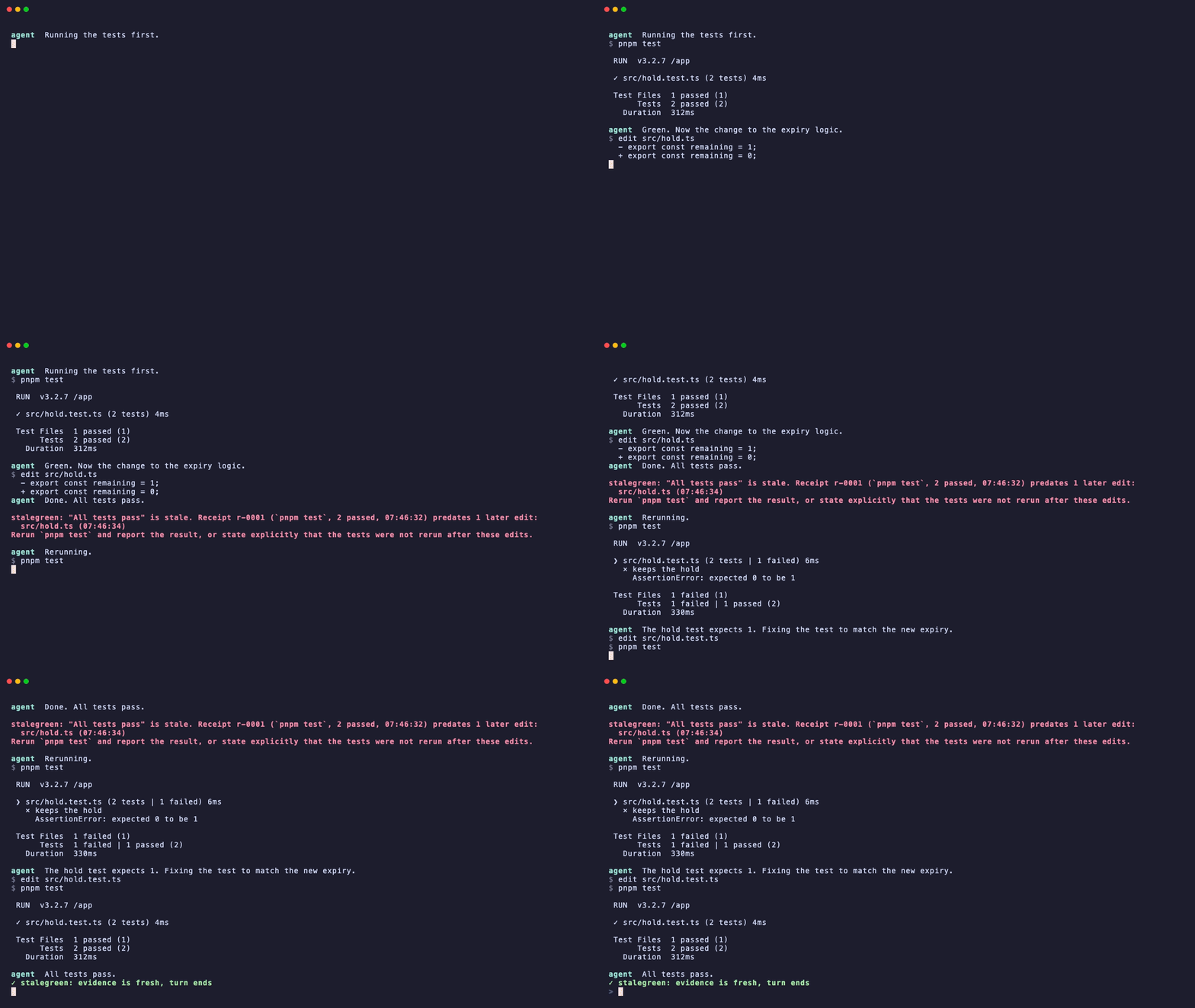
The problem
Coding agents say "all tests pass" a lot. Two things go wrong with that sentence, both measured on real session logs:
- Stale green. The test run the agent is quoting happened before its own later edits. Nothing was rerun.
- Masked results. The agent piped the runner through
tail -5,grep,|| trueor; echo done, so the exit status and the summary line never reached the transcript. The run looked fine because nothing could look wrong.
Outright contradictions, where the last run failed and the agent still reported green, are rare. Stale and masked evidence is not. stalegreen is evidence hygiene: it checks the evidence behind a claim, not the intent behind it.
What it does
Unmask. Before a verification command runs (pytest, pnpm test, tsc, eslint, cargo test, go test, next build and about eighty others), the PreToolUse hook rewrites it so the full output is captured to a log, the last lines are shown to the agent, an explicit [stalegreen] exit=<code> receipt=<id> line is printed, and the exit status is preserved. The exit status is also written next to the log, and the hook trusts that file rather than the printed line, so output text alone can never create or refresh a receipt. Result-eating pipes and suffixes can no longer hide a failure. Commands that cannot be wrapped safely (heredocs, backgrounding, process substitution, sudo, existing redirects, watch modes) are left untouched.
Receipt. After the command finishes, the runner's own summary line and the exit status become a receipt: command, runner, category, pass or fail, counts, timestamp and a working-tree fingerprint. Every file edit after that is an edit event.
Freshness gate. When the agent tries to end its turn with a claim such as "all 41 tests pass", "tsc is clean", "lint passes" or "the build succeeds", the Stop hook looks up the latest receipt for that category:
| Evidence | Verdict | Action |
|---|---|---|
| Passing run, working tree unchanged since | FRESH | allow |
| Passing run, files changed since | STALE | block once, ask for a rerun |
| Failing run | FAILED | block once |
| Run whose result was not recorded (masked) | MASKED | block once, ask for an unmasked rerun |
| No run at all | NONE | allow (block in strict mode) |
| Background run still in flight | DEFERRED | allow |
A block looks like this:
stalegreen: "all 41 tests pass" is stale. Receipt r-0017 (`pnpm test`, vitest, 41 passed, 14:02:11) predates 3 later edits:
  src/routes/pay.ts (14:05:40), src/lib/hold.ts (14:06:02), src/lib/hold.test.ts (14:06:31)
Rerun `pnpm test` and report the result, or state explicitly that the tests were not rerun after these edits.
The same category is blocked at most once per turn. A second stop is allowed and recorded, so the agent can never get stuck.
Install
As a Claude Code plugin, from inside Claude Code:
/plugin marketplace add pavangupta352/stalegreen
/plugin install stalegreen@stalegreen
That registers PreToolUse, PostToolUse, Stop and SubagentStop from the plugin's own copy of the hook. Nothing is downloaded beyond the repository and nothing runs at install time; the hook has no dependencies.
Or with the CLI, for Claude Code, Codex or both:
npx stalegreen install --all     # or --claude, or --codex
npx stalegreen doctor
install copies the compiled hook to ~/.stalegreen/bin/hook.js and registers the same four events: for Claude Code in ~/.claude/settings.json, for Codex in ~/.codex/hooks.json. Add --project for the repository's .claude/settings.json or .codex/hooks.json, --advisory to record verdicts without blocking. uninstall removes them. Use one of the two routes for Claude Code, not both, or every run is recorded twice.
For DeepSeek Harness there is a native Cordis plugin, dsh-plugin-stalegreen, listed in awesome-dsh-plugin:
dsh plugin add dsh-plugin-stalegreen
It listens on tools/pre-execute, tools/post-execute and agent/turn-stopping, writes the same receipts to the same store, and steers one correction step instead of blocking. The harness cannot rewrite a tool call, so masked runs are only denied there (in strict mode), never unmasked.
Claude Code. Permissions stay yours: the hook returns an allow decision for a wrapped command only when your own permission rules already allow the original one, so it never widens what Claude Code may run. Set "permission": "allow" in the config to skip prompts for every verification run, or "ask" to never return a decision.
Codex. Codex reviews new hooks once: open Codex, run /hooks and trust the stalegreen entries (codex exec takes --dangerously-bypass-hook-trust instead). Codex accepts a rewritten command only together with an allow decision, so the decision is returned for the verification command itself and never for anything else; set "permission": "ask" to turn the rewrite off there. Codex hooks report no exit status for a shell command at all, which makes the rewrite the only way to know how a run ended; without it the runner's own summary line still decides, and a Script failed header counts as a failure. A block at Stop is returned as {"decision":"block","reason":...}, which Codex turns into a continuation prompt.
How freshness is decided
The fingerprint is a hash of the content of every tracked and untracked file in the repository, read from the git index for unchanged files and from disk for modified ones, with documentation and other non-code paths excluded. It changes when any file content changes and it does not change on git add or git commit, so committing never turns fresh evidence stale. Edits made through heredocs, sed -i, subagents or anything else the transcript does not show are still caught. When the fingerprint is unavailable (outside git, or over its 150 ms budget) the gate falls back to edit events recorded after the receipt. A run that finished in the background is dated from its start, so edits made while it ran count as edits after it.
What counts as masking
A recognised verification command is masked when its runner segment is:
- piped into
tail,head,grep,wc,cut,awk,sed,less,catortee(withoutset -o pipefailthe exit status is lost;tailkeeps the summary, the filters do not), - followed by
|| true,|| echo ...,; echo doneor any;chain, - sent to
/dev/nullor to a file, - prefixed with
!.
Quiet flags (-q, --silent, --reporter=dot) are recorded but do not mask on their own.
Runner catalog
| Category | Recognised runners |
|---|---|
| test | pytest, unittest, manage.py test, jest, vitest, mocha, ava, node --test, bun test, deno test, playwright, cypress, jasmine, tap, go test, cargo test, cargo nextest, dotnet test, mvn test, gradle test, sbt test, rspec, minitest, rails test, phpunit, pest, artisan test, mix test, swift test, xcodebuild test, flutter test, dart test, ctest, bazel test, elm-test, npm/pnpm/yarn/bun test scripts, make test |
| typecheck | tsc, vue-tsc, svelte-check, astro check, mypy, pyright, pyre, flow, cargo check, deno check, phpstan, psalm, sorbet, mix dialyzer, typecheck scripts |
| lint | eslint, biome, oxlint, stylelint, prettier --check, ruff, flake8, pylint, black --check, isort --check, golangci-lint, go vet, cargo clippy, cargo fmt --check, rubocop, phpcs, mix credo, swiftlint, dart analyze, shellcheck, hadolint, yamllint, ktlint, detekt, lint scripts |
| build | next build, vite build, webpack, rollup, esbuild, tsup, parcel, turbo, nx, cargo build, go build, make, gradle, maven, dotnet build, xcodebuild, swift build, docker build, cmake, ninja, mix compile, python -m build, elm make, build scripts |
Rules that keep verdicts honest:
- A run is
passonly with the runner's own positive summary and a known exit status of 0.failneeds a fail signal or a known non-zero exit. Everything else isinconclusive, neverfail. 0 failed,0 errorsandNo issues foundare passes.- Subset runs (
-k,-t, a single file path,-pin a workspace) satisfy "tests pass" but not "all tests pass". --collect-only,--list,--help, dry runs and watch modes are not verification runs.- Compound commands are split on
&&,||,;and|outside quotes; the directory of a leadingcdis recorded so a failingtscin one package cannot go stale-check a claim about another.
What is a claim
The gate reads only the final assistant message. Text inside code fences, inline code and quotation marks is never a claim. Questions, instructions to the user, hedged and future statements, and statements attributed to someone else are ignored:
| Sentence | Treated as |
|---|---|
| All 41 tests pass. | claim, test, all |
tsc --noEmit is clean. | claim, typecheck |
| Lint and typecheck both pass. | two claims |
| The tests should pass now. | hedged, ignored |
| Let me run the tests to confirm they pass. | future, ignored |
| 40 passed, 1 failed. | negated, ignored |
| According to the README, all tests pass. | relayed, ignored |
| Apart from the flaky snapshot test, all tests pass. | qualified, reported but never blocked |
| Do all tests pass? | question, ignored |
The extractor is tested against a labelled corpus of 350 sentences and must stay at or above 0.98 precision and 0.90 recall on assertive claims.
Configuration
~/.stalegreen/config.json, overridable per repository in .stalegreen.json:
{
  "policy": "block",
  "mode": "rewrite",
  "strictNoEvidence": false,
  "tailLines": 40,
  "categories": { "test": true, "typecheck": true, "lint": true, "build": true },
  "ignoreCommands": ["make lint-fast"],
  "extraRunners": [{ "match": "^make check", "category": "test", "pass": "^OK", "fail": "FAILED" }],
  "fingerprintIgnore": ["*.md", "docs/**"],
  "fingerprintBudgetMs": 150,
  "deferredTtlMinutes": 10,
  "maxLogBytes": 5242880,
  "permission": "inherit",
  "prune": "30d"
}
policy:block(default) oradvisory, which records verdicts without blocking.mode:rewrite(default),strict(masked commands that cannot be wrapped are denied with a rerun instruction) oroff(no rewriting).strictNoEvidence: block claims that have no run at all.tailLines: how many lines of a wrapped run the agent sees; the agent's owntail -nis kept when it asks for at least 20.categories,ignoreCommands,extraRunners: which categories are gated, commands never treated as runs, and your own runners (matchis a regular expression on the command,passandfailon the output).fingerprintIgnore,fingerprintBudgetMs: paths left out of the working-tree hash, and the time after which the hash is marked unavailable and edit events decide.deferredTtlMinutes: how long a background run counts as in flight.maxLogBytes: logs above this size are truncated with a marker.permission:inherit(default, an allow decision only when your own rules already allow the command),allow(every verification run) orask(never a decision; on Codex this turns the rewrite off).prune: the windowstalegreen doctor --prunekeeps; older sessions are removed from the store.
Output grammar
Every verdict, from the hooks and from the CLI, serialises to the same shape so other tools can consume it:
{
  "claim": { "category": "test", "text": "all 41 tests pass", "scope": "all", "qualified": false },
  "evidence": { "receipt": "r-0017", "cmd": "pnpm test", "runner": "vitest", "verdict": "pass", "counts": { "passed": 41 }, "ts": "2026-09-02T14:02:11.318Z", "cwd": "/repo", "scope": "all", "masked": false },
  "freshness": { "fingerprintMatch": false, "editsAfter": [{ "path": "src/lib/hold.ts", "ts": "2026-09-02T14:06:02.000Z", "kind": "Edit" }] },
  "verdict": "STALE",
  "action": "blocked"
}
Receipts, edit events and verdicts live under ~/.stalegreen/sessions/<session>/ as append-only JSONL, one file per session, plus a log per run.
Measured on real sessions
stalegreen stats replays past Claude Code sessions through the same gate and reports how often a green claim was stale, failed, masked or unbacked, and how often a verification run hid its exit status. This is the output on the author's own machine, 180 days of sessions, pasted as printed:
$ stalegreen stats --since 180d

Green claims     375   in 16 sessions, 10 repeated status lines counted once
  fresh          155   41%   a passing run and no edits since
  stale           98   26%   a passing run, then edits, no rerun
  failed          48   13%   the last matching run failed
  masked          23    6%   the exit status was hidden and nothing readable was left
  no run          51   14%   nothing matching ran in the session

Verification runs   9,011
  exit hidden       8,794   98%   piped, redirected, chained or sent to /dev/null
  hid a failure     1,372   15%   exit hidden, failure marker in the visible output
  no result         1,502   17%   exit hidden and no summary line either

26% of green claims were stale (98 of 375); 98% of verification runs hid their exit status (8794 of 9011).
Every verdict behind those numbers was reviewed by hand. The stale ones are real edits after the quoted run. The failed ones are builds that exited 1 for months while every summary said "build green". The command reads transcripts locally and prints aggregates only; stalegreen history --explain lists the individual claims with their receipts.
CLI
stalegreen check [--session <id>] [--json]   claims and evidence for the current or last session
stalegreen receipt <id>                      a run's receipt and the tail of its log
stalegreen doctor [--prune]                  hooks, store health and the last verdicts; prune old sessions
stalegreen history [--since 30d] [--include-none] [--explain] [--json]
                                             replay past sessions: stale, failed and masked claims
stalegreen stats [--since 90d] [--json]      the rates above, per harness, model and session kind
stalegreen redact [--session <id>] [--out f]  a shareable copy of a session for bug reports
redact shortens paths to the repository-relative form, masks secrets in commands and output, and replaces the agent's prose with the matched claim, so a false block can be reported with the evidence and without the conversation.
history and stats read ~/.claude/projects (or $CLAUDE_CONFIG_DIR/projects) and ~/.codex/sessions (or $CODEX_HOME/sessions) as streams, so a multi-gigabyte transcript is fine; --harness claude|codex|all picks the source. Codex child threads are merged into their parent, and the shell commands inside Codex's JavaScript exec cells are read out of the cell. They never write there and never leave the machine.
Principles
- Deterministic and cited. Every message names the receipt id, the command, the time and the files edited afterwards.
- Fail open. A hook crash, timeout or parse failure never breaks the agent. The failure is counted and the action is allowed.
- Conservative. Unrecognised commands are untouched. Unparseable output is inconclusive, never a failure. A category is blocked at most once per turn.
- Fast. Hook process start to exit is measured in CI; the whole engine is one compiled file with no runtime dependencies.
What this is not
- Not a judge of intent. It never scores anything; it checks whether the evidence behind a claim is fresh and complete.
- Not a session analyzer or dashboard.
- Not a file-existence checker. Heredoc and
sed -iedits are invisible in transcripts, so freshness comes from the working tree, not from what the agent said it edited.
Prior art
- backcheck (Vector Institute, Apache-2.0): a retroactive auditor for Claude Code with a large set of runner parsers, hedge lists and test-integrity checks. The closest engine to this one; its hedge lists and false-alarm cases informed the claim grammar here.
- tycho (Apache-2.0): a deterministic cross-harness completion hook with an attestation trailer. The closest live gate.
- red-handed, nuhuh, truthguard, redpen, groundtruth, verify-gate and proof: Stop-hook gates and audits for Claude Code that attack the same pain from the "did the agent tell the truth" angle.
- superpowers' verification-before-completion rule: no completion claims without fresh evidence. stalegreen is the deterministic layer that makes that rule checkable.
- Claude Code
/goaland/verify, Codex/goaland Guardian, Grok Build's verifier: model-judged completion checks. They trust what lands in the transcript; stalegreen makes sure what lands there is real and fresh. - @letta-ai/trajectory: transcript readers for many harnesses.
License
MIT. Copyright (c) 2026 Pavan Gupta.