
 @prgrmrwy
dsh-auto-model-routing
DeepSeek Harness plugin: use Jev to adjust reasoning effort per turn without changing the selected model, with configurable subagent routing
- Stars
- 1
- Language
- TypeScript
- Created
- Oct 23, 2026
- Updated
- Oct 26, 2026
Introduction
dsh-auto-model-routing
English · 简体中文
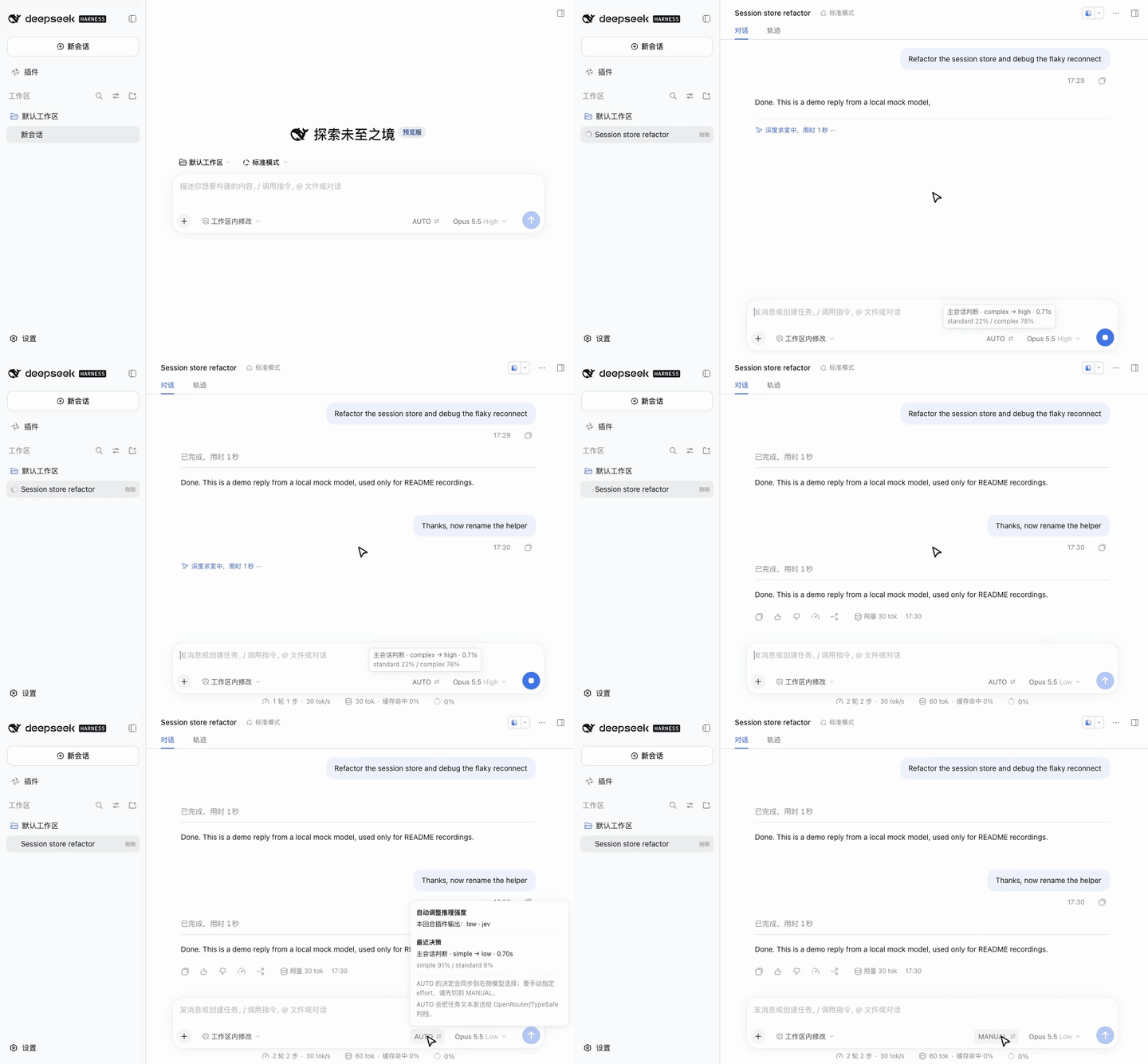
Interaction recording from the earlier four-tier UI (isolated mock Host); current decisions use independent capability and depth as described below.
Repository · Releases · npm
Add AUTO mode to DSH: automatic effort for the main agent, automatic model + effort for sub-agents. Stop adjusting reasoning investment every turn or choosing a model for every delegated task.
- Main agent: keep your selected model and adjust reasoning effort per user turn.
- Sub-agents: judge capability needs and reasoning investment independently, then select model + effort. A stronger model does not automatically mean deeper reasoning.
- Visible decisions, local feedback: inspect candidate distributions and actual application status, then rate the allocation below a reply.
Which DSH scenarios does AUTO cover?
| Scenario | AUTO behavior | Current boundary |
|---|---|---|
| Main-agent user turn | Judge effort for each new user turn; keep the main model | Not rejudged at every tool step; model must support the effort |
Official fresh subagent | Select and bind child model + effort before its first request | Real Magpie Claude/GPT ordinary child calls verified; catalog and allowlist apply |
Official fresh spawn_teammate | Bind the new teammate's model + effort using the same policy | Mock-host coverage; real-provider teammate acceptance remains unverified |
| Resume or continue a bound child | Replay its initial allocation without rejudging | Requires the plugin enabled and intact route records |
| Explicit model / effort | Preserve the specified dimension; judge only the other | Both specified: validate without calling Jev |
| Fork, third-party or unbound creation paths | No automatic-allocation guarantee | Fork and unbound AUTO child paths are explicitly rejected, not silently replaced |
This describes official integration paths—not acceptance of every DSH entry point, CLI/TUI interface or third-party plugin. The Web UI is the currently verified interface. MANUAL makes no new judgments. route_subagent is a preview, not a required step before dispatch.
Local feedback → future learning and adjustment
Available now: rate a decision-bound reply as appropriate, too high, too low or unknown; change or clear the rating. Feedback and decision snapshots stay on your machine. Submitting feedback does not upload it to the decision service or immediately change routing; AUTO task judgments themselves still use your selected external service.
Planned direction: add learning, evaluation and policy adjustment based on local feedback and execution outcomes, so AUTO can better fit your tasks. Automatic learning and feedback-driven tuning are not implemented yet. Today's records support later evaluation; they are not evidence of measured quality gains or cost savings.
Install. Tested with DSH 0.2.0-rc.2, Web UI, Node.js >=22.19.
dsh plugin --profile web add dsh-auto-model-routing
# Or install source (approve the local build when prompted):
dsh plugin --profile web add prgrmrwy/dsh-auto-model-routing
Restart DSH and refresh the Web page. In Settings → Auto model routing, choose a decision service, save its API key, and use Test connection with a fixed public sample. These are English descriptions of the controls; the plugin's interface labels are currently in Chinese. New chats default to MANUAL; click the chip to use AUTO. The companion delegation skill is included—no separate skill installation is needed.
Use
| Where | What you do |
|---|---|
| AUTO / MANUAL chip, left of the model picker | Click to switch. Hover for the decision, candidate distribution, certainty, model/effort and application status. |
| Decision hint | Shows new decisions briefly; its Settings switch does not hide the hover panel. |
| Gauge button below an eligible reply | Mark the allocation appropriate, too high, too low or unknown; change or clear your feedback later. Only replies bound to an applied main decision qualify. |
| Settings → Auto model routing | Choose service/model, manage its separate key, test the connection, set defaults/cap/deadline, or expand View decision strategy to inspect the actual rubric and model slots. |
Main model stays fixed; children are selected separately
- Main chat:
lower / baseline / highermoves at most one supported effort step below/at/above the model's verified recommended starting point. The cap defaults toxhigh; AUTO never selectsmax. It does not change the main provider/model or write global model defaults. - Fresh children: capability is
bounded / analytical / frontier; effort is judged separately. Claude slots are Haiku / Sonnet / Opus 5.5; GPT slots are Luna / Sol / Sol. The current catalog, supported efforts and official child allowlist must all permit the route. Magpie uses its exact provider and full family-prefixed model IDs, not a fallback to local transports. - Explicit choices win: specifying a model or effort leaves only the other dimension to judge. Specifying both skips Jev and validates the route. Missing task scope stops delegation rather than guessing.
- Official creation binds the route: fresh
subagentand freshspawn_teammatepaths bind an exact child identity before its first request.route_subagentis an optional preview—not proof of application and not a user constraint to copy into a subsequent call. Fork and unbound creation paths are unsupported; there is no silent substitution. - Resume keeps the initial route. Switching the root to MANUAL stops new judgments; already bound children retain their initial route.
appliedmeans the actual request configuration matched, not that the task succeeded. Real Magpie Claude/GPT ordinary calls were tested; fresh teammate routing and cold resume have mock-host coverage, not real-provider teammate acceptance.
Choose the decision service
| Service | Endpoint | Default model | Credential reference |
|---|---|---|---|
| OpenRouter (default, preserves existing installations) | https://openrouter.ai/api/alpha/decisions | typesafe/jev-1.13 | OPENROUTER_API_KEY |
| TypeSafe | https://api.typesafe.ai/v1/systemone | jev-1.13.0 | TYPESAFE_API_KEY |
| Concentrate | https://api.concentrate.ai/v1/systemone | jev-1.13.0 | CONCENTRATE_API_KEY |
| Custom System One | Your full endpoint | Editable | AUTO_DECISION_CUSTOM_API_KEY |
Preset model menus expose documented versions, not live availability guarantees. Custom services keep an editable model ID and must support state + questions → answers; an OpenAI chat-completions endpoint alone is not compatible. Custom endpoints require HTTPS (loopback HTTP is allowed), reject URL credentials/query/fragment and redirects. Only configure endpoints you trust with the dedicated key. TypeSafe and Concentrate have contract/mock coverage; their live authentication and regional availability were not verified here. No service failover occurs automatically.
Certainty is not the selected probability. Choice certainty is (pmax − 1/n) / (1 − 1/n): with three candidates, a 70% top probability gives 55% certainty. The panel shows the service's returned certainty and full candidate distribution separately, including returned zeroes; missing values are marked unavailable. Neither number is task success rate.
Good to know
- Failures are visible. Main judgment failure disables AUTO with a reason; child judgment/route failure stops dispatch. No local classifier, automatic retry, upgrade or cross-service fallback.
- MANUAL stops adjustments, not history. It does not restore an earlier effort. The official current selection remains in control; existing bound children keep their route while the plugin is enabled.
- Data leaves the machine. AUTO sends shape-redacted task text (up to 8000 characters) and short previous-turn excerpts to your chosen service. Redaction is best effort, not a guarantee that all secrets are removed. Test Connection sends only a fixed public sample and can incur a small charge.
- Keys use official DSH credentials, never plugin configuration. Launch-environment keys take precedence and are read-only. Service changes clear key drafts; save the service before managing its separate key. Changing a custom endpoint does not create a new credential namespace—review the key before trusting a new host.
- Local state: configuration is under
$DSH_HOME/plugins/dsh-auto-model-routing/; mode, child routes and feedback are under$DSH_HOME/state/auto-model-routing/. Feedback stores resource metadata, IDs, versions, returned distributions and timestamps—not task/reply text. Request event IDs allow later usage correlation; costs are not fabricated when unavailable. See feedback and evaluation. - No automatic learning. Human allocation feedback is observational. It does not change routing or prove quality/cost benefits. Old messages without decision bindings are not backfilled; old records with missing evaluation fields remain unknown.
- Upgrade: existing AUTO sessions use the new policy without a version switch or rewriting their stored mode. New chats still default to MANUAL unless configured otherwise. Historical four-tier mappings remain only for explicit
policy: "legacy"rollback in plugin configuration; they are not the current policy or feedback menu.
Architecture

Main failures disable AUTO; child failures stop dispatch. Explicit model/effort constraints are preserved. The diagram shows the AUTO paths; MANUAL makes no new judgments and fork is unsupported. Feedback does not automatically alter routing.
Entry: index.ts. Enforcement: policy-host.ts. Actual rubric: policy-v2-rubric.json. Model slots: policy-v2.ts. UI: client. Coverage and limitations: development verification, real Magpie acceptance.
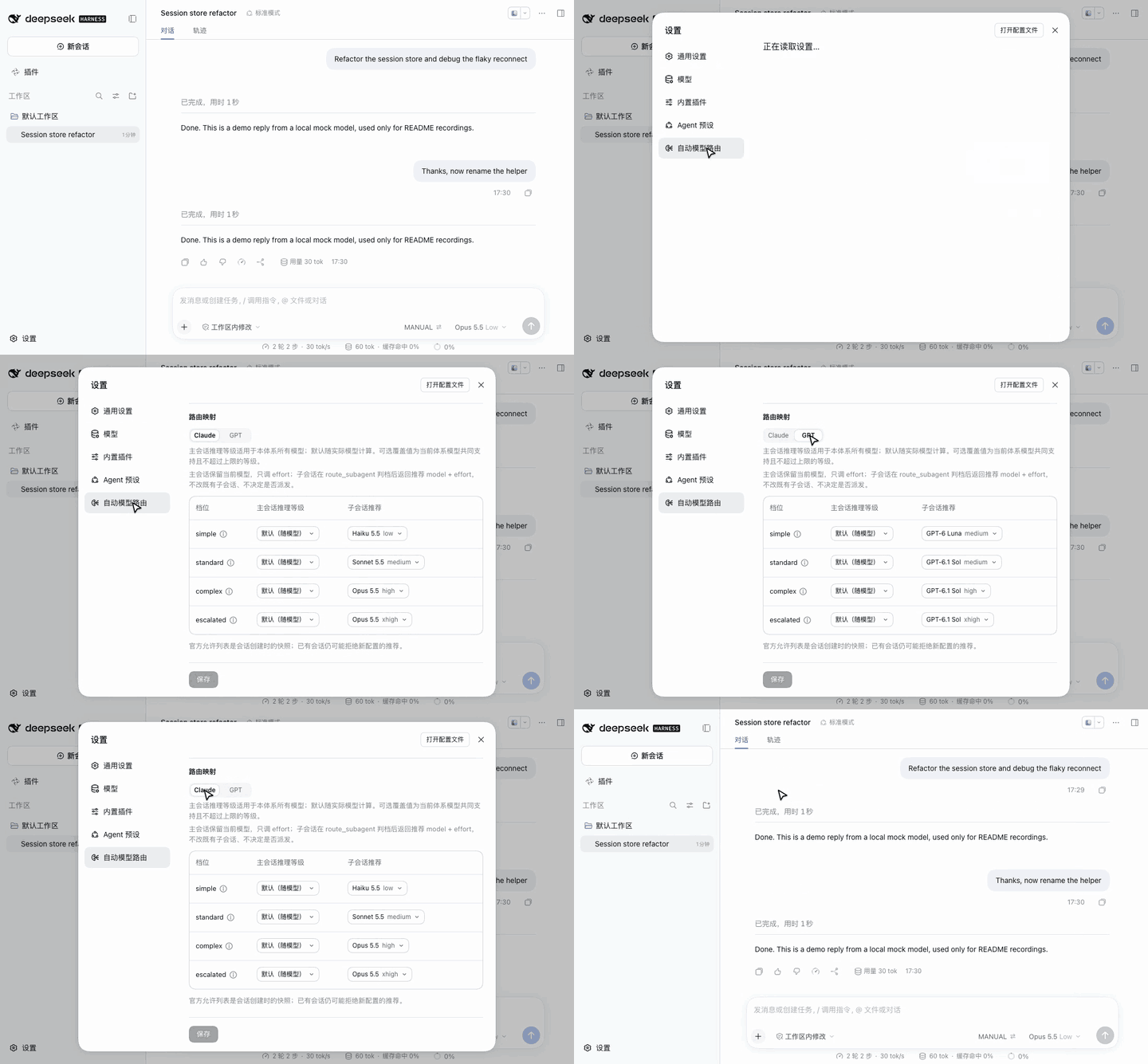
Earlier four-tier UI demos (legacy rollback only)
These isolated-host recordings use mock Jev/model responses and show the previous UI, not the current default policy.
Development
npm test
npm run typecheck
npm run build
Tests use the official AgentLoop with fake LLM streams and mock/loopback Jev responses, not paid model calls. scripts/label-report.mjs reports legacy tier labels only. To observe AUTO decisions and their actual token usage, ask the agent to use the auto-model-routing-report skill (on demand only; it runs the read-only lib/usage-report.js). It is observational, not a savings measurement. Evaluation schema and deduplication rules are in feedback-evaluation.md.
Development stays in the source monorepo; this repository is its release mirror. The package builds and loads independently using its declared dependencies, bundled skill and official DSH services; no monorepo checkout or monorepo instruction file is required. External design references are optional background, not runtime inputs.
The current specification lives in the source monorepo. The bundled delegation skill supplies guidance; enforcement belongs to the official host hooks, not the prompt. No measured task-quality or token-savings claim is made.
Removal
dsh plugin --profile web remove dsh-auto-model-routing
Restart DSH and refresh the page. The plugin's skill/tools and request hooks disappear; settings and logs remain. Without the plugin, child replay is no longer enforced and host restoration uses the original creation configuration. In ohmydsh, disable the local entry and rebuild instead.