
 @uos1231234
dsh-plugin-virtuoso-layout
An AI agent that drives Cadence Virtuoso to draw layout: 12 DeepSeek Harness tools, with DRC and LVS verified on a real 0.18 um process
- Stars
- 0
- Language
- JavaScript
- Created
- Oct 21, 2026
- Updated
- Oct 21, 2026
Introduction
dsh-plugin-virtuoso-layout
An AI agent that drives Cadence Virtuoso to draw layout — packaged as a DeepSeek Harness plugin.
12 host-side tools, zero runtime dependencies, driving Virtuoso 6.1.7-64b inside a
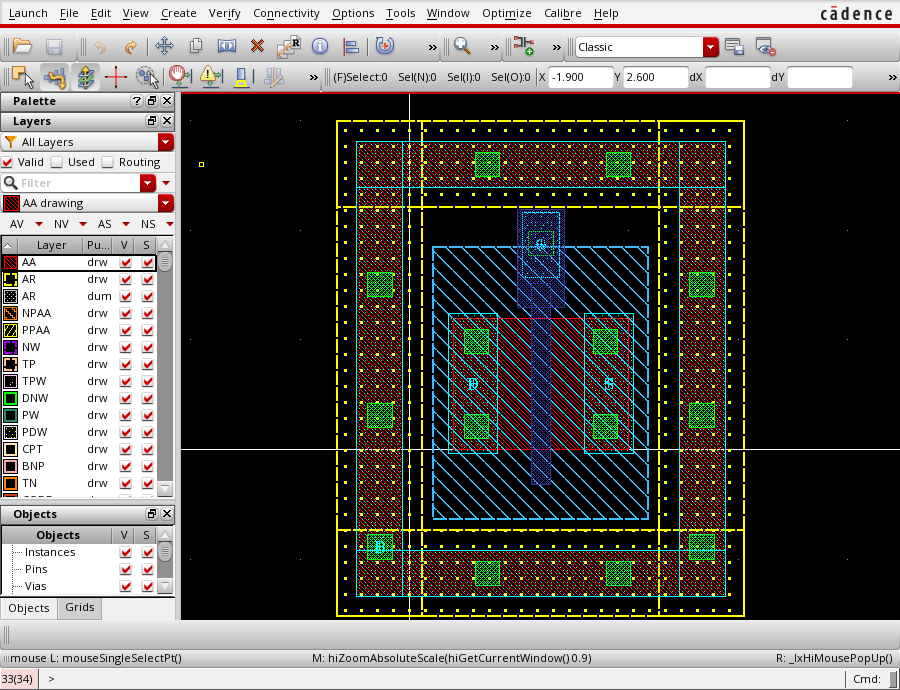
RHEL 6.5 VMware guest. Verified end to end on a real SMIC 0.18 µm process: the layout it
produced passes Calibre DRC with zero geometry violations and passes LVS as a
recognised N18E2R device.
What this actually is
Not a script that clicks menus. Commands are SKILL expressions evaluated inside the running Virtuoso CIW:
host (this plugin, Node.js)
  │  SSH / SCP
  ▼
guest (RHEL 6.5)
  │  virtoso-bridge daemon on :65452  ◄── SSH tunnel to 127.0.0.1:65453
  ▼
ramic_bridge.il inside the CIW
  │  evalstring("(progn …)")
  ▼
Cadence database API  →  dbCreateRect / dbSave / cv~>shapes
Because it goes through the database API rather than the GUI, the agent can state facts about the layout — "18 rectangles, bbox ((0.2 −1.0) (2.2 1.68)), gate length 0.18 µm" — instead of opinions about a picture.
XTEST key/mouse injection exists, but only to unwedge a modal dialog. It is never the primary channel.
The 12 tools
| Tool | Purpose |
|---|---|
virtuoso_status | four-layer readiness: VM → sshd → tunnel → CIW answers 1+1 |
virtuoso_vm | VM + tunnel lifecycle; up is the one-call repair |
virtuoso_config | persisted settings, applied on the next call |
virtuoso_recover | repair the guest GUI, then prove it with a real eval |
virtuoso_windows | SKILL window list + X11 window ids |
virtuoso_screenshot | capture one Virtuoso window to a PNG the model can look at |
host_window | enumerate / raise / capture Windows host windows (the VMware console) |
virtuoso_eval | arbitrary SKILL over stdin |
virtuoso_run | a long guest command as a background job |
virtuoso_drc | parse Calibre DRC output into structured JSON |
workspace_create | register a workspace |
context_usage | this session's token budget (read-only) |
Full parameter/output schemas: TOOLS.md — generated from the live tool
definitions, so it cannot drift from the code.
The write gate
lib/guard.js installs a single global tool guard that denies mutating
virtuoso_eval / virtuoso_run calls unless they carry a stateless, sha256-derived
confirm token.
The contract was read out of the harness, and it shaped the whole design: a guard is synchronous (it cannot wait for a human), it runs after the pre-execute waterfall, it can only deny — it can never force a call through. So the design is:
- Read-only calls are never gated.
dbOpenCellViewByType(… "r"),cv~>shapes,sleep; echopass untouched — otherwise the gate trains you to paste tokens without looking. - Fail-closed. If the sandbox policy cannot be read, the guard denies.
confirm: trueis deliberately rejected. That is a rubber stamp, not consent.danger-full-accessabstains, because the user already granted full write authority — andvirtuoso_statusreportsenforcedNowso the gate is observable.
Verified live in four cases: deny → token → allow, wrong token, read-only exempt, and abstain under full access.
Verified results
The DSH_NMOS/dsh_nmos15 cell, on the real smic18ee SMIC 0.18 µm technology:
| Result | |
|---|---|
| DRC | 393 checks, 6 violations — all density rules, zero geometry violations |
| LVS | CORRECT — N=4 EP=4, M0 S G D B N18E2R L=0.18um W=1.2um |
| Guard ring | four-sided P+ frame, closed loop proven by rasterising and counting holes |
| Iterations | 22 → 24 → 35 → 36 → 18 → 16 → 13 → 7 → 6 |
The 6 remaining are density rules (PD.*, MIM_8a): an isolated 3.7 × 4.5 µm device
cannot fill a 30 % metal-density target. They are full-die constraints, not defects.
Not achieved, and documented as such:
- PEX / parasitic extraction. The xRC rules are complete, but the shipped deck was
written for Calibre xRC v2009.3 and the installed v2015.2 rejects it with Tcl parse
errors. See
PEX-STATUS.md. A control experiment with the unmodified deck rules out editor error. - Multi-finger / common-centroid matching, place & route, clock tree, power grid.
Documentation map
This project is as much a record of what went wrong as of what works. The failures are the interesting part.
| Document | Contents |
|---|---|
HISTORY.md | timeline, bug ledger, and the judgements that were retracted |
AGENTS.md | project memory: paths, environment facts, troubleshooting order |
LAYOUT-AUDIT.md | hand-written geometry audit → discovering DRC is the authority |
DRC-RESULTS.md | first real Calibre run: 393 checks, 22 violations |
SKILL-FIXES-AND-LVS.md | three SKILL method errors, first LVS pass |
NMOS-FINAL.md | converging the device to density-only violations |
WELLS.md | well experiments: P-well is derived, N-well needs a pickup |
RING-AND-CONNECTIVITY.md | measuring connectivity: 8 islands, a ring fixes 1 of 3 |
RING-CLOSED.md | closing the ring; why only a screenshot revealed it was a solid bar |
PEX-STATUS.md | why parasitic extraction does not run here |
Three findings worth the read
-
A guard ring that was a solid bar. Four rectangles overlapped in y and filled in. No DRC rule says "a ring must have a hole", and connectivity analysis counted one component and passed it. A screenshot showed it immediately. The fix was to rasterise the shapes at 10 nm and count enclosed holes — a check the eye can make, now automated.
-
Prefix arithmetic is unavailable in Virtuoso 6.1.7.
(- x d)fails with a load error that reports the end of the wrapper, pointing nowhere near the fault. Infix (x - d) works. Six diagnostic rounds were spent on this. -
procedurepcannot probe built-in functions here. It returnsnilforgeOpen, which demonstrably works, anderrsetcollapses "no such function" and "refused" into the samenil. Every conclusion drawn from those probes had to be re-derived.
Requirements
- Cadence Virtuoso with a licensed install (this was developed against 6.1.7-64b)
- A Linux guest reachable over passwordless SSH, in VMware or similar
- A technology library to bind to
- Calibre for DRC/LVS (optional; the plugin can drive Virtuoso without it)
- Node.js (the plugin uses only Node builtins — no
npm install) - DeepSeek Harness
Without Virtuoso and a PDK this plugin has nothing to drive. It is published because the technique — turning an opaque EDA tool into a programmable, verifiable, documented interface — transfers to any tool with a scripting layer.
Installing the plugin
# from the DSH checkout
node tools/virtuoso.mjs config-set vmrun="C:\path\to\vmrun.exe"
node tools/virtuoso.mjs config-set vmx="D:\path\to\guest.vmx"
node tools/virtuoso.mjs config-set guestIp=192.168.1.50
node tools/virtuoso.mjs config-set sshUser=youruser
node tools/virtuoso.mjs health      # proves the CIW answers
Then copy dsh-plugin-virtuoso-layout/ into your DSH profile's node_modules/ and
restart DSH. lib/*.js changes require a restart (HMR only watches patch files).
Validating without a VM
node .validate/plugin-test.mjs     # registers all 12 tools against a mock ctx
node .validate/guard-test.mjs      # the write gate: classification / policy / registration
node .validate/context-test.mjs    # token-meter contract, 50 checks
node .validate/job-test.mjs        # background-job payload, 8 checks
node .validate/hint-test.mjs       # error-message mapping
node .validate/paren-check.mjs f.il  # SKILL paren balance
Credits and acknowledgements
Tsinghua University
This project would not exist without the RAMIC Bridge SKILL layer, and that comes from Tsinghua University.
virtuoso-bridge-lite (MIT) is by
Zhishuai Zhang, Xintian Li, Nan Sun and Lu Jie — the work of Professor Nan Sun's
group at Tsinghua University, whose research spans analog and mixed-signal IC design
and the EDA automation around it. The ramic_bridge.il file that lets a socket evaluate
SKILL inside a live CIW — the single mechanism this whole plugin stands on — is theirs.
Sincere thanks to Tsinghua University and to that group for releasing it. 清华大学,谢谢。
That project is not vendored here; it is a dependency. Install it from its own repository.
Mentor Graphics / Siemens EDA
Calibre, whose DRC and LVS decks made it possible to check the layout rather than merely look at it. The verdicts quoted in the documents are Calibre's, not this project's.
Cadence
Virtuoso, and the SKILL language and database API the plugin drives.
Note on third-party material
No foundry PDK, rule deck, or Calibre output containing rule text is included in this repository. Foundry decks are confidential material and are distributed only by the foundry to licensed customers. The documents here discuss rule identifiers and the reasoning behind each geometry decision; obtain the decks from your foundry.
License
MIT — the full text is in LICENSE, and the package manifest says the same
thing in dsh-plugin-virtuoso-layout/package.json.
Third-party notices that must not be folded into the MIT text — the
virtuoso-bridge-lite attribution, and what foundry material is deliberately absent —
are in THIRD-PARTY.md. That split is not fussiness: GitHub identifies
a licence by template-matching the file, so appending paragraphs to LICENSE makes the
repository report NOASSERTION instead of MIT.