
 @wings1848
dsh-rtk
RTK command rewriting and tool-output compaction for the DeepSeek Harness: rewrites bash commands to their rtk equivalents and compacts the result before the model sees it.
- Stars
- 0
- Language
- TypeScript
- Created
- Sep 12, 2026
- Updated
- Sep 19, 2026
Introduction
dsh-rtk




RTK command rewriting and tool-output compaction for the DeepSeek Harness.
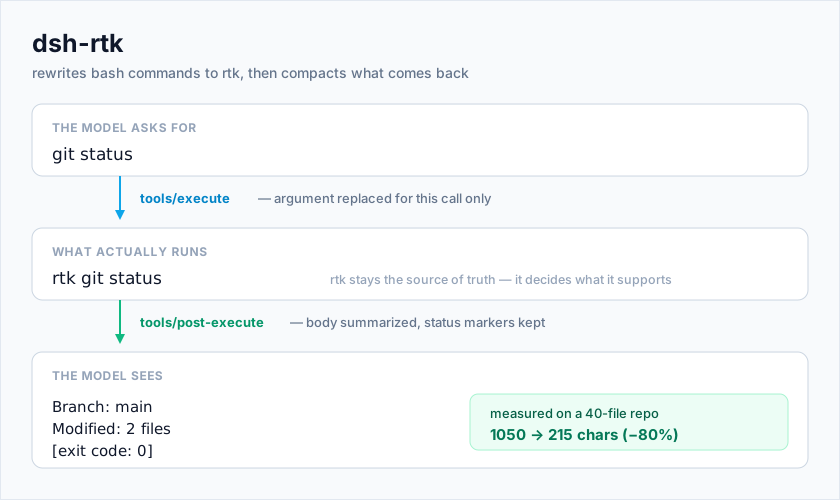
dsh-rtk rewrites bash commands to their rtk equivalents before they run, and compacts noisy tool output before it reaches the model. It is a port of pi-rtk-optimizer to the harness's plugin model.
model asks:  git status
runs:        rtk git status
model sees:  Branch: main
             Modified: 2 files
               src/a.ts
Features
Command rewriting
- Every command with an rtk equivalent is rewritten before dispatch; commands rtk does not support run untouched.
- rtk stays the source of truth. The plugin carries no rewrite table of its own — it asks the installed binary via
rtk rewrite, so support tracks whatever rtk version is installed. rewriteandsuggestmodes.rewritereplaces the command;suggestruns it unchanged and reports the equivalent it would have used.- Runtime guard. With
guardWhenRtkMissingon (the default), a call that cannot prove rtk is available runs the original command. A missing optimizer never blocks work. - Rewritten commands get an isolated
RTK_DB_PATH, so rtk's usage history does not land in the working tree.
Output compaction
A multi-stage pipeline over bash, read, and grep results:
| Stage | What it does |
|---|---|
| ANSI stripping | Removes terminal color and formatting sequences |
| Build filtering | Extracts compiler errors and warnings, drops progress chatter |
| Test aggregation | Collapses runner output to pass/fail/skip plus failure excerpts |
| Git compaction | Summarizes git status, git diff, and git log |
| Linter aggregation | Counts issues and ranks them by rule and file |
| Search grouping | Groups grep-style matches by file |
| Source filtering | none, minimal, or aggressive comment/whitespace removal (off by default) |
| Smart truncation | Keeps signatures and imports when dropping lines (off by default) |
| Hard truncation | Final character budget |
Two properties are load-bearing:
- The harness contract survives. A
bashresult ends with status markers —[exit code: N],[stderr],[timed out after …],[sandbox: …]. Compaction lifts those out before rewriting the body and puts them back afterwards; the model is told to check[exit code: N]on every call, and the Web UI parses that same line for its exit-status pill. - Compaction never inflates a result. If a technique would not actually shrink the text, the original is kept and nothing is reported.
Oversized output belongs to the harness
When dsh-spill-policy is mounted, it writes a full result to disk and keeps a head/tail preview inline — that truncation is recoverable. This plugin's own hard truncation is not, and it runs first: at its 12 000-character default it fires far below spill's 50 000-byte threshold, so spill never sees a large result at all and the file that would have let a reader see the rest is never written.
With deferToHarnessSpill on (the default) the plugin turns its own truncation off whenever the spill service is present, so a runaway command's output stays readable. Set it to false to keep the plugin's bound regardless.
Session metrics
/rtk stats reports how many characters compaction saved, per tool and per technique.
Install
1. Install the package
dsh plugin --profile web add @wingsbutterfly/dsh-rtk
Working from a checkout instead? Link it where the composition resolves bare specifiers:
mkdir -p ~/.dsh/node_modules/@wingsbutterfly
ln -s /path/to/dsh-rtk ~/.dsh/node_modules/@wingsbutterfly/dsh-rtk
2. Add one row to an agent preset
dsh-rtk is an agent-plane row: it registers listeners into the tool pipeline and contributes no service, so it needs no isolate realm. Add it to the preset whose sessions should be optimized:
- id: rtk
  name: '@wingsbutterfly/dsh-rtk'
  config:
    enabled: true
    mode: rewrite
To try it without touching an existing preset, copy one and add the row:
# ask a cordis-preset agent to run this
agentPresets.copy('standard', 'rtk', 'RTK 优化')
The row works at the host plane too (add it to ~/.dsh/cordis.patch.yml instead), which covers every session in the deployment — but that needs a host restart, and a host row plus a preset row would both want the same process-global settings namespace. Pick one plane.
Configuration
Every field is optional; defaults are shown.
- id: rtk
  name: '@wingsbutterfly/dsh-rtk'
  config:
    enabled: true                    # master switch
    mode: rewrite                    # rewrite | suggest
    guardWhenRtkMissing: true        # run the original when rtk is unavailable
    showRewriteNotifications: false  # append a one-line rewrite note to the result
    rtkExecutable: rtk               # name or absolute path
    rewriteTimeoutMs: 3000           # deadline for one `rtk rewrite` call
    compactedTools: [bash, read, grep]
    outputCompaction:
      enabled: true
      stripAnsi: true
      readCompaction:
        enabled: false               # lossy read compaction; off so code reads stay exact
      sourceCodeFilteringEnabled: false
      preserveExactSkillReads: false
      sourceCodeFiltering: none      # none | minimal | aggressive
      aggregateTestOutput: true
      filterBuildOutput: true
      compactGitOutput: true
      aggregateLinterOutput: true
      groupSearchOutput: true
      trackSavings: true
      deferToHarnessSpill: true      # let the harness spill policy own oversized output
      smartTruncate:
        enabled: false
        maxLines: 220                # 40–4000
      truncate:
        enabled: true
        maxChars: 12000              # 1000–200000
The configuration is also registered as the dsh-rtk namespace in the harness settings document, so it can be edited there and takes effect without a restart. A composition config: block supplies the base layer; the settings document supplies the user layer on top.
Why
readCompactionis off by default. Filtering or truncating areadresult can leave the model editing against text that no longer matches the file. Everything on by default is lossless for the body text it summarizes, or only fires on outputs whose whole shape is being replaced.
Commands
| Command | Description |
|---|---|
/rtk | Show configuration and runtime status |
/rtk show | Same as /rtk |
/rtk path | Where the configuration is stored |
/rtk verify | Check whether the rtk executable is usable |
/rtk stats | Compaction savings for this session |
/rtk clear-stats | Reset the savings counters |
/rtk reset | Restore configuration defaults |
/rtk help | Usage text |
How it works
Both halves ride the tool pipeline rather than wrapping a tool, because the harness offers exactly two seams that fit:
-
Rewriting rides
tools/execute.tools/pre-executedeliberately may not mutate arguments — they are logged and presented before dispatch, so a rewrite there would desync the recorded call from the one that ran. The around-dispatch stage is the only place the executing command may differ, anddsh-rtkscopes the change to a single call: the original arguments are restored as soon as dispatch returns, so later pipeline stages and the session log still see what the model asked for. -
Compaction rides
tools/post-execute, the stage that may replace result content.
Both listeners register in the scope the row was mounted into. A preset row therefore covers exactly its own agent (the preset's standing scope is an ancestor of every session that joins it), and a host row covers every agent in the process.
Only the tools service is a hard dependency. settings, commands, and systemPrompt are resolved with ctx.get, so a composition that omits any of them still gets the optimization.
Caveat: the rewriting seam is not a sanctioned extension point
The harness documents tools/execute wrappers as wrappers that "may change only exec.signal". Replacing arguments is not a supported extension point — it works because the execution object is not frozen until its result is notified, and the failed alternative is worse: tools/pre-execute deliberately may not rewrite input (arguments are logged and presented before dispatch), and a tool cannot be re-registered over one in the same layer.
dsh-rtk takes that seam knowingly, and pays for it where it can: the replacement is scoped to a single call and restored in finally, and every failure path falls back to the command the model sent. If a future harness version freezes the execution object earlier, rewriting goes quiet rather than breaking — commands run unrewritten and compaction is unaffected, because tools/post-execute is a documented content-replacement stage.
Differences from pi-rtk-optimizer
| pi-rtk-optimizer | dsh-rtk |
|---|---|
Rewrites event.input.command in the tool_call hook | Replaces exec.arguments for the duration of one dispatch, then restores it |
Compacts in the tool_result hook | Compacts in the tools/post-execute waterfall |
/rtk opens a TUI settings modal | /rtk prints status text; configuration lives in the harness settings document |
| Config is a JSON file it owns | Config is a harness settings namespace layered over the composition's config: block |
Streams are sanitized through tool_execution_* hooks | No equivalent hook exists, so streamed output is not sanitized |
| Windows-specific shell fixups | Not ported; the target deployment is POSIX |
Everything else — the rewrite delegation to rtk rewrite, the exit-code contract, the guard when rtk is missing, the documented default for every compaction switch, and each technique's algorithm — is ported as-is.
Development
pnpm install          # or link the peer packages manually
pnpm run typecheck    # tsc --noEmit against the real harness types
pnpm test             # builds first, then runs node --test test/
pnpm run build        # emit lib/
pnpm run check        # typecheck + test
The tests import lib/, so pnpm test builds before it runs; a src/ edit that is never built would otherwise pass the suite unnoticed.
The port's acceptance evidence, including the eight defects later reviews and live testing surfaced, is in https://github.com/wings1848/dsh-rtk/blob/main/docs/verification.md.
test/integration.test.ts drives the real apply() through a stand-in context and calls the real rtk binary, so it fails on a machine without rtk installed — that is intentional: the rewrite path is the feature.
Star history

License
MIT