
 @x7687315-gif
dsh-policy
User-controlled policy and personalization runtime for DeepSeek Harness - enforce hard project constraints at the agent lifecycle boundary.
- Stars
- 1
- Language
- TypeScript
- Created
- Sep 2, 2026
- Updated
- Sep 3, 2026
Introduction
dsh-policy







User-controlled policy & personalization runtime for DeepSeek Harness.
A policy-driven runtime extension that lets users define project-level hard constraints (MUST / MUST NOT / BLOCK), manage behavioral guidance and coding preferences, and incrementally build a user-controlled personalization system — without giving the AI autonomous authority over long-term user rules.
The system is not merely telling the Agent what to do. It is enforcing what the Agent is allowed to finish.
What the plugin actually does
dsh-policy hooks into four verified DeepSeek Harness seams and turns your policy file into runtime enforcement:
Agent edits code          ──► tools/post-execute ──► normalized evidence (real tool results)
Agent calls a MUST NOT tool ─► tools/pre-execute ───► DENIED before the tool body runs
Agent says "done"         ──► agent/turn-stopping ──► evaluate hard rules
        violated, budget left                        ► BLOCK: remediation injected as a user message
                                                       (the loop re-opens the turn — the model must act)
        budget exhausted                             ► the turn can only end as an ERROR (never a fake completion)
        all rules pass                               ► the turn completes normally
Subsystems behind that pipeline:
| Subsystem | What it does | Where it hooks |
|---|---|---|
| Policy loader & validator | Reads .dsh-policy/policy.json, fails loudly on anything malformed (including bad regexes) | activation |
| Scope resolver | Merges global / project / task rules; enforces Constraint Monotonicity (specific scopes may ADD rules, never weaken stronger ones) | activation |
| Constraint engine | Pure function evaluate(rules, evidence) → PASS | BLOCK + remediation; fail-closed | agent/turn-stopping |
| MUST NOT gate | Forbidden tools are denied before their body executes | tools/pre-execute |
| Evidence store | Per-session JSONL of real tool results; survives restarts (an unremediated violation keeps blocking) | tools/post-execute |
| Behavior observation | Detects recurring patterns (repeated remediations, denied-tool retries, user corrections) — zero extra LLM calls; candidates NEVER become rules without user review | session/event + enforcement actions |
| Behavior Guard | User-confirmed, contextual, NEVER-blocking reminders (type-isolated from hard rules) | prompt layer 910 + post-execute context |
| User Model + 🧋 Review | Durable personalization with a single write path (ConfirmRequest), full audit trail, interactive review CLI | CLI (the only writer) |
| Context Resolver | Injects only task-relevant preferences/goals under a hard 800-token budget; hard rules are never evicted | prompt layers 920/925 |
| Project lifecycle | Paused/completed/archived projects stop contributing rules | activation (registry) |
Verification baseline: 166/166 tests across 25 files, benchmarked end-to-end (see docs/benchmarks.md), a local web management UI (pnpm ui), and packaging tests that run against the built dist/ bundle.
Screenshots
The bundled web management UI (pnpm ui / dsh-policy ui) — localhost-only, point-and-click instead of config-file editing:
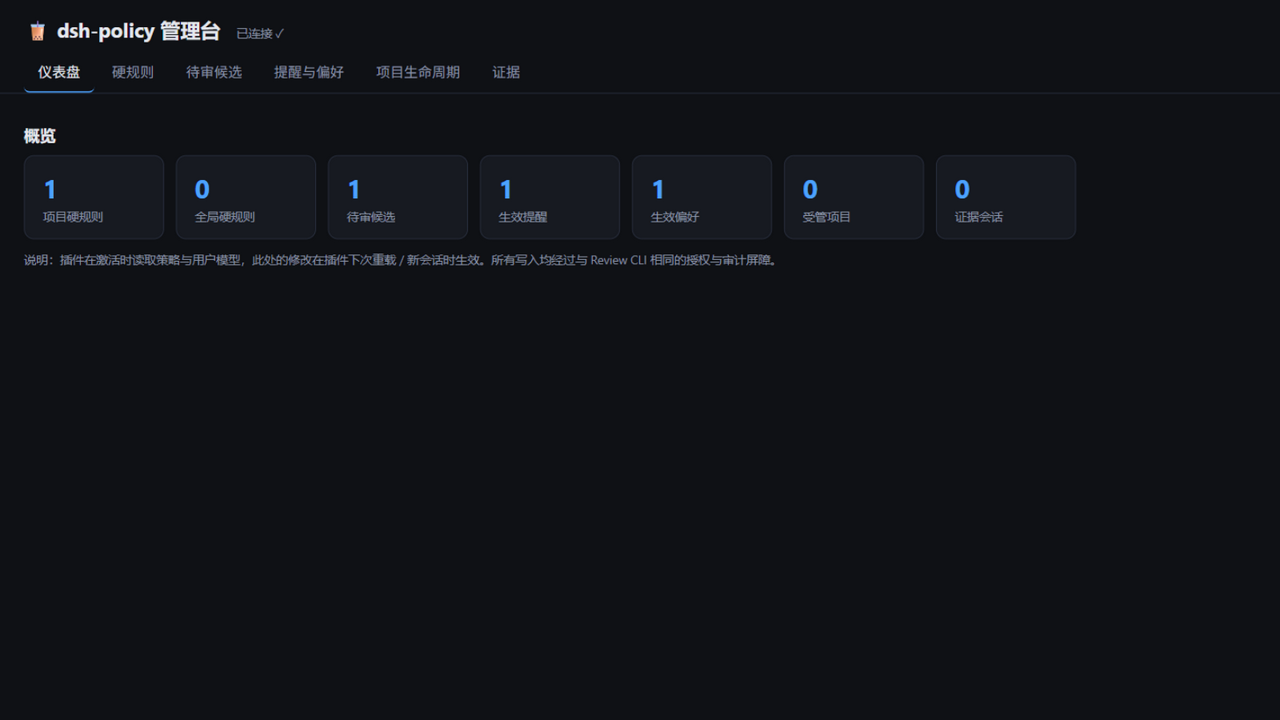
Dashboard — everything at a glance
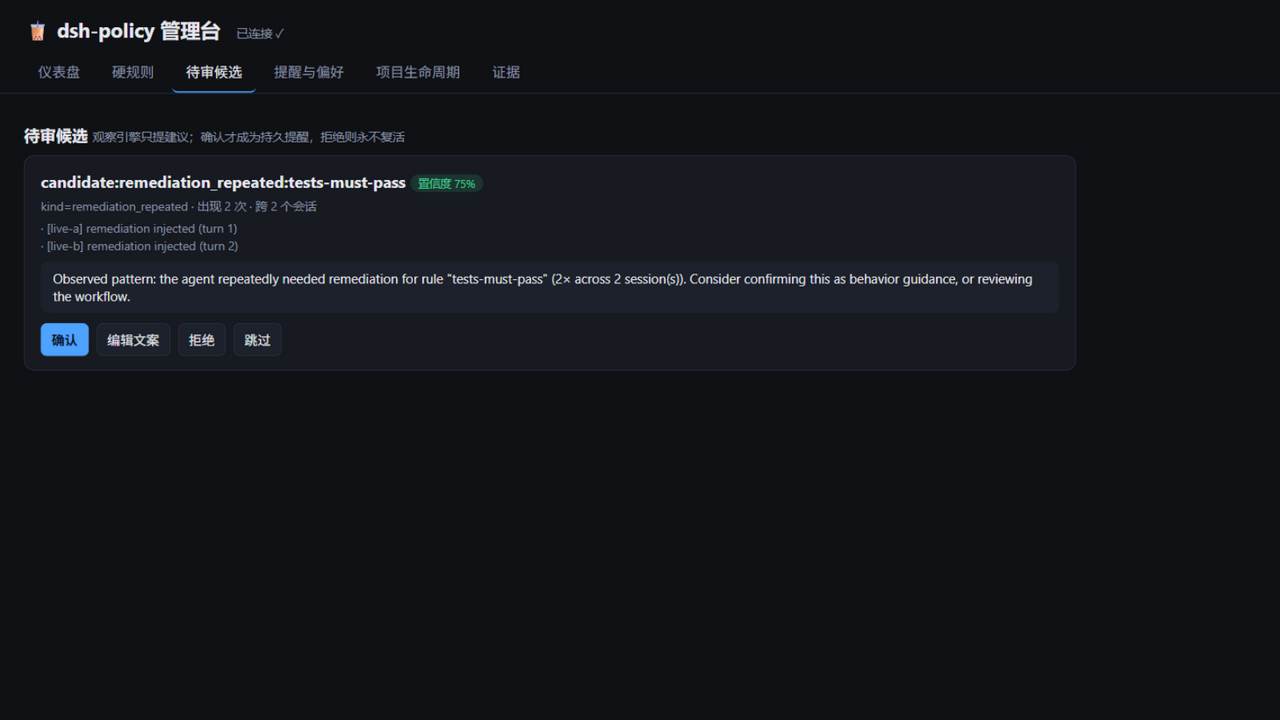
Behavior review — confirm / edit / reject observed patterns (evidence + confidence shown)
Why
Most "memory plugins" put more user information into a prompt. This project is different: the Agent operates inside a user-controlled policy boundary with three layers:
| Layer | Semantics | Can block the Agent |
|---|---|---|
| 1. Project Policy (hard constraints) | MUST / MUST NOT / BLOCK, machine-verifiable | Yes |
| 2. Behavior Guard (recurring mistakes) | WARNING / GUIDE | No |
| 3. Coding Preference (style/habits) | PREFER / SOFT | No |
Priority: Hard Project Policy > Behavioral Guidance > Coding Preference.
Core invariants:
- AI suggestion is not user authorization. The AI may observe and suggest, but never silently creates/modifies/deletes durable rules.
- Runtime truth beats model claims. Hard rules are verified from observable tool/session events, not from the LLM saying "I did it".
- Constraint Monotonicity. Specific rules may add requirements but never silently weaken stronger hard rules.
It is implemented as a native DeepSeek Harness plugin (Cordis), not a second agent framework.
Installation
Note: the package is not yet published to npm. Until then, install from GitHub or a local checkout (see below); once published it will be
pnpm add dsh-policy.
1. Add the dependency & scaffold
# from GitHub (pin a commit/tag for reproducibility)
pnpm add github:x7687315-gif/dsh-policy

# or from a local checkout
pnpm add ./path/to/dsh-policy
Then scaffold your first policy with the bundled CLI (never overwrites an existing file):
npx dsh-policy init # creates .dsh-policy/policy.json with a working starter rule
Requirements: Node ≥ 20, pnpm (or npm/yarn), and a DeepSeek Harness runtime with the Cordis loader.
2a. Wire it into your Harness via cordis.yml (recommended)
plugins:
  # your LLM adapter — the API key comes from the environment, never a file
  - name: '@deepseek-ai/dsh-llm-deepseek'
    options:
      apiKey: ${DEEPSEEK_API_KEY}
      model: deepseek-chat
      baseURL: https://api.deepseek.com

  - name: dsh-policy
    options:
      policyPath: .dsh-policy/policy.json   # your project's hard rules
      userModelPath: ~/.dsh-policy/user-model.json
      behavior:
        enabled: true                       # opt-in pattern observation
      context:
        tokenBudget: 800                    # prompt budget for guidance/preferences
      projectId: my-project                 # enables the lifecycle registry
A complete production example lives at examples/cordis.yml.
2b. Or mount it programmatically
import { dshPolicy } from 'dsh-policy'

await ctx.plugin(dshPolicy, {
  policyPath: '.dsh-policy/policy.json',
  behavior: { enabled: true },
})
3. Write your first policy
Create .dsh-policy/policy.json in your project:
{
  "project": "my-api",
  "policy": {
    "hard": [
      { "id": "test-after-code-change", "trigger": "code_change", "require": "tests_pass", "enforcement": "hard" },
      { "id": "no-dangerous-commands", "trigger": "always", "denyTools": ["drop_database"], "enforcement": "hard" }
    ]
  }
}
The full schema (tool-pass rules, deny rules, evidence matchers, scopes, remediation text) is documented in docs/policy.md.
Plugin options
| Option | Default | Purpose |
|---|---|---|
policy / policyPath | <cwd>/.dsh-policy/policy.json | Project hard rules (inline wins over path) |
globalPolicy / globalPolicyPath | ~/.dsh-policy/policy.json | Cross-project hard rules |
taskRules | — | Additive-only task-scope rules |
projectId / projectRegistryPath | ~/.dsh-policy/project-registry.json | Lifecycle: paused/archived projects stop enforcing |
maxRemediations | 2 | Injected remediations per turn before hard refusal |
evidenceRoot | in-memory | Directory for durable per-session JSONL evidence |
behavior | disabled | Pattern observation (writes candidates for review, never rules) |
userModelPath | — | Read-only consumption of confirmed guards/preferences |
guards / preferences / goals | — | Inline overrides of the user-model projections |
context.tokenBudget | 800 | Prompt budget for guidance/preferences (hard rules never evicted) |
Running things
The unified CLI (installed as dsh-policy via the bin entry, or from the repo):
dsh-policy init      # scaffold .dsh-policy/policy.json (never overwrites)
dsh-policy review    # interactive/piped candidate review
dsh-policy project   # lifecycle: pause | resume | complete | archive
dsh-policy ui        # local web management UI -> http://127.0.0.1:5178
From a repo checkout, the same commands work via pnpm scripts (pnpm ui, pnpm review, pnpm project, pnpm init) plus:
pnpm install
pnpm test        # 166 tests / 25 files — real Harness stack, scripted LLM (no API key needed)
pnpm bench       # full benchmark sweep -> bench/report.json (constraint/personalization/cost)
pnpm demo        # end-to-end: BLOCK -> remediation injected -> tests run -> PASS
pnpm typecheck   # strict TS, zero errors
pnpm build       # tsdown -> dist/ (npm-publishable bundle, verified by packaging tests)
🖥️ Web management UI — point-and-click management
pnpm ui --policy .dsh-policy/policy.json --candidates <behaviorRoot> --model ~/.dsh-policy/user-model.json
# open http://127.0.0.1:5178  (localhost only)
Six tabs, no configuration file editing required:
- Dashboard — counts of rules, pending candidates, active guards/preferences, projects, evidence sessions
- Hard rules — add/edit/enable/disable tool-pass and MUST-NOT rules across project & global scopes; every save is server-side validated (invalid rules — including bad regexes — never reach disk)
- Candidates — review observed patterns with evidence & confidence: confirm / edit the message / reject (tombstoned forever) / skip
- Guards & preferences — manage durable user-model records with enable/disable/delete (all audited), add preferences with
appliesToconditions - Project lifecycle — pause/resume/complete projects
- Evidence — read-only per-session JSONL viewer
Write-path discipline holds in the UI: it is the second legitimate writer (after the Review CLI), every mutation is an explicit user action flowing through ConfirmRequest{via:'review-ui'} + audit; the plugin stays read-only and picks changes up at its next activation.
🧋 Review CLI — confirm or reject behavior candidates
Observation produces candidates; only you make them durable:
pnpm tsx src/review/cli.ts --candidates <behaviorRoot> --model ~/.dsh-policy/user-model.json
For each candidate it shows the evidence, occurrence counts and confidence, then asks:
[y] confirm / [e <msg>] edit / [n] reject / [s] skip. Confirmed candidates become
Behavior Guards on the next activation; rejected ones are tombstoned and never resurface.
The CLI is the ONLY writer of the user model, and every change is audited.
Project lifecycle CLI
pnpm project pause <projectId>     # rules stop contributing to new sessions
pnpm project resume <projectId>
pnpm project complete <projectId>
pnpm project archive <projectId>   # .dsh-policy moved to archive/, history kept
Production run
export DEEPSEEK_API_KEY=...(never commit keys),- start your Harness with
examples/cordis.yml, - the plugin loads your policy, tells the model the rules in its prompt, and enforces them at the turn boundary — no local inference, all LLM calls go to the DeepSeek cloud API.
Enforcement behavior at a glance
Agent edits code                     → tools/post-execute records code_change (real tool result)
Agent says "done" without tests      → agent/turn-stopping evaluates the policy
                                     → BLOCK: remediation injected as a user message
Agent runs tests, tests fail again   → BLOCK again (within the remediation budget)
Budget exhausted while still violated → the turn can only end as an error (never a fake completion)
Agent runs tests, tests pass         → PASS: the turn may complete
Agent calls a MUST NOT tool          → tools/pre-execute denies the call before the body runs
Every step                           → the model sees the active rules in its prompt (explanation ≠ enforcement)
Status
Stage 0–18 complete — the full project plan (Phase 0–18) plus the web management UI and real-environment hardening. Verification baseline: pnpm test 166/166 across 25 files, pnpm typecheck clean, pnpm build green, pnpm bench full-sweep benchmark green (report, interpretation).
- Stage 0 — repository foundation
- Stage 1 — Harness integration verification (turn-stopping blocking mechanism confirmed)
- Stage 2 — policy & constraint engine core
- Stage 3 — hard-constraint proof of concept (
code_change → tests_pass) - Stage 4 — documentation & wrap-up
- Stage 5 — generalized rule model + Constraint Monotonicity
- Stage 6 — MUST NOT gate (
tools/pre-executedeny) + rule visibility in the prompt - Stage 7 — CI (GitHub Actions) and docs sync
- Stage 8 — durable session evidence, HMR safety, publishable build
- Stage 9 — defect review (per-turn budget, root cleanup, strict deny trigger)
- Stage 10 — behavior observation engine (zero extra LLM calls)
- Stage 11 — Behavior Guard (contextual, never-blocking guidance)
- Stage 12 — User Model + 🧋 Review pipeline & CLI (single write path + audit)
- Audit — L1/L2 security audit: soft layers cannot gain BLOCK or bypass authorization
- Hardening — R1 regex fail-fast + R2 fail-closed turn gate
- Stage 13 — preference layer & Context Resolver (token budget, relevance, order 920)
- Stage 14 — scopes (global/project/task) + lifecycle registry & CLI
- Stage 15 — full composition: goal model,
cordis.yml, scenarios A–E end-to-end - Stage 16 — benchmarks: constraint effectiveness / personalization effectiveness / cost
- Stage 17 — web management UI (out-of-plan enhancement): point-and-click management of rules, candidates, guards, preferences, lifecycle
- Stage 18 — real-environment verification (dist bundle, discovery semantics, real-browser UI test) + install simplification (
dsh-policy init/ unified CLI / bin entry)
Next: hardening & deployment — npm publish, cloud smoke test (DeepSeek key), registered engineering debts (see docs/PROGRESS.md).
Engineering reports — everything we did, stage by stage
Each stage below has a full report (what was done, how, and where the project stood afterwards). Start with the project plan (the original specification) and the stage table (current status), then dive into any stage:
Foundation
- Stage 0 — 仓库奠基 — scaffold, doc system, GitHub repo
- Stage 1 — Harness 接入验证 — real extension APIs verified, turn-stopping mechanism confirmed
- Stage 2 — 策略与引擎核心 — schema / validator / loader / evidence / pure engine
- Stage 3 — POC 集成测试 — the four cases proving an agent cannot finish while violating the policy
- Stage 4 — 收尾同步
Generalization
- Stage 5 — 规则模型泛化 — two rule kinds, scope resolution, Constraint Monotonicity
- Stage 6 — MUST NOT 门禁与规则可见性 — pre-execute deny gate, prompt layers, root-scope finding
- Stage 7 — CI — GitHub Actions (typecheck + tests on push/PR)
- Stage 8 — 持久化与 HMR 安全 — per-session JSONL evidence, restart survival, policy authoring guide
- Stage 9 — 缺陷审查与修复 — per-turn budget, root-registration cleanup, strict deny trigger
Personalization
- Stage 10 — 行为观察引擎 — deterministic patterns, confidence formula, rejection tombstones
- Stage 11 — Behavior Guard — contextual never-blocking guidance, type-isolation invariant
- Stage 12 — User Model 与 Review — single write path + audit + 🧋 CLI (interactive/piped)
- Security audit — L1/L2 架构安全审计 — soft layers cannot gain BLOCK or bypass authorization
- Hardening — R1/R2 — regex fail-fast + fail-closed turn gate
Composition & verification
- Stage 13 — 偏好层与 Context Resolver — relevance matching, 800-token budget, order 920
- Stage 14 — 作用域与生命周期 — global/project/task scopes, lifecycle registry & CLI
- Stage 15 — 全量集成与端到端验收 — goal model, cordis.yml, scenarios A–E
- Stage 16 — 基准测试 — three-dimension benchmark + the P1 defect it caught
- Review round — 一致性/全局性/安全性审查 — cross-cutting defect review
- Stage 17 — Web 管理界面 — out-of-plan enhancement: point-and-click management UI (planned extra)
- Stage 18 — 真实环境验证与安装简化 — dist packaging tests, discovery semantics, real-browser UI verification,
dsh-policy init
Reference documents
- docs/architecture.md — verified Harness extension seams & findings
- docs/policy.md — how to write a policy file
- docs/benchmarks.md — benchmark interpretation
- docs/roadmap.md — technical plans for every stage
- docs/PROGRESS.md — the live stage table & commit log
Community
dsh-policy is part of the DeepSeek Harness plugin ecosystem ("Everything is a Plugin") — find it (and siblings) via the GitHub topics dsh and dsh-plugin.
- 🐛 Found a bug or want a feature? Open an issue
- 🔀 PRs welcome — small, testable, explainable changes (see the plan's contribution philosophy)
- 🧋 Feedback on the beta is especially valuable: does the three-layer model map to how YOU want to constrain your agents?