
 @youngrock-labs
dsh-provider-copilot
use a GitHub Copilot subscription as a DSH LLM provider
- Stars
- 4
- Language
- TypeScript
- Created
- Sep 1, 2026
- Updated
- Sep 3, 2026
Introduction
dsh-provider-copilot
Bridge a GitHub Copilot subscription into DeepSeek Harness (dsh) as a plain LLM provider.
Scope
- ✅ Chat completions (streaming)
- ✅ Model listing (whitelist ∩ remote)
- ✅ Reasoning-stream passthrough (
delta.reasoning_content→reasoningchunk) - ✅
/copilot login | logout | statuscommands - ✅ JSONL observability with strict field allowlist
- ❌ Tool / function calling (explicitly out of scope)
- ❌ Copilot CLI runtime / FFI (not used)
Architecture
The package is a dsh plugin bundle: a cordis object plugin
(name/inject/apply) whose apply(ctx) registers a provider route on
the harness LLM service. dsh discovers the model group purely from that
registration — no dsh source changes are needed.
┌────────────────────────────────────────────────────────────────────┐
│                    dsh (host, any profile)                          │
│  cordis loader ── apply(ctx, config)                               │
│    └─ ctx.llm.registerAdapter(["copilot"], CopilotAdapter)         │
└────────────────┬───────────────────────────────────────────────────┘
                 │
                 ▼
┌────────────────────────────┐   ┌────────────────────────────────┐
│     CopilotAdapter        │──▶│    CopilotClient (HTTP)        │
│  • dsh StreamChunk emit   │   │  • layered timeouts             │
│  • no tools ever          │   │  • SSE parser                   │
│  • whitelist (+ ∩/models) │   │  • 429 retry once                │
│  • alias collapse         │   │  • never hardcodes base URL      │
└────────────┬───────────────┘   └────────────────┬───────────────┘
             │                                    │
             ▼                                    ▼
┌────────────────────────────┐   ┌────────────────────────────────┐
│    JsonlLogger + Metrics   │   │    AuthManager                 │
│  • ring buffer for status  │   │  • Device Flow state machine   │
│  • JSONL 0600/0700 daily   │   │  • token exchange + cache      │
│  • strict field allowlist  │   │  • blocking + bg refresh, dedup│
└────────────────────────────┘   └────────────────────────────────┘
Inside dsh the streamed response uses the harness chunk protocol
(block-start / text-delta / reasoning-delta / block-end / usage /
finish); reasoning deltas render in dsh's collapsible "thinking" row.
The adapter is plain chat: it never forwards tools, and dsh handles that
fine — an assistant reply without tool calls ends the turn normally.
Sequence: first call after login
user       dsh         CopilotAdapter   CopilotClient   AuthManager   github
 │  /copilot login     │                │              │             │
 │────────────────────▶│                │              │             │
 │  (returns code+URL; device flow continues in the background)       │
 │◀── code: ABCD-1234 ─│                │              │             │
 │  authorize in browser                                 │◀── ghu_* ─│
 │                    │                │              │──── exchange│
 │                    │                │              │◀ Copilot bearer + endpoints
 │  first prompt      │                │              │             │
 │──────────────────▶│  stream(req)   │              │             │
 │                    │───────────────▶│ getBearer()  │             │
 │                    │                │─────────────▶│ cached      │
 │                    │                │◀── bearer ───│             │
 │                    │                │──── POST /chat/completions (SSE) ─▶
 │                    │◀── StreamChunks│◀── parsed chunks ────────────────
 │◀── rendered ───────│                │              │             │
Non-public API notice
This project uses api.github.com/copilot_internal/v2/token to exchange a
GitHub OAuth token for a Copilot bearer token. That endpoint is a
non-public, unstable interface; GitHub may change or revoke it at any
time. Use in production at your own risk.
Additional compliance notes:
- User-Agent must start with
GitHubCopilot*; anti-scraping otherwise returns a 403 that looks like an auth error. - The plugin ships the official VSCode Copilot Chat OAuth
client_id(Iv1.b507a08c87ecfe98). Tokens are minted under your GitHub account and used only against the Copilot subscription you own. - The Device Flow scope is
read:useronly. No repository / gist / issue scopes are requested. - dsh requires app attribution on every provider HTTP request; the Copilot
endpoints additionally require the
GitHubCopilot*User-Agent. Verify the header combination you ship against a live request before release.
Install
The package is a dsh bundle: its manifest declares dsh.bundle and it
ships a cordis.patch.yml that inserts the plugin row. Installing it with
dsh plugin therefore adds it to the profile's bundle layers:
# install from GitHub:
dsh plugin --profile <your-profile> add github:youngrock-labs/dsh-provider-copilot
# install from a local checkout:
dsh plugin --profile <your-profile> add /absolute/path/to/dsh-provider-copilot
Restart dsh (or reload the profile) to activate the plugin. It mounts
dormant: the copilot provider group is advertised immediately — it shows
up in the model picker without any sign-in — and the first request without
credentials reports MISSING_CREDENTIAL with pointers to /copilot login
and the environment variables below.
Development without packaging: add the row to the profile patch manually
- id: llm-copilot
  name: './path/to/dsh-provider-copilot/src/plugin/plugin.ts'
Usage — inside dsh
The /copilot login | logout | status commands are real dsh commands,
registered when the host command service is present (dsh Web resolves /
lines against them):
/copilot login    # Device Flow: prints the verification URL + code and
                  #   finishes authorizing in the background
/copilot status   # source, expiry, model count, p50/p95 latency
/copilot logout   # wipes cache + memory + metrics
/copilot login returns the GitHub verification URL and the one-time code
to enter there; authorization continues in the background once you approve
it in the browser:

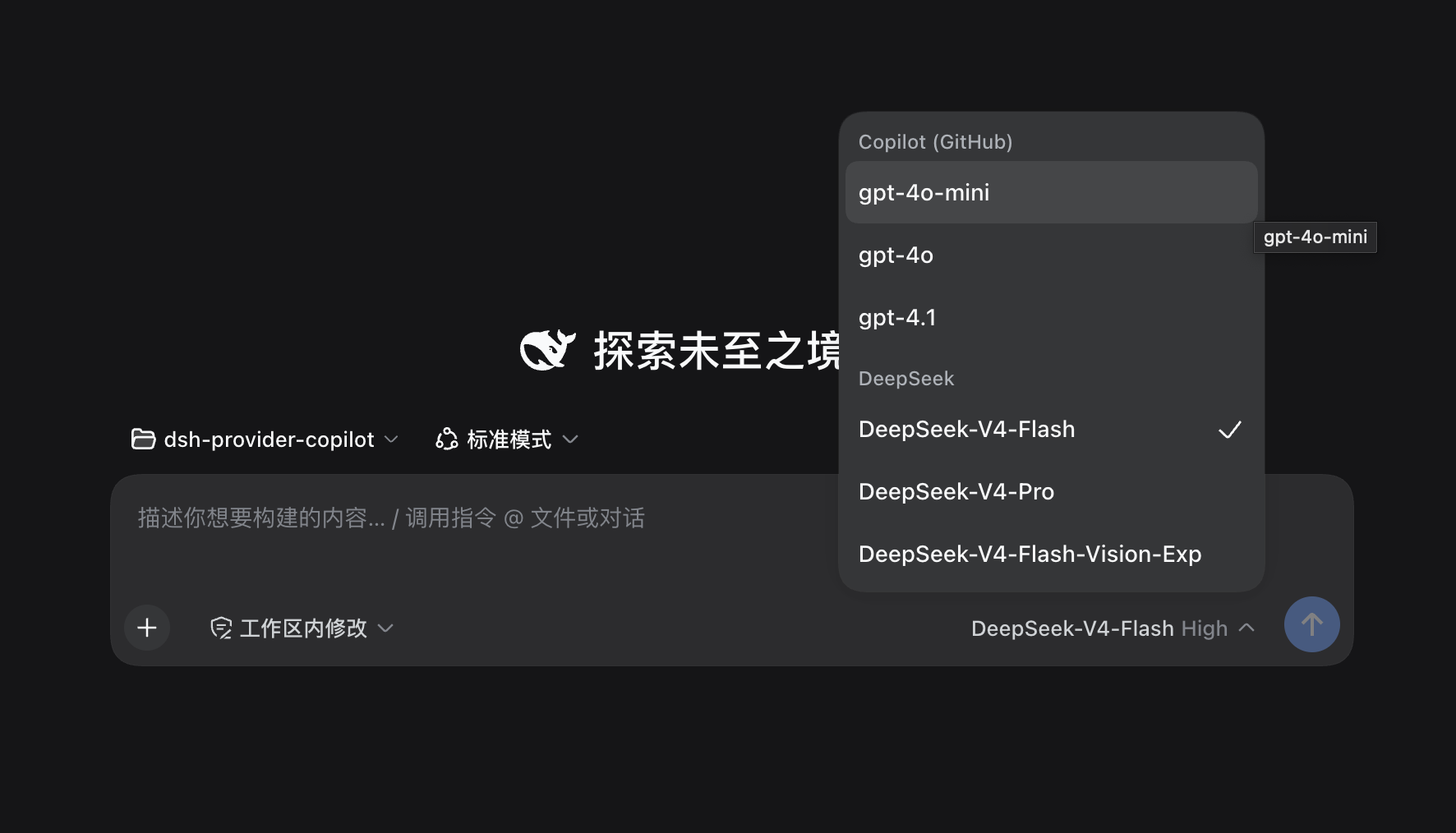
In dsh's model picker (the group is visible from install, see above),
select a model inside the Copilot (GitHub) group. Selecting a model
makes it the default for new sessions; each session keeps its own recorded
selection. Pick again any time to switch models. Sending a request requires
a credential: set COPILOT_TOKEN / COPILOT_GITHUB_TOKEN, or run
/copilot login above. Once signed in, the advertised list is intersected
with the upstream /models catalog.
Usage — programmatic (BYOK)
import { AuthManager, CopilotClient, CopilotProvider } from "dsh-provider-copilot";

const auth = new AuthManager({
    byok: { kind: "github", token: process.env.MY_GITHUB_TOKEN! },
});
const client = new CopilotClient({
    getBearer: async () => {
        const s = await auth.getSession();
        return { token: s.token, endpoints: { api: s.endpoints.api } };
    },
});
const provider = new CopilotProvider({ client });

for await (const chunk of provider.stream({
    model: "gpt-4o-mini",
    messages: [{ role: "user", content: "hi" }],
})) {
    if (chunk.type === "text") process.stdout.write(chunk.text);
}
Token source priority
AuthManager resolves credentials in this order:
byokconstructor option — a{ kind: "bearer" | "github", token }.env COPILOT_TOKEN— a raw Copilot bearer; skips exchange.env COPILOT_GITHUB_TOKEN— a GitHub token; drives exchange.- On-disk OAuth cache from a previous
/copilot login. ~/.config/gh/hosts.yml(opt-in:DSH_COPILOT_ALLOW_GH_HOSTS=1).GH_TOKEN/GITHUB_TOKEN(opt-in:DSH_COPILOT_ALLOW_ENV_GH=1).
Sources 5–6 are opt-in because "any GitHub token" leaking into a Copilot-specific credential surface is easy to do by accident.
Configuration
| Env var | Effect |
|---|---|
COPILOT_TOKEN | Skip exchange; use as Copilot bearer directly. |
COPILOT_GITHUB_TOKEN | GitHub token to exchange for a Copilot bearer. |
DSH_COPILOT_ALLOW_GH_HOSTS | 1 enables reading gh hosts.yml as fallback. |
DSH_COPILOT_ALLOW_ENV_GH | 1 enables reading GH_TOKEN / GITHUB_TOKEN fallback. |
DSH_COPILOT_NO_LOG | 1 disables JSONL log writes (no directory / files). |
XDG_CONFIG_HOME | Standard XDG override for cache & log location. |
Observability
- In-memory ring buffer: last 10 successful calls used for
/copilot statusp50/p95. - JSONL log:
~/.config/dsh/copilot/log/copilot-YYYY-MM-DD.jsonl. Fields are a hard-coded allowlist:ts, requestId, event, model, latencyMs, promptTokens, completionTokens, totalTokens, errorCode, source, sku. Any attempt to log outside that set is rejected at runtime. - Retention: 7 days by default; pruning is lazy on the first write of a new UTC day; failures are silent.
- Perms: dir 0700, files 0600, matching auth cache.
Troubleshooting
| Symptom | Likely cause / fix |
|---|---|
403 scraping from api.github.com | Non-Copilot UA. Do not override the built-in headers. |
token_exchange_forbidden (403) | Account has no Copilot entitlement (individual not subscribed, org/enterprise seat unassigned). |
token_exchange_unauthorized (401) | Stale GitHub token. /copilot logout then /copilot login. |
no_token_source | Nothing to authenticate with. Set COPILOT_TOKEN / COPILOT_GITHUB_TOKEN or run /copilot login. |
http_connect_timeout | Network / DNS. Check corporate proxy; tune timeouts.connectMs if needed. |
http_first_byte_timeout | Upstream slow to respond. Tune timeouts.firstByteMs. |
http_idle_timeout | Stream stalled mid-flight. Tune timeouts.idleMs. |
Model missing from /copilot status count | Not in the whitelist ∩ upstream. Pass a custom whitelist to CopilotProvider if you know the id. |
unknown subcommand: X | Only login, logout, status are supported. |
Development
npm install
npm test           # 160+ tests across auth / client / provider / plugin / commands / observability / e2e
npm run typecheck
npm run lint
New dsh-facing code lives under src/plugin/ (adapter, chunk translation,
error taxonomy, plugin entry, dsh command handler); the legacy BYOK
CopilotProvider API is unchanged.
Feasibility PoC (Device Flow → models → stream):
npm run poc -- device
export GH_OAUTH_TOKEN=ghu_xxx
npm run poc
Coverage is opt-in:
npm i -D @vitest/coverage-v8@2.1.8   # match your vitest version
npx vitest run --coverage
License
MIT — see LICENSE.