dsh-claude-compat
deepseek harness 插件,兼容claude的skill、rules加载规则,mcp配置
- Stars
- 0
- Language
- TypeScript
- Created
- Sep 9, 2026
- Updated
- Sep 10, 2026
Introduction
dsh-claude-compat
English | 中文
A standalone plugin for DeepSeek Harness (DSH) that makes the harness work with your existing Claude Code / Codex setup — and adds a Harness 兼容 settings page where you manage MCP servers and prompt rules from the Web UI instead of hand-editing YAML.

What you get
- MCP management, live. The settings page lists every MCP server (
@deepseek-ai/dsh-mcp-clientrow) — global and per agent preset, with its scope, description, and status — and lets you add / edit / enable / disable each one. Writes go to the composition file and are applied to the running host immediately, with no restart. Toggling shows a transient启动中 / 停止中state while the MCP child process starts or stops, so the list never blocks. - Claude Code compatibility. Discovers
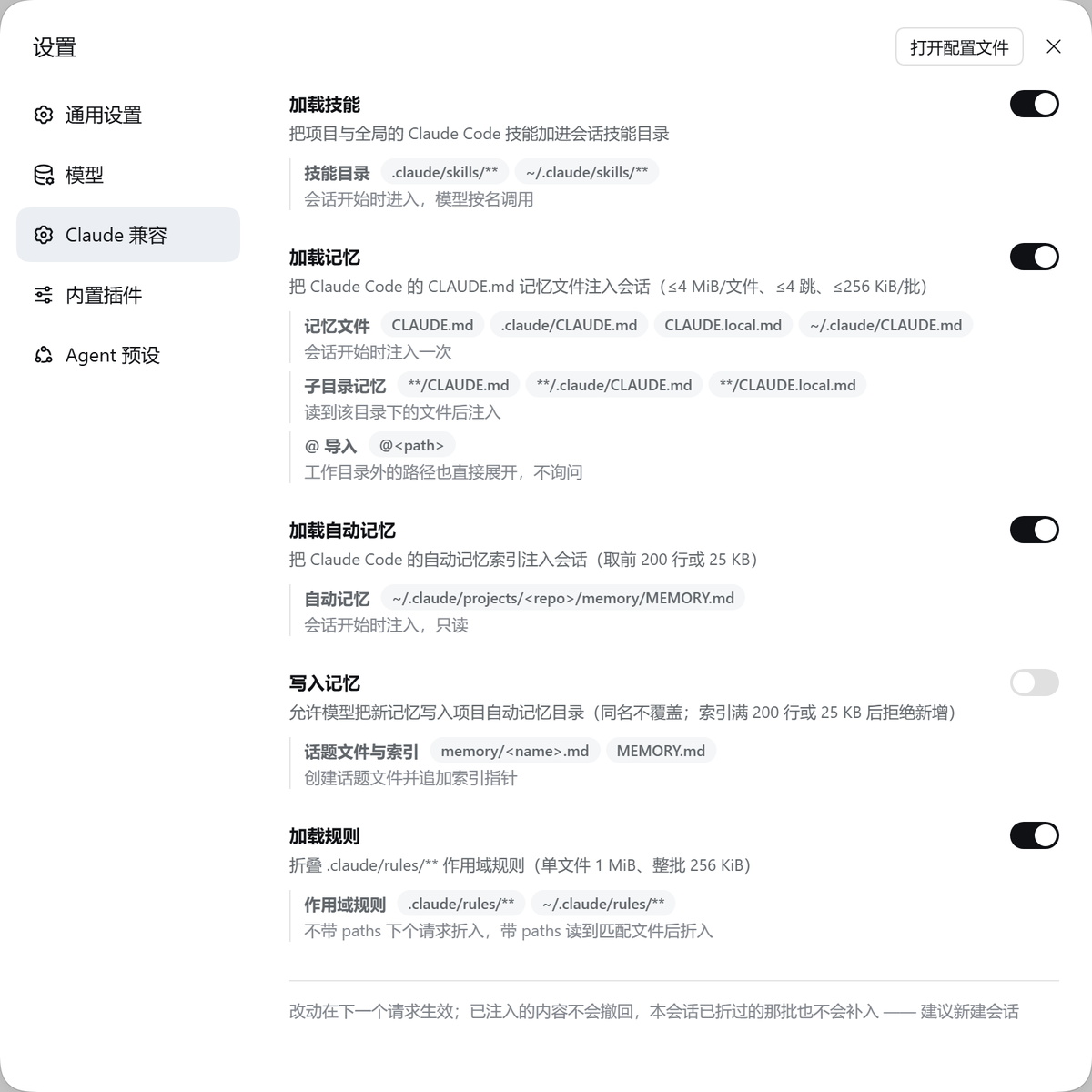
<root>/.claude/skills/**into the session skill catalog, folds.claude/CLAUDE.mdand~/.claude/CLAUDE.mdinto the first request, and folds.claude/rules/**— includingpaths:-scoped rules that activate when you read a matching file. - Codex compatibility. Folds
.codex/AGENTS.mdand~/.codex/AGENTS.md. - A system prompt field. Write a system-level prompt from the settings page; it is injected as a real system-prompt section.
- Master toggles. Turn Claude-rule and Codex-rule injection on or off.
/btw. Ask a side question in a forked, continuable child subagent.
Screenshots
提示词管理 — system prompt and rule toggles

MCP 管理 — one JSON box, parsed and validated on save

Install
The built lib/ is committed, so the repository installs and runs directly — no build step.
From the git repository (recommended)
Install a release tag (v0.1.3-alpha.1) rather than the default branch, so a later
work-in-progress commit on master is not picked up:
# over HTTPS (public repo)
npx @deepseek-ai/dsh plugin --profile web add "git+https://github.com/zhang-guo-wen/dsh-claude-compat.git#v0.1.3-alpha.1&path:packages/claude-compat"
# or over SSH
npx @deepseek-ai/dsh plugin --profile web add "git+ssh://git@github.com/zhang-guo-wen/dsh-claude-compat.git#v0.1.3-alpha.1&path:packages/claude-compat"
The spec has two parts: #<ref> pins a tag / commit / branch, and
&path:packages/claude-compat selects the plugin package inside the repository (pnpm's
subdirectory git spec). Omit the #<ref>& part to follow the default branch (not recommended);
re-run the command with a newer tag to update.
From a local checkout
npx @deepseek-ai/dsh plugin --profile web add /absolute/path/to/dsh-claude-compat/packages/claude-compat
A file: dependency installs a copy, so a rebuild in the checkout does not reach the running
host until you reinstall. For a live link while developing, use pnpm link instead (see
AGENTS.md).
In a profile manifest
Either form also works as a plain profile dependency:
{
"dsh": { "profile": { "bundles": ["@zhang-guo-wen/dsh-claude-compat"] } },
"dependencies": {
"@zhang-guo-wen/dsh-claude-compat": "git+ssh://git@github.com/zhang-guo-wen/dsh-claude-compat.git#path:packages/claude-compat"
}
}
After installing, run npx @deepseek-ai/dsh web and open the settings page.
Managing MCP servers
Open 设置 → Harness兼容 → MCP 管理. Every MCP row the harness has configured is listed with its
scope (全局 or a preset id), a plugin-owned description, and its live status. Each row has an
编辑 button and an enable/disable switch; 新增 MCP opens the editor.
That server list is a live read of the Cordis Loader, so a change shows up as soon as it is applied:
- Global rows use the loader directly and are live immediately.
- Preset (agent) rows write the preset's
agent.cordis.ymland refresh the preset's standing mount in place, so enabling or disabling one MCP never restarts the others.
The editor JSON
The editor takes Claude-compatible connection JSON and normalizes it. All of these work:
{ "type": "stdio", "command": "cmd", "args": ["/c", "npx", "-y", "@upstash/context7-mcp"] }
{ "context7": { "command": "cmd", "args": ["/c", "npx", "-y", "@upstash/context7-mcp"] } }
{ "mcpServers": { "context7": { "command": "cmd", "args": ["/c", "npx", "-y", "@upstash/context7-mcp"] } } }
Rules:
- A missing
typeis inferred: acommandmeans stdio, aurlmeans streamable HTTP. - A single-entry map or an
mcpServerswrapper uses its key as the server name. - A bare spec derives the server name from the arguments (
@upstash/context7-mcp→context7-mcp) when the 服务器名 field is left empty. stdioneedscommand;http/sse/streamable-httpneedurl.
The 配置范围 dropdown lists Global and every agent preset, so you pick a target instead of typing
an id. 描述 is a plugin-owned label shown in the list, stored in the context-injection settings
namespace — not part of the MCP connection.
Lazy loading — start a server only when it is needed
Every running MCP server's tool schemas ride every request, so a deployment with a dozen servers pays for all of them all the time. Two things work together to avoid that:
-
Keep a server stopped. Disable its row in MCP 管理. A disabled row is never mounted, so its tools stay out of the catalog.
-
Start it on demand. The plugin registers three tools the model can call:
Tool What it does mcp_listThe configured servers, their scope, and whether each is running mcp_load(server)Starts one server for the calling session only and returns the tool names it added mcp_unload(server)Stops that session's server again and shrinks the tool list
The mount is agent-scoped: a server one session loads never appears in another. This is the same trade-off as Claude Code's tool search — you pay one extra round trip, and the loaded schema, only when you actually need a server.
Choosing the loading mode
The two controls answer different questions:
- A row's enable switch — may this server be used at all. Disabled means never: it is not listed
by
mcp_listandmcp_loadrefuses it. - Settings → Claude Compat → MCP management → MCP loading — when an allowed server enters context. One of three:
| Mode | Behavior |
|---|---|
Load all (eager) | Allowed servers mount at session start, so their tools are always in the request |
Dynamic insert (dynamic, default) | Allowed servers stay unmounted by default; mcp_load mounts one into the calling session, so its tools join the request — best tool binding, but the tool list changes once per load |
Lazy (lazy) | Allowed servers stay unmounted by default; mcp_load connects over the MCP SDK without registering anything and returns the tool schemas, and the model calls them through the fixed mcp_call proxy — the tool list never changes, so the request-cache prefix is never invalidated |
Measured on one standard+MCP preset (alibaba-devops, lightrag, kingdee, playwright): the first
request carries 29 tools under dynamic (built-ins plus mcp_list/mcp_load/mcp_unload) and
378 under eager, 348 of which are MCP tools.
Holding a row back is runtime state: the plugin unmounts the rows in memory and never rewrites
your preset file (an agent-presets composition is an input, not a persistence target), so switching
modes cannot pollute configuration. The price is one restart of those MCP child processes per switch.
- name: '@zhang-guo-wen/dsh-claude-compat'
config:
mcpLoading: lazy # only while the user document has no such entry
The choice is stored in the user's context-injection settings namespace (mcpLoading in
~/.dsh/settings.yaml) and swaps the tool set as soon as it commits, from the next request on in
every session. The plugin's config.mcpLoading only supplies the default while the user document
has no entry yet.
Claude Code / Codex compatibility
Skills
| Rank | Source | Path |
|---|---|---|
| 250 | project-claude | <projectRoot>/.claude/skills |
| 550 | user-claude | ~/.claude/skills |
The project root is the nearest ancestor containing .git. A skill is
<root>/.claude/skills/<name>/SKILL.md (or a flat <name>.md) with YAML frontmatter: required
name and description, plus optional whenToUse, metadata, disable-model-invocation, and
user-invocable.
Rules
The project .claude/CLAUDE.md and the global ~/.claude/CLAUDE.md are folded into the first request
as user messages under the claude-code source kind. Rules under .claude/rules/** (project) and
~/.claude/rules/** (user) fold under claude-rule: a rule whose frontmatter carries a paths: glob
list is path-scoped and folds after a read of a matching file; a rule without paths is always-on.
Configuration
| Field | Default | Meaning |
|---|---|---|
providerName | claude-code | Unique provider name registered on ctx.skills |
claudeHome | $CLAUDE_HOME or ~/.claude | Claude Code home, scanned for skills and CLAUDE.md |
codexHome | $CODEX_HOME or ~/.codex | Codex home, scanned for AGENTS.md |
projectRootMarkers | ['.git'] | Directory entries that identify the project root |
includeProjectRoot | true | Scan the project .claude/skills root |
includeGlobalRoot | true | Scan the user ~/.claude/skills root |
includeProjectRule | true | Load the project .claude/CLAUDE.md rule |
includeGlobalRule | true | Load the global ~/.claude/CLAUDE.md rule |
includeProjectRules | true | Fold the project .claude/rules/** tree |
includeGlobalRules | true | Fold the user ~/.claude/rules/** tree |
maxRuleSourceBytes | 1048576 | Maximum UTF-8 bytes read from one rule file |
maxRuleRenderBytes | 262144 | Maximum UTF-8 bytes rendered in one rules batch |
claude / codex | true | Rule-injection master toggles (also editable from the settings page) |
maxQuestionBytes | 4096 | Maximum UTF-8 bytes in the /btw side question |
provider | fork | The ctx.subagents fork provider name used by /btw |
Known limitations
- No skill watcher —
.claude/skillsis discovered onlist(); add/rename/delete is picked up when discovery runs again. - Rules fold once per session —
.claude/CLAUDE.md,~/.claude/CLAUDE.md, and.codex/AGENTS.mdare read at the first request; later edits are not re-read mid-session. - Path-scoped rules trigger on
readonly —write/editdo not activate them. - Enabling an MCP still takes the child process's own startup time (
npx -y …/uvx …usually 1–3s). The UI stays responsive; installing the server as a direct executable shortens it.
Development
See AGENTS.md for the build, the Cordis/Typert plugin contract, and the pitfalls.
npm run build # host (tsdown) + client (rolldown ModuleLoader handoff)
License
Apache License 2.0 — see LICENSE. It is an OSI-approved, permissive license: commercial use, modification, and redistribution are permitted, and every contributor grants a copyright license plus an express patent grant (Section 3).
This product includes MIT-licensed portions derived from DeepSeek Harness; see NOTICE.